

TL;DR:
- Natural induction methods support your body’s readiness for labor but cannot force it to start.
- Walking and eating dates have the strongest evidence and the lowest risk, making them the safest options.
Natural induction methods are non-medical techniques that help prepare your body for labor by encouraging cervical ripening, contractions, and hormonal readiness. Clinically, these approaches fall under the broader category of non-pharmacological labor stimulation. They do not replace medical care, but they can gently support what your body is already working toward. Walking, eating dates, nipple stimulation, and acupuncture are among the most discussed options. Before you try any of them, a conversation with your provider is the most important first step.
Which natural induction methods have scientific support?
Not every home induction technique carries the same weight of evidence. A few have solid research behind them. Others are more anecdotal. Knowing the difference helps you make a confident, informed choice.
-
Walking. A 2022 study supports walking 30 minutes, three times a week at 2.5 mph starting at 38 weeks as a gentle labor aid that may reduce medical interventions. Walking encourages the baby to descend into the pelvis, which puts pressure on the cervix and can signal the body to prepare. It also helps you stay calm and grounded, which matters more than most people realize.
-
Eating dates. 2017 research shows that eating dates in the final weeks of pregnancy improves cervical ripening and dilation, and decreases the need for Pitocin. Six dates a day starting at 36 weeks is the amount most commonly referenced in the literature.
-
Nipple stimulation. This technique releases oxytocin, the same hormone used in medical induction, which can trigger uterine contractions. The risk is that contractions may become too intense too quickly. Provider monitoring is not optional here. It is required.
-
Acupuncture and acupressure. A 2024 review suggests acupuncture may increase the likelihood of spontaneous labor onset, though more research across diverse populations is still needed. Acupressure points like SP6 (inner ankle) and BL32 (lower back) are commonly used by trained practitioners.
-
Sexual intercourse. Semen contains prostaglandins that soften the cervix, and orgasm releases oxytocin. Research findings are mixed, but the theoretical basis is sound and the risk profile is low for uncomplicated pregnancies.
Pro Tip: Avoid castor oil entirely. It causes severe gastrointestinal distress and is not recommended by medical professionals despite its long history as a folk remedy.
Is it safe to try natural labor methods at home?
Safety depends entirely on your individual pregnancy. What works well for one person can create real complications for another. The American College of Obstetricians and Gynecologists (ACOG) states that labor induction is appropriate only when the risks of continuing the pregnancy outweigh the risks of birth. That principle applies to natural methods too.
There are specific situations where you should not attempt any form of home induction:
- Placenta previa or low-lying placenta
- Vasa previa
- Active herpes outbreak
- Prior classical uterine incision
- Umbilical cord prolapse or concerns about cord position
- Your provider has advised against it for any reason
Herbal remedies like evening primrose oil have mixed evidence and may actually prolong labor or increase complications. They feel natural, but “natural” does not automatically mean safe during pregnancy.
Pro Tip: Before trying any inducing labor naturally technique at home, review your birth plan with your provider. A quick check-in at your 38-week appointment can clarify exactly which methods are appropriate for your specific situation.
Myserenitydoula recommends pairing any natural approach with holistic childbirth preparation so you feel grounded and informed, not just reactive.
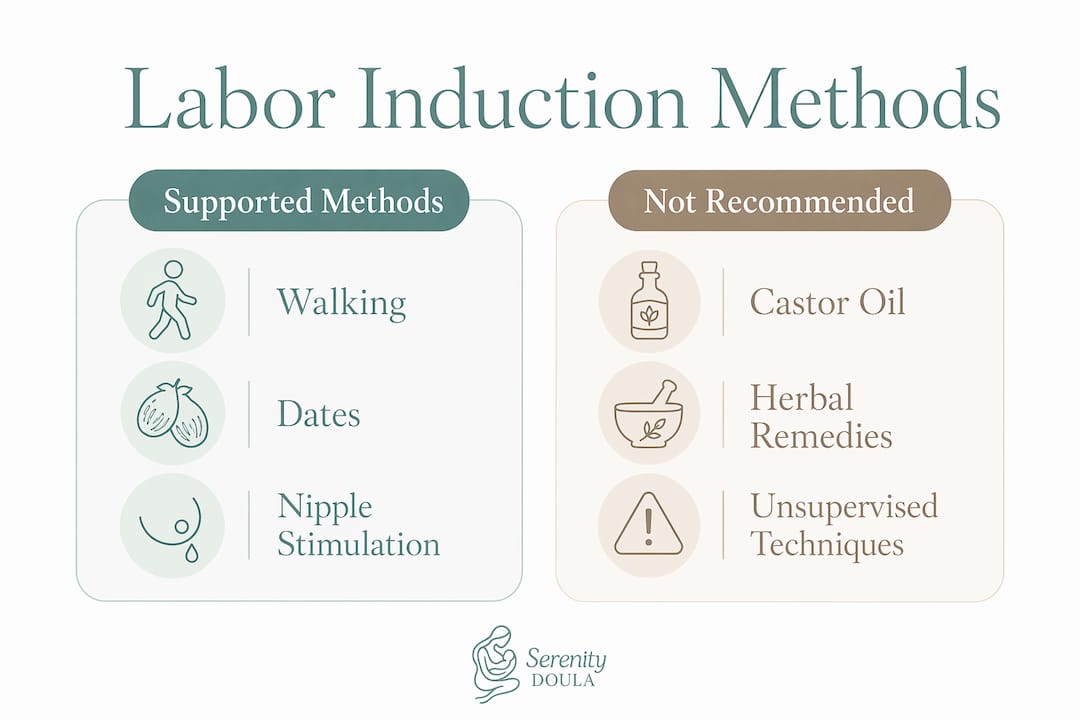
Comparing common non-invasive induction techniques
Use this table to get a clear picture of how popular methods stack up. It is a starting point for your conversation with your provider, not a replacement for it.
| Method | How it works | Scientific support | Safety notes |
|---|---|---|---|
| Walking | Encourages fetal descent and cervical pressure | Strong (2022 study) | Safe for most; avoid overexertion |
| Eating dates | Supports cervical ripening and reduces Pitocin need | Strong (2017 research) | Safe; watch blood sugar if diabetic |
| Nipple stimulation | Releases oxytocin to trigger contractions | Moderate | Requires provider approval and monitoring |
| Sexual intercourse | Prostaglandins soften cervix; oxytocin from orgasm | Mixed | Avoid with placenta previa or ruptured membranes |
| Acupuncture | May increase spontaneous labor onset | Emerging (2024 review) | Use a certified practitioner only |
| Evening primrose oil | Thought to soften cervix; mechanism unclear | Weak or mixed | May increase complications; not recommended |
The clearest takeaway from this comparison: the methods with the strongest safety profiles are also the simplest. Walking and eating dates carry the least risk and the most consistent research support. Methods that directly trigger hormonal responses, like nipple stimulation, need professional oversight.
Popular methods have weak or mixed support overall, which is why managing expectations matters as much as choosing the right technique.
How to try natural birth induction responsibly at home
When your provider gives you the green light, here is how to approach the most evidence-backed methods with care.
-
Start walking at 38 weeks. Aim for 30 minutes at a comfortable pace, three times a week. You do not need to push yourself. A gentle walk around the neighborhood counts. Bring water, wear supportive shoes, and stop if you feel pressure, pain, or contractions.
-
Add dates to your daily routine. Six dates a day starting at 36 weeks is the amount referenced in research. Eat them as a snack, blend them into a smoothie, or add them to oatmeal. They are naturally sweet and easy to work into most diets.
-
Try nipple stimulation only with provider approval. If your provider says yes, the general approach involves gentle stimulation of one nipple at a time for a few minutes, then pausing to monitor contractions. Stop immediately if contractions become long, strong, or close together.
-
Support your body with rest and hydration. Dehydration can cause false contractions and exhaustion. Drink water consistently throughout the day. Rest between activity. Your body is doing enormous work already.
-
Know when to stop and call your provider. If contractions become regular and intense, your water breaks, you notice decreased fetal movement, or something simply feels off, stop what you are doing and reach out. Trust that instinct.
Pro Tip: Natural methods serve as prompts to a body already near readiness. If your body is not ready yet, they will not force labor to start. That is actually reassuring, not discouraging.
For more guidance on supporting labor progress, Myserenitydoula has a detailed resource on helping labor progress that pairs well with these techniques.
Key takeaways
Natural induction methods work best as gentle support for a body already approaching readiness, not as guaranteed labor starters, and every method carries a different risk profile that requires provider input.
| Point | Details |
|---|---|
| Evidence varies by method | Walking and dates have the strongest research support; acupuncture is promising but still emerging. |
| Safety requires provider input | ACOG guidelines and medical experts agree that consultation is required before any induction attempt. |
| Avoid castor oil and unproven herbs | Castor oil causes severe gastrointestinal distress; evening primrose oil may increase complications. |
| Nipple stimulation needs monitoring | Oxytocin release can trigger overly intense contractions without professional oversight. |
| Readiness is the real factor | Natural methods prompt a body near labor; they cannot initiate labor in a body that is not ready. |
What I’ve learned from supporting families through this
Here is something I want you to hear clearly: your baby has a say in this timing. That is not a platitude. The baby ultimately dictates when labor begins, and no amount of date-eating or walking will override that biological reality. What natural methods can do is support your body’s readiness so that when labor does start, you are in the best possible position.
What I see most often is parents putting enormous pressure on themselves to “do something” as the due date approaches. That pressure is completely understandable. The waiting is hard. But the most effective thing you can do is stay informed, stay connected to your provider, and stay gentle with yourself.
The methods that actually help are also the ones that feel good: moving your body, nourishing yourself with whole foods, resting well, and staying calm. That is not a coincidence. Your nervous system and your labor readiness are deeply connected. A body that feels safe is a body more ready to open.
I also want to be honest about the limits of what we know. Consulting your healthcare provider before trying any technique is not just a legal disclaimer. It is genuinely the most protective thing you can do. Your pregnancy is specific to you, and a one-size approach does not serve you well.
— Alexis Wallace
How Myserenitydoula supports your natural birth preparation
You do not have to figure this out alone. Myserenitydoula works with expecting parents to build confidence, clarity, and calm as birth approaches.

Whether you are curious about natural labor prep, want to understand your options, or simply need someone in your corner, Myserenitydoula’s pregnancy and birth support services are built around your specific needs and birth goals. From one-on-one doula support to childbirth education classes that cover evidence-based natural birth methods, every resource is designed to help you feel seen, prepared, and grounded. Schedule a consultation and find out what personalized birth support actually looks like.
FAQ
What are the safest natural induction methods?
Walking and eating dates are the safest options, with the strongest research support and the lowest risk profiles. Both are appropriate for most uncomplicated pregnancies starting at 36–38 weeks.
Can natural methods actually start labor?
Natural methods can support a body that is already near readiness, but they cannot force labor to begin if the body is not ready. The baby and your body’s hormonal signals ultimately control the timing.
Is nipple stimulation safe to try at home?
Nipple stimulation carries a risk of triggering overly intense contractions and should only be attempted with explicit provider approval and a plan for monitoring.
Why is castor oil not recommended?
Castor oil reliably causes severe gastrointestinal distress and is not recommended by medical professionals, despite its long history as a folk remedy for inducing labor.
When should I talk to my provider about natural induction?
Bring it up at your 36 or 38-week appointment. Your provider can review your specific situation and tell you which methods are appropriate, which to avoid, and what signs to watch for once you begin.