

TL;DR:
- Labor often unfolds unpredictably, making comfort, mobility, and appropriate positioning essential for progress. Techniques like walking, supported squatting, and Spinning Babies® exercises encourage baby descent and rotation, reducing intervention need. Having a doula provides personalized support, ensuring your comfort and helping your labor progress naturally regardless of epidural use or unforeseen challenges.
Labor rarely unfolds exactly as you imagined it would, and when things move slowly, worry sets in fast. Knowing how to help labor progress naturally is one of the most empowering things you can do for yourself and your birth experience. Whether you’re in early labor at home, just arrived at your birth center, or working with a doula in Bucks County, the right movements, positions, and support strategies can genuinely make a difference. This guide covers everything from preparation and natural techniques to epidural-specific positioning and the role of doula support.
Table of Contents
- Preparing for a smoother labor: what you need to know
- Step-by-step natural techniques to encourage labor progress
- Managing labor progression with an epidural: what to expect and do
- Troubleshooting and common mistakes: when labor progress stalls
- What successful labor progress looks like: expectations and signs
- A doula’s take: personalizing labor progress support
- How Serenity Doula supports your natural labor progression
- Frequently asked questions
Key Takeaways
| Point | Details |
|---|---|
| Movement shortens labor | Walking and upright positions during early labor can shorten labor by over an hour and reduce intervention risks. |
| Spinning Babies® helps fetal rotation | Techniques that promote baby’s anterior position increase labor efficiency and ease delivery. |
| No single perfect position | Freedom to move and find what’s comfortable is more important than sticking to one posture. |
| Epidural requires adjusted positioning | With epidural analgesia, side-lying or hands-and-knees positions are safer than upright ones. |
| Doulas personalize support | Expert doula care adapts techniques to your unique labor needs and preferences for best outcomes. |
Preparing for a smoother labor: what you need to know
Having a solid understanding of what to expect creates a real foundation for actively helping your labor progress. The first stage of labor, which covers early labor through full dilation, is often the longest part. Your cervix needs to efface (thin out) and dilate to 10 centimeters, and your baby needs to navigate downward through your pelvis. That’s a lot of work, and your body does best when you support it rather than fight it.
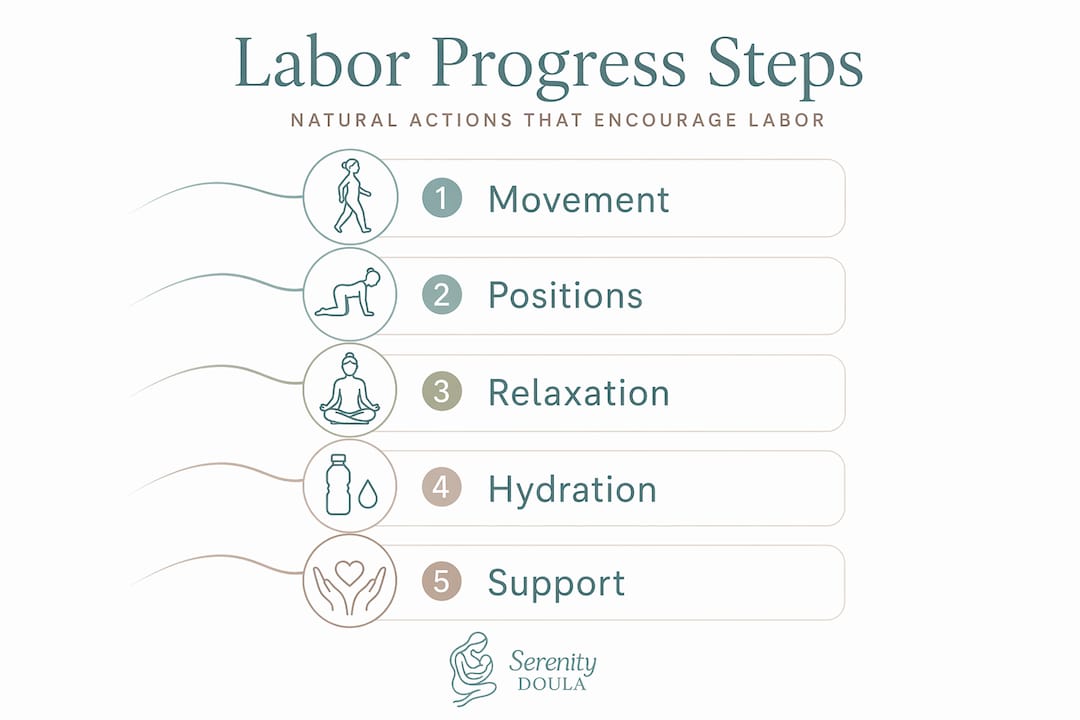
One of the clearest things research shows is that upright positions reduce labor duration and the need for interventions in the first stage. Staying mobile allows gravity to work with you. It encourages your baby to settle deeper into your pelvis and apply steady pressure to your cervix, which is exactly what drives dilation forward.
Here’s what to keep in mind before labor begins:
- Comfort matters. Tension and fear can slow labor by triggering stress hormones that interfere with oxytocin, the hormone that drives contractions. Learning comfort measures during labor before your due date gives you real tools to draw on.
- Mobility is medicine. Don’t plan to lie in bed waiting it out. Pack comfortable socks, wear a loose gown, and keep your options open for walking and changing positions.
- Your preferences are valid. There’s no single correct way to labor. What helps one person may not suit another, and that’s completely normal.
Pro Tip: Talk with your care team and doula before labor about which positions you want to try. Knowing your plan going in means you’re not figuring it out while managing contractions.
Step-by-step natural techniques to encourage labor progress
Now that you know the importance of preparation and comfort, here are specific things you can do during labor to help it along. These natural labor progression techniques work by encouraging your baby to descend, rotate, and engage with your pelvis in the most favorable way.
Movement and positioning sequence to try
- Walk during early labor. Even slow, steady walking uses gravity and hip movement to help your baby drop. Take breaks when contractions come; lean into your partner or a wall.
- Use a birthing ball. Sitting and gently rocking on a birthing ball opens your pelvis and shifts pressure in a way that flat sitting doesn’t. Figure-eight hip circles are especially useful.
- Try supported standing. Drape your arms over your partner’s shoulders and sway. This position allows your hips to move freely while keeping you upright.
- Practice squatting. A supported squat (with a partner, squat bar, or birthing stool) can increase pelvic outlet diameter and help baby descend. Your knees should stay below your hips.
- Try hands-and-knees positioning. This takes pressure off your back and can help rotate a baby who is posterior (facing your belly), which is a common cause of slow labor.
Spinning Babies® techniques
Spinning Babies® is a specific approach that uses maternal positioning and balance exercises to encourage the baby’s head to rotate into the optimal anterior position (facing your back). These techniques increase anterior rotation likelihood by 45%, which can meaningfully shorten labor and reduce the chance of intervention.
Key Spinning Babies® practices include:
- The Side-lying release: Relaxes the ligaments of the lower uterus and pelvis to allow more room for baby to shift.
- The Forward-leaning inversion: Done briefly between contractions, this technique uses gravity to encourage baby’s head to disengage momentarily and re-engage in a better position.
- Walking up and down stairs sideways: Alternates the height of your hips to encourage rotation.
Ask your doula about incorporating these into your birth plan, ideally rooted in an evidence-based birth framework that matches your goals.
Pro Tip: You don’t need to try every technique at once. Pick two or three positions you feel drawn to and rotate through them every 20 to 30 minutes.
Comparison table: labor positions and their effects
| Position | How it helps | Best for |
|---|---|---|
| Walking | Engages gravity, encourages descent | Early and active labor |
| Birthing ball (sitting) | Opens pelvis, relieves pressure | Active labor, back discomfort |
| Hands-and-knees | Rotates posterior baby, eases back pain | Posterior positioning, back labor |
| Supported squat | Widens pelvic outlet | Second stage, pushing |
| Side-lying | Rest while maintaining some progress | Fatigue, between contractions |
Note that moving freely and changing position is more effective than staying locked in any single position. Variety is the real strategy here. For more ideas, check out these natural birth tips tailored for moms who want to feel empowered through movement.
Managing labor progression with an epidural: what to expect and do
If you’re planning to or have had an epidural, you can still help your labor move forward, though the approach shifts. Epidurals reduce sensation below the waist, which means you’ll need your care team’s guidance for safe movement.
The evidence here is nuanced. Upright positions with epidurals may increase operative births, meaning forceps or vacuum delivery. That’s a meaningful difference from laboring without an epidural, where upright positioning consistently helps. This doesn’t mean you need to stay completely flat, though.
Here’s what tends to work well with an epidural:
- Side-lying with a peanut ball: A peanut-shaped exercise ball placed between your knees while lying on your side helps open your pelvis and rotate baby even when you can’t fully feel your legs.
- Hands-and-knees with support: Some people with low-dose epidurals can safely move to hands-and-knees with help from a nurse or doula. Always ask first.
- Frequent position changes: Even small shifts from left side to right side every 30 minutes can help baby rotate.
- Patience in the second stage: Delayed pushing (also called “laboring down”) allows contractions to do the work of bringing baby lower before you start pushing actively.
Learn more about giving birth on all fours with an epidural and what that experience can realistically look like.
Pro Tip: Ask your nurse whether your birth facility uses peanut balls routinely. If they don’t have one available, you can bring your own.
Troubleshooting and common mistakes: when labor progress stalls
Even with the best approaches, labor can slow down, and knowing what to watch for helps you respond rather than panic.
Signs labor may not be progressing as expected:
- Contractions that space out significantly after becoming regular
- No cervical change over two or more hours in active labor
- Increasing exhaustion without baby descending
- Baby not rotating despite positional changes
Common mistakes that can slow labor:
- Staying in one position for too long (more than 45 to 60 minutes).
- Eating too little in early labor, leading to exhaustion when you need energy most.
- Tensing up and bracing against contractions instead of breathing through them.
- Isolating yourself; fear and loneliness genuinely slow labor by raising cortisol levels.
“The support of a doula, nurse-midwife, or partner who encourages and guides movement can be the difference between stalled labor and steady progress.”
Walking and upright positioning reduce intervention needs and don’t increase risk, so don’t be afraid to stay active. Your care team can assess dilation and baby’s position and suggest when a change of approach is needed. You can also find out more about labor support with doulas and how continuous presence changes outcomes.

What successful labor progress looks like: expectations and signs
Understanding what positive progress looks like helps you feel grounded and ready to act when needed.
Healthy signs that labor is moving forward:
- Contractions becoming longer, stronger, and closer together
- Increased pressure in your pelvis as baby descends
- Cervical dilation of roughly 0.5 to 1 centimeter per hour in active labor
- A strong urge to push as you near full dilation
Typical labor progression: a general reference
| Stage | Duration (first-time parents) | Key sign of progress |
|---|---|---|
| Early labor (0 to 6 cm) | 6 to 12 hours | Contractions every 5 to 7 minutes |
| Active labor (6 to 10 cm) | 3 to 5 hours | Contractions every 2 to 3 minutes |
| Second stage (pushing) | 30 minutes to 2 hours | Baby descends with each push |
These are general ranges. Your experience may vary, and that’s okay. What matters is a pattern of progress, not hitting exact checkpoints. Being upright and mobile reduces labor duration and epidural use, which gives you more flexibility to work with your body. If you want to understand more about understanding labor progress within a broader birth framework, that resource is worth bookmarking.
A doula’s take: personalizing labor progress support
Here’s something that often gets lost in conversations about positioning and technique: labor is not a performance. There’s no prize for doing every Spinning Babies® exercise or hitting a certain position every 20 minutes if you’re exhausted and overwhelmed. The research on how to keep labor progressing is clear about movement and position, but it cannot account for you, specifically. Your history, your fears, your physical comfort, your relationship with your body. That’s where doulas come in.
We’ve seen labors that looked “stalled” on paper transform the moment a laboring person felt truly safe, seen, and supported. That shift is not mystical; it’s physiological. When you feel less afraid, your body releases more oxytocin. Contractions pick up. Baby moves. Progress happens.
What doulas offer isn’t just a repertoire of positions. It’s the ability to read you in real time. To notice that your shoulders are up near your ears and that a warm compress and a quiet word matter more right now than switching positions. To advocate with your care team when something feels off, or to reassure you when slow progress is still normal progress.
If you want evidence-based doula labor support that’s tailored to your goals and your comfort, that’s what we build every birth plan around. No two labors are the same, and neither is the support we provide.
How Serenity Doula supports your natural labor progression
You don’t have to figure this out alone. At Serenity Doula, we work with expecting parents across Bucks County to make sure you walk into your birth feeling prepared, supported, and genuinely confident in the strategies ahead.

Our pregnancy and birth doula support includes hands-on guidance with positioning, movement, and comfort measures throughout your labor, whether you’re planning a natural birth, an epidural, or something in between. We also offer childbirth education programs that teach you these techniques before your due date, so nothing feels new or confusing when contractions start. To explore everything we offer, visit our full list of doula services and find what fits your birth vision best.
Frequently asked questions
What are the best positions to help labor progress naturally?
Positions that combine movement and gravity work best, including walking, supported standing, squatting with knees below hips, and rocking on a birthing ball. These help baby descend and rotate, and upright movement reduces labor duration and the need for interventions.
Can movement during labor actually reduce the risk of cesarean birth?
Yes. Upright positioning reduces cesarean risk and epidural use in low-risk pregnancies without increasing harm to mother or baby.
Is there a risk in being upright during labor if I have an epidural?
With an epidural, being upright in the second stage may raise the chance of an operative birth. Side-lying and supported positions are generally safer options, and your care team can guide what’s appropriate for your situation.
What is the Spinning Babies® technique and how does it help labor?
Spinning Babies® is a system of exercises and positions designed to encourage baby to rotate into an anterior (face-down) position for more efficient labor. These techniques improve fetal rotation to the anterior position by 45%, reducing the likelihood of intervention.
How can doulas help me with labor progress?
Doulas offer continuous physical support, emotional reassurance, and real-time guidance on safe positioning and movement. They also communicate your birth preferences to your care team and help you navigate decisions calmly when things don’t go exactly as planned.