

TL;DR:
- Cervical exams during pregnancy are targeted procedures done for specific reasons, not routine at every visit. Understanding the different exam types, timing, and purposes empowers women to ask questions and give informed consent. Holistic support from doulas enhances confidence and comfort during these assessments, improving the overall pregnancy experience.
If you’ve ever felt nervous, confused, or caught off guard when someone mentioned a cervical exam during pregnancy, you are definitely not alone. So many parents, in Pennsylvania and New Jersey, walk into prenatal appointments unsure of what these exams actually are, when they happen, or whether they’re even necessary.
Some people assume cervical exams happen at every visit. Others hear the words “cervix check” and immediately feel anxious without really knowing why. And honestly? A lot of that anxiety comes from not having clear, supportive information ahead of time.
The good news is this: cervical exams during pregnancy are not random or automatic. They’re done for specific reasons, at specific times, and understanding the “why” behind them can help you feel much more informed and grounded going into your appointments.
You deserve to know what’s happening with your body and to feel like an active part of your care — not like things are just happening to you.
Table of Contents
- Understanding cervical exams during pregnancy: types and purposes
- When and why cervical exams are performed during pregnancy
- How cervical length assessments help predict and prevent preterm birth
- Comparing cervical exams: cancer screening, pregnancy monitoring, and labor checks
- What to expect during a cervical exam and how to prepare
- Why understanding cervical exams changes your pregnancy journey
- How holistic doula support complements your cervical exam journey
- Frequently asked questions
Key Takeaways
| Point | Details |
|---|---|
| Know the exam types | Cervical exams include cancer screening, pregnancy monitoring, and labor checks, each with different purpose and timing. |
| Routine exams are rare | Cervical exams during pregnancy happen only when medically indicated, not automatically at every visit. |
| Cervical length matters | Measuring cervical length mid-pregnancy helps predict and prevent preterm birth through targeted interventions. |
| Prepare and consent | Understanding what to expect during cervical exams helps you give informed consent and feel more comfortable. |
| Holistic support helps | Doula care provides education and emotional support to empower you through cervical exams and birth. |
Understanding cervical exams during pregnancy: types and purposes
One of the biggest reasons cervical exams feel confusing is because several completely different exams often get grouped together under the same name.
But not all cervical exams are the same.
There are three main types you may hear about during pregnancy:
Cervical cancer screening
This includes Pap smears and HPV testing. These screenings check for abnormal or precancerous cervical cells and are usually done based on age and routine health guidelines, not specifically because you’re pregnant.
Cervical length assessment
This is an ultrasound used to measure the length of your cervix during pregnancy, usually between 16 and 24 weeks if there’s concern about preterm birth risk.
Dilation and effacement checks
These are manual exams done later in pregnancy or during labor to check whether the cervix is opening (dilating) and thinning (effacing).
Even though these exams all involve the cervix, they each have very different purposes, timing, and methods.
And knowing which exam is being recommended — and why — can make a huge difference emotionally. Instead of walking into an appointment feeling tense or uncertain, you can ask questions, understand what’s happening, and give truly informed consent.
When and why cervical exams are performed during pregnancy
Here’s something many parents are surprised to learn:
Routine cervical exams are not automatically done at every prenatal appointment.
In fact, pelvic exams during pregnancy are usually only recommended when there’s a specific reason for them.
That reason might include:
Monitoring preterm birth risk
If you’ve had a previous preterm birth, a history of a short cervix, or certain uterine conditions, your provider may recommend cervical length monitoring starting around 16–20 weeks.
Checking for signs of labor later in pregnancy
Between 36 and 40 weeks, your provider may offer a cervical check to see whether your cervix has started dilating or thinning.
Evaluating symptoms
If you’re experiencing pelvic pressure, cramping, spotting, contractions, or leaking fluid, your provider may recommend an exam to rule out preterm labor or other concerns.
Confirming active labor
Once labor begins, cervical checks can help your care team understand how labor is progressing and guide decision-making.
The key word throughout all of this is targeted. Cervical length measurement is the most reliable technique we have for identifying and preventing preterm birth when paired with timely interventions. That kind of specific, purposeful exam is very different from a routine check just because it’s Tuesday.
Pro Tip: If your provider recommends a cervical exam, it’s completely appropriate to ask: “What are we checking for, and how will the result change my care?” That one question opens a real conversation. It also opens up the opportunity for informed consent and the option to say “No” and decline the cervical check.
You can learn more about the timing of cervix checks throughout pregnancy to feel more prepared at each stage.
How cervical length assessments help predict and prevent preterm birth
Cervical length ultrasounds are one of the most helpful tools providers have for identifying early signs of preterm birth risk.
For most of pregnancy, the cervix stays long, firm, and closed. As labor approaches, it gradually softens and shortens. If shortening begins too early, it can sometimes signal increased risk for preterm labor.
A transvaginal ultrasound is considered the most accurate way to measure cervical length.
Here’s what those measurements generally mean:
| Cervical length | Risk level | Possible action |
|---|---|---|
| 40 mm or more | Low risk | Routine monitoring |
| 25 to 39 mm | Borderline | Increased monitoring |
| Under 25 mm before 24 weeks | Higher risk | Progesterone, cerclage, or activity changes |
| Under 10 mm | Significant concern | Immediate specialist referral |
Hearing that something “looks short” on an ultrasound can feel incredibly scary in the moment. But it’s important to know this: identifying a short cervix early gives your care team an opportunity to step in and help reduce the risk of preterm birth.
Possible interventions may include:
- Vaginal progesterone
- A cerclage (a stitch placed to support the cervix)
- Additional monitoring or activity recommendations
So if you ever receive concerning results, it does not mean you’re powerless. It means there’s information available that can help guide supportive next steps.
Pro Tip: If your provider gives you a number without much explanation, it’s okay to ask:
“Is this normal for my stage of pregnancy, and what does it mean moving forward?”
You deserve answers in language that actually feels understandable.
Comparing cervical exams: cancer screening, pregnancy monitoring, and labor checks
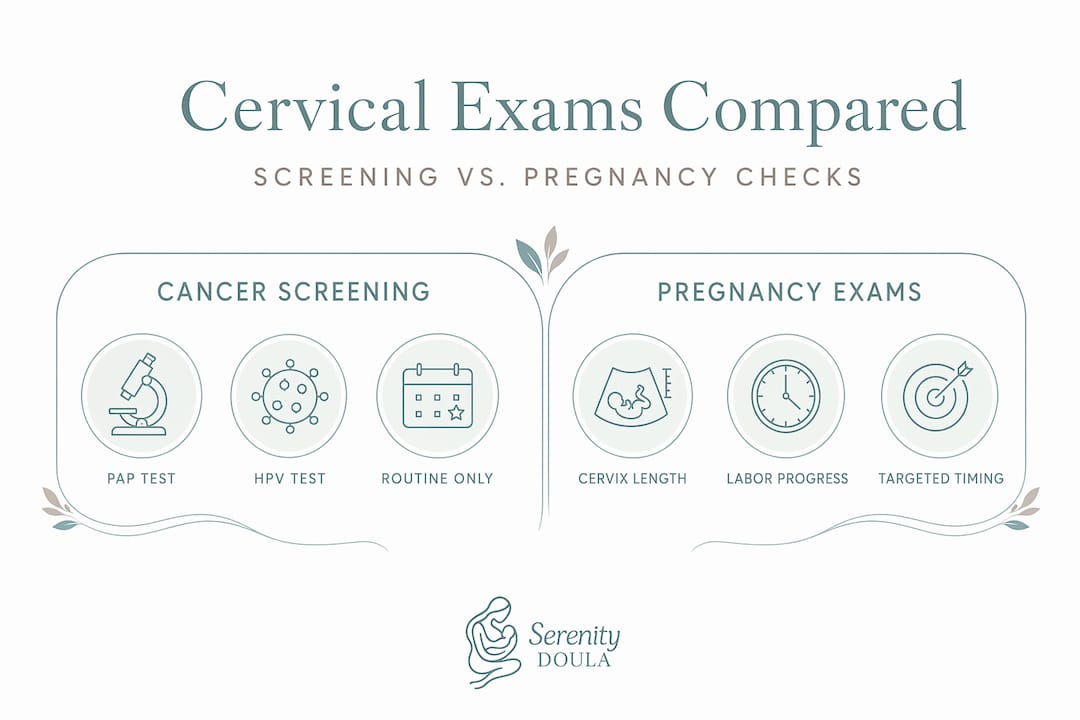
Since these three exam types are so frequently confused, a side-by-side view makes the differences much clearer.
| Exam type | Timing | Method | Purpose |
|---|---|---|---|
| Cervical cancer screening | Per guidelines (often every 3 to 5 years); may be delayed during pregnancy | Pap smear, HPV co-test | Screen for HPV and pre-cancerous cells |
| Cervical length assessment | 16 to 24 weeks with risk factors | Transvaginal ultrasound | Predict and prevent preterm birth |
| Dilation and effacement check | Late pregnancy or active labor | Manual exam by provider | Assess labor progress and readiness |
The American College of Obstetricians and Gynecologists (ACOG) now also includes options for patient-collected HPV testing in updated guidance, which gives some patients more flexibility and comfort during screening.
A few other important things to know:
- Pap smears may sometimes happen during pregnancy if you’re overdue for screening.
- Cervical length ultrasounds are usually gentle and cause minimal discomfort.
- Manual cervical checks during labor can feel uncomfortable or intense for some people.
- You can always ask for slower, gentler care.
- You also have the right to decline an exam.
That last part matters. Consent is ongoing. Even during labor. Even in the hospital. Even if something is “routine.”
For more context on navigating these decisions, the evidence-based birth framework at Serenity Doula is a helpful resource.
What to expect during a cervical exam and how to prepare
ometimes the fear of a cervical exam is worse than the exam itself simply because nobody explained what to expect ahead of time.
While every provider has their own style and everybody experiences exams differently, here’s what a typical process often looks like:
- Your provider explains the exam. They should tell you what type of exam it is, why it’s being done, and what they’re looking for.
- You give consent. This is not optional. You have every right to ask questions before agreeing or declining.
- The exam begins gently. Pelvic exams involve visual inspection, gentle bimanual palpation (pressing from inside and outside simultaneously), and possibly a speculum if needed. Providers are trained to minimize discomfort.
- Results are shared with you. Your provider discusses what they found and how it affects your care plan.
- You ask follow-up questions. What does this mean? What happens next? Do I need another check?
For ultrasound-based cervical length checks, the process is even gentler. A thin ultrasound wand is placed transvaginally by a trained provider. It typically takes just a few minutes and causes minimal discomfort.
A few ways to help yourself feel more grounded during an exam:
- Practice slow breathing beforehand
- Relax your jaw and shoulders
- Bring your partner or support person if allowed
- Tell your provider if you’re nervous
- Ask them to go slowly
- Request pauses if needed
And if an exam becomes too uncomfortable physically or emotionally, you can absolutely ask to stop.
Knowing that ahead of time can make a huge difference.
Explore comfort measures during labor for more ways to stay grounded through physical exams and birth.
Why understanding cervical exams changes your pregnancy journey
Most anxiety around cervical exams comes from not knowing what they’re for. When you don’t understand why something is happening, your brain fills in the gaps, usually with the worst-case scenario.
Here’s the honest truth: pelvic exams shouldn’t be a default, catch-all screening tool. Evidence strongly supports condition-specific approaches tailored to each pregnancy. Which means if your provider is recommending an exam, there’s a reason. And if you don’t know that reason, ask.
This knowledge changes things. You stop carrying a vague sense of dread into appointments and start showing up with specific questions. You feel more like a partner in your care and less like something is being done to you. That shift, from anxious to informed, is one of the most empowering things that can happen during pregnancy. Pairing medical understanding with an informed birth care framework helps you arrive at every appointment feeling grounded rather than guarded.
How holistic doula support complements your cervical exam journey
Navigating cervical exams and everything else that comes with pregnancy is a lot to carry. You don’t have to carry it alone.

At Serenity Doula, we walk alongside expectant parents in Pennsylvania and New Jersey through every stage of pregnancy, including the parts that feel confusing or uncertain. Our pregnancy and birth doula support includes personalized education about exams, labor milestones, and your rights as a patient. We help you and your partner prepare for appointments, process new information, and feel genuinely confident in your choices. Our childbirth education programs cover what to expect at each stage, and our prenatal emotional support gives you a safe space to ask all the questions you might hesitate to ask elsewhere.
Frequently asked questions
Are cervical exams done at every prenatal visit?
No, routine pelvic exams are not recommended as a periodic screening during pregnancy. Cervical exams during pregnancy are performed for specific medical reasons, not automatically at every appointment.
What is a cervical length check and why is it important?
A cervical length check uses transvaginal ultrasound to measure your cervix and identify preterm birth risk. Transvaginal cervical length measurement is the most reliable method available for predicting and preventing preterm birth when paired with early interventions.
Is cervical cancer screening the same as pregnancy cervical exams?
No, they are two separate things entirely. ACOG’s 2026 guidance confirms that cervical cancer screening is distinct from pregnancy cervical checks and labor dilation exams, with different methods, timing, and purposes.
Can doulas help me understand cervical exams better?
Yes, absolutely. Doulas provide education and emotional support that help you feel prepared and confident about cervical exams, labor milestones, and your options throughout pregnancy, so you never feel like you’re facing it without backup.