

TL;DR:
- Internal exams during pregnancy are not routine and should be performed only when medically indicated through shared decision-making. Ultrasound offers a more accurate, less invasive alternative for preterm risk assessment, and patients have the right to decline exams or request noninvasive options. Advocating for comfort and informed choices empowers pregnant individuals to receive respectful, low-intervention maternity care.
Many pregnant people assume internal examinations are a routine part of every prenatal visit, but that’s not always the case. Routine pelvic exams are not the default standard of care and should be based on medical indication and shared decision-making between you and your provider. In this guide, we’ll walk through exactly what internal exams involve, when they’re truly recommended, what alternatives exist, and how you can advocate confidently for your comfort throughout your pregnancy and birth experience.
Table of Contents
- What is an internal examination during pregnancy?
- When and why are internal exams recommended?
- Comparing internal exams with alternative methods
- How to advocate for comfort and informed choices
- Our perspective: Why internal exam frequency matters more than you think
- Where to find holistic pregnancy support near you
- Frequently asked questions
Key Takeaways
| Point | Details |
|---|---|
| Internal exams are not routine | Most pregnant people only need internal exams when medically necessary and after informed discussion. |
| Ask questions and advocate | You can always ask about the reason for an exam, how it changes care, and whether less invasive options exist. |
| Alternatives may be available | Ultrasound and external signs can sometimes replace manual exams, especially for some preterm labor assessments. |
| Holistic support improves comfort | Doulas and childbirth education help you feel more informed, at ease, and empowered during pregnancy and labor. |
What is an internal examination during pregnancy?
Now that you know not every pregnancy requires frequent internal exams, let’s clarify what these examinations actually are and what’s involved.
An internal examination during pregnancy, sometimes called a vaginal or cervical exam, is a physical assessment performed by a midwife or doctor. It’s done with sterile, gloved hands to check the condition of your cervix. According to guidance from UPMC, a cervical check involves manual assessment of the cervix, where the clinician evaluates dilation (measured in centimeters), effacement (how thinned the cervix is), position, station (how far down the baby is in the pelvis), and consistency.
These exams feel different for everyone. Some people find them mildly uncomfortable, while others find them more distressing, particularly if they have a history of trauma or sensitivity.
When might a cervical exam be considered?
- Labor assessment: Checking how far along you are when contractions begin
- Preterm symptoms: If you’re experiencing cramping or pressure before 37 weeks
- Suspected rupture of membranes (PROM): When your water may have broken
- Post-dates pregnancy: In later pregnancy to discuss options for induction
- Specific clinical concerns your provider needs to address
Understanding when cervix checks start and why they’re suggested can help you feel grounded and informed rather than caught off guard.
Pro Tip: You can ask your provider ahead of your appointment whether a cervical exam is planned. This gives you time to prepare emotionally and ask questions before you’re already on the table.
When and why are internal exams recommended?
Understanding what an internal exam is leads to the important question: when and why might your provider suggest one?
The short answer is that clinical need should drive the decision, not routine habit. Pelvic examinations should be performed when indicated by medical history or symptoms, and the decision should be made collaboratively between you and your provider. This is your right as a patient.
The most common medically indicated reasons include:
- Active labor progression monitoring when you’re admitted to the hospital or birth center
- Preterm labor evaluation when symptoms suggest your cervix may be changing early
- Rupture of membranes assessment to confirm whether your water has broken
- Post-dates assessment when discussing labor induction options after 40 weeks
- Specific complaints such as pelvic pressure, unusual discharge, or spotting
It’s worth knowing that in labor, routine vaginal exams are performed at regular intervals in many hospital settings, but evidence raises real concerns about overdiagnosis and unnecessary interventions that can follow from those findings.
“Shared decision-making means you’re an active participant in your care, not a passive recipient. You get to ask questions, weigh your options, and decide what feels right for your body and your birth.”
If you’re preparing for labor and want to feel more confident in these conversations, reading about how to support your partner during labor can also give your support person the tools to advocate alongside you.
Comparing internal exams with alternative methods
With the decision to perform an internal exam being so individual, what alternatives are available if you’d like to minimize internal checks?
This is a really important question, and the good news is that options do exist. In certain situations, particularly for preterm labor risk assessment, ultrasound technology offers a more objective and less invasive picture.
Research shows that transvaginal ultrasound predicted preterm labor with significantly higher sensitivity (84.3%) and specificity (78.7%) compared to digital vaginal examination, which measured 62.5% sensitivity and 56.2% specificity. In plain terms, ultrasound gave a more accurate result. For preterm risk evaluation, it’s worth asking whether ultrasound is appropriate for your care.
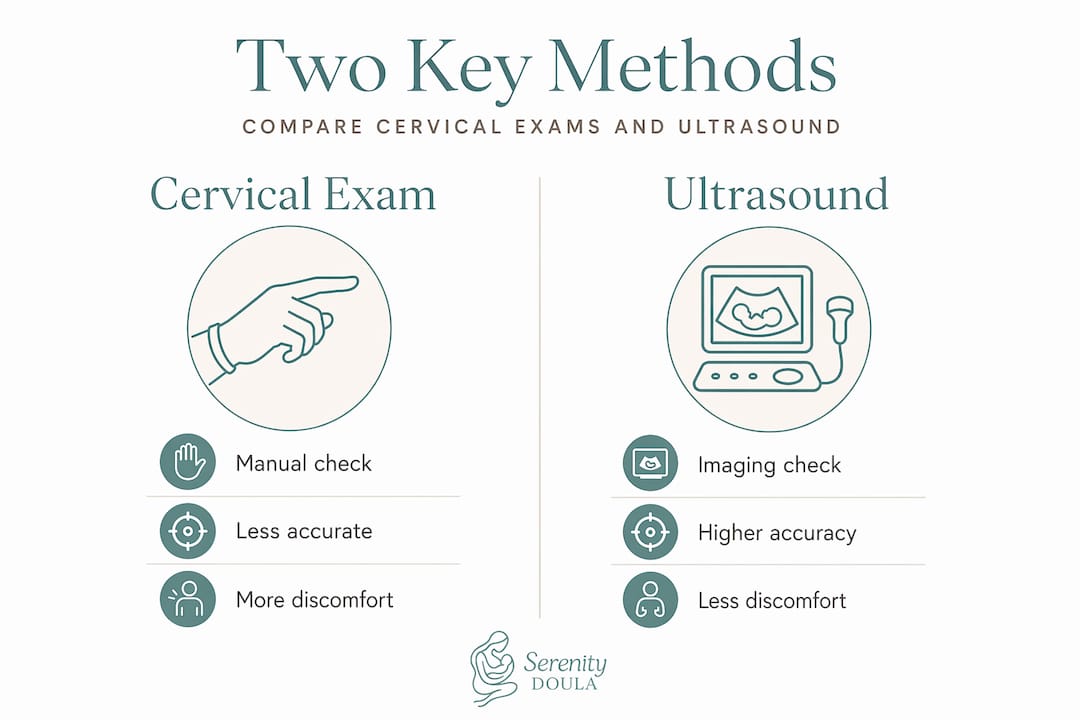
| Method | Accuracy for preterm prediction | Comfort level | Best used for |
|---|---|---|---|
| Digital cervical exam | Lower (62.5% sensitivity) | Varies; can be uncomfortable | Labor progress in active labor |
| Transvaginal ultrasound | Higher (84.3% sensitivity) | Generally well tolerated | Cervical length and preterm risk |
| External observation | Limited for cervix assessment | Non-invasive | General labor cues, contractions |
Evidence also suggests that in labor, internal exams are not the only way to assess progress, and external cues combined with clinical judgment are under ongoing evaluation as valid tools.
Your birth environment matters too. Knowing about labor and delivery bed options and comfort tools like TENS units for labor pain can make a real difference in how grounded and in control you feel during each stage of labor, regardless of what monitoring is involved.
Pro Tip: If ultrasound is available and appropriate for your clinical picture, it’s completely reasonable to ask your provider whether it might be used in place of or alongside a digital exam, especially for preterm risk evaluation.
How to advocate for comfort and informed choices
Knowing the options is empowering, but having a voice in your care is just as important. Here’s how to speak up and find support that respects your choices.

Many pregnant people worry about seeming “difficult” when they raise concerns. You are not being difficult. You are being an informed participant in your own healthcare. A practical approach is to ask your provider why the exam is needed, what decision it affects, and whether noninvasive alternatives are possible.
Questions to ask your provider:
- Why is this exam being recommended right now?
- How will the results change my care plan?
- What happens if I choose to wait or decline?
- Is there a noninvasive alternative in my situation?
- How many exams are typically done in labor at this facility?
Comfort measures that can help if you do have an exam:
- Ask to be talked through each step before it happens
- Bring your doula or support person into the room
- Practice slow, deep breathing to stay grounded
- Ask your provider to go slowly and check in with you
- Let your provider know about any history of discomfort or trauma
Evidence confirms that routine exams in labor can be distressing, and discussing a plan to minimize exam frequency when clinically safe is a completely valid conversation to have with your care team.
| Scenario | Suggested approach |
|---|---|
| Routine late pregnancy visit | Ask if an exam is clinically indicated before agreeing |
| Admitted in early labor | Discuss preferred exam frequency with your care team upfront |
| Preterm symptoms | Ask whether ultrasound is an option |
| Feeling anxious about exams | Bring support person; ask for slow, narrated approach |
Investing in comfort measures during labor and exploring childbirth education ahead of time gives you a toolkit that’s ready before you ever walk through those hospital doors. And if emotional weight feels heavy between appointments, prenatal emotional support can help you feel seen and held through all of it.
Our perspective: Why internal exam frequency matters more than you think
Here’s something that doesn’t get said enough: more exams do not equal better care.
In birth culture, there’s a quiet assumption that frequent cervical checks are reassuring. They feel like data. They feel like progress. But in our experience supporting families in Bucks, Montgomery, Mercer, Burlington, and Philadelphia counties, we’ve watched how a single unexpected number on a cervical check can send a laboring person spiraling into anxiety or onto an intervention pathway they didn’t want or need.
The number on a cervical check is just one small snapshot. It does not tell you how your labor will unfold. A cervix that’s 2 cm in the morning can open to 10 cm by afternoon. And a person who declines frequent checks can still birth beautifully, supported by their body’s cues and a care team they trust.
What we believe deeply is that empowerment doesn’t end with clinical understanding. It extends into how you shape your care experience, how you communicate your values to your provider, and who you bring into your birth space to hold that vision with you. Learning to prepare for labor and birth includes preparing for these conversations.
Low-intervention, patient-centered birth isn’t a fringe idea. It’s supported by evidence and embraced by holistic birth communities right here in our local area. You deserve care that respects your dignity and your choices, every single step of the way.
Where to find holistic pregnancy support near you
If you want trusted local resources to support your birth goals and comfort, help is close at hand.

A doula can be one of the most powerful tools you have for navigating these conversations. Our pregnancy and birth support services are designed to help you feel grounded, informed, and genuinely cared for throughout your pregnancy journey. We help you understand your options, prepare thoughtful questions for your provider, and stay centered in your values when labor gets intense.
Our childbirth education services give you and your partner the knowledge to make truly informed decisions, from understanding when exams are clinically useful to building a birth plan that reflects your preferences. Combined with prenatal holistic care, you’ll never have to carry this alone. Reach out to connect with our team serving families across the greater Philadelphia area.
Frequently asked questions
Are internal exams required during every prenatal visit?
No, internal exams are not performed at every prenatal visit and are usually done when medically indicated or in late pregnancy. Routine pelvic exams are not the default and should only be performed when there is a clinical reason.
Can I refuse an internal exam if I feel uncomfortable?
Yes, you have the right to consent to or decline an internal examination at any point in your care. The decision to perform internal exams should always be shared between you and your provider.
Are there accurate alternatives to digital cervical checks for preterm labor risk?
Yes, transvaginal ultrasound for cervical length measurement is often more accurate and objective. Transvaginal ultrasound has higher sensitivity and specificity for predicting preterm labor than digital exams.
What should I ask if my provider suggests an internal exam?
Ask about the purpose of the exam, how results will impact your care, and whether noninvasive alternatives like ultrasound are an option. Asking why the exam is needed and what it will inform is a practical and empowered approach to shared decision-making.
Do internal exams increase risks of infection or labor interventions?
Routine internal exams can increase the risk of distress or unnecessary interventions and should be limited to when clinically indicated. Routine vaginal exams in labor can lead to harm from unnecessary follow-on interventions, which is why limiting them to clinical necessity matters.