

TL;DR:
- Many women find the all-fours position helpful for back pain relief and fetal rotation, especially during active labor.
- With a low-dose or mobile epidural, repositioning to all fours is often feasible with proper support and medical consent.
- While research shows limited evidence that all-fours reduces interventions, individualized comfort and support remain crucial for a positive birth experience.
You’re planning on getting an epidural, but you’ve heard that all-fours or hands-and-knees positions can feel amazing during pushing. Now you’re wondering: will I lose that option the moment the epidural goes in? This is one of the most common questions expecting mothers ask, and the honest answer is, it depends. The type of epidural you receive, the support around you, and your own body’s response all play a role. This guide walks you through exactly what’s possible, what the research actually says, and how to prepare so you feel confident and informed going into your birth.
Table of Contents
- What does it mean to give birth on all fours?
- What you need: Types of epidurals and requirements for mobility
- How to get into all fours with an epidural: Step-by-step
- What the evidence and experts say about outcomes
- A doula’s take: Why individual choice matters more than any single position
- Explore your options with holistic support
- Frequently asked questions
Key Takeaways
| Point | Details |
|---|---|
| All-fours possible with epidural | The hands-and-knees position can be used with some types of epidurals when safety is confirmed. |
| Type of epidural matters | Low-dose or ‘walking’ epidurals offer greater mobility compared to traditional ones. |
| Outcomes are individual | Evidence shows no clear advantage for all-fours, so comfort and support are most important. |
| Always seek support | Hands-on help from staff and open communication with your care team are essential when changing positions. |
What does it mean to give birth on all fours?
The all-fours position, also called hands-and-knees, means you are on your hands and knees during pushing or active labor, with your weight distributed through your palms and knees rather than lying flat on your back. It’s a posture many women find instinctively comforting, especially during contractions.
Here’s why so many birthing people are drawn to it:
- Relief from back labor: The position reduces pressure on the sacrum and can ease the sharp, persistent aching of back labor.
- Gravity and rotation: Some midwives and doulas believe it encourages babies in posterior positions (facing the ceiling) to rotate, though evidence is mixed.
- A sense of agency: Being upright and active can feel empowering, especially when so much of labor feels out of your control.
- Reduced perineal pressure: Some mothers report less pressure and tearing in this position, though outcomes vary.
If you’re already preparing your mind and body for labor, it’s worth knowing that while these benefits feel real and meaningful to many mothers, Cochrane’s review of maternal positions in the second stage with an epidural finds no strong evidence that upright positions like all fours reduce operative births overall. Individual factors, your comfort, your baby’s position, and your support team, matter more than any single posture.
What you need: Types of epidurals and requirements for mobility
Now that you know what the all-fours position is, let’s look at the specific requirements and epidural types that determine if this position is feasible for you.
Not all epidurals are created equal. This is the piece most people don’t realize until they’re already in labor.
| Epidural type | Typical mobility level | All-fours feasibility |
|---|---|---|
| Traditional epidural | Significant leg weakness | Usually not feasible |
| Low-dose “walking” epidural | Partial leg strength retained | Often feasible with support |
| Combined spinal-epidural (CSE) | Variable, often moderate | Possible in many cases |
A low-dose mobile epidural preserves more motor function in your legs, which is exactly what you need to shift positions safely. Traditional higher-dose epidurals numb sensation more completely and often leave legs too heavy to bear any weight at all.
Before attempting the all-fours position, a few things need to be in place:
- Medical team consent: Your OB, midwife, or nurse must assess your leg strength and agree it’s safe.
- A secure IV line and fetal monitor placement: Wireless or telemetry monitoring may be needed.
- Hands-on support: You will need at least one person steadying you throughout the repositioning.
- A flat, stable surface: Hospital beds can often be adjusted to support this position.
“Mobility during labor isn’t just about convenience. It’s about feeling present and in control of your own body. When that’s possible with an epidural, it can genuinely change the emotional tone of a birth.” — perspective shared by labor and delivery nurses and doulas alike.
Pro Tip: Ask your anesthesiologist early in the process whether a low-dose or mobile epidural is available at your birth facility. Not all hospitals offer this routinely, but many will consider it if you request it as part of your birth preferences.
Pairing your epidural with other comfort measures during labor can also help you stay grounded and comfortable while you explore different positions. Some mothers also use TENS units for labor pain before an epidural is placed, as an added layer of relief during early labor.
How to get into all fours with an epidural: Step-by-step
Once you’ve confirmed that it’s safe and feasible, here’s exactly how to try the all-fours position with an epidural.
-
Confirm leg strength with your nurse. Before any repositioning, ask your nurse to assess how much feeling and strength you have in your legs. You should be able to feel pressure and have some resistance in your legs, even if sensation is reduced.
-
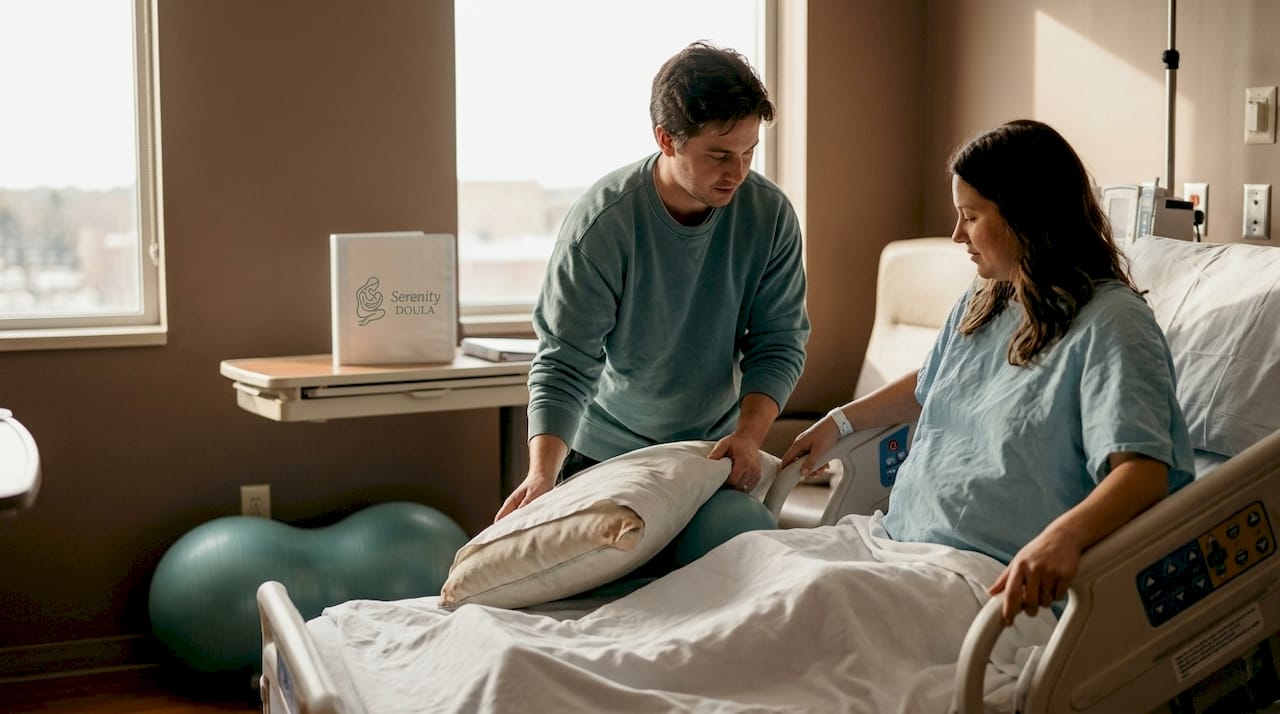
Request the right help. You’ll want at least two people present: your nurse and your partner or doula. One person should stabilize your torso, the other should support your legs as you shift.
-
Lower the bed to a flat position. Ask the nursing staff to flatten the hospital bed so there is a stable, even surface beneath you.
-
Start on your side. Roll gently to one side first, with assistance. Avoid any sudden or independent movements, since numbed legs can give way without warning.
-
Move to hands and knees gradually. From your side, with support under your hips and torso, ease yourself up onto your knees. Keep your hands flat and wide for stability.
-
Check your IV line and monitor leads. Make sure your IV and any monitoring equipment have enough slack and aren’t being pulled. Your nurse will adjust these as needed.
-
Communicate throughout. Tell your team immediately if you feel dizzy, if your arms tire, or if you feel any unusual sensations. Your comfort and safety come first.
-
Use pillows or a peanut ball for support. A peanut ball (an oblong exercise ball) placed under your chest can take weight off your arms and help you hold the position longer.
Research confirms that low-dose epidurals support greater mobility and make repositioning like this more achievable. Learning how to support your partner during labor is just as important, since your birth partner’s role becomes even more hands-on when you’re navigating position changes with an epidural.
Pro Tip: Practice getting on all fours during pregnancy so the motion feels familiar to your body. That muscle memory can be helpful even when your lower body sensation is reduced.
What the evidence and experts say about outcomes
With the position and process explained, here’s what the strongest evidence actually shows, and what it really means for your labor.
| Outcome measured | Upright/all-fours | Recumbent (lying down) | Evidence quality |
|---|---|---|---|
| Operative birth rate | RR 0.86 | Reference | Low quality |
| Second stage duration | Minimal difference | Reference | Low quality |
| Perineal trauma | Unclear difference | Reference | Low quality |
| Maternal comfort | Often preferred | Variable | Low quality |
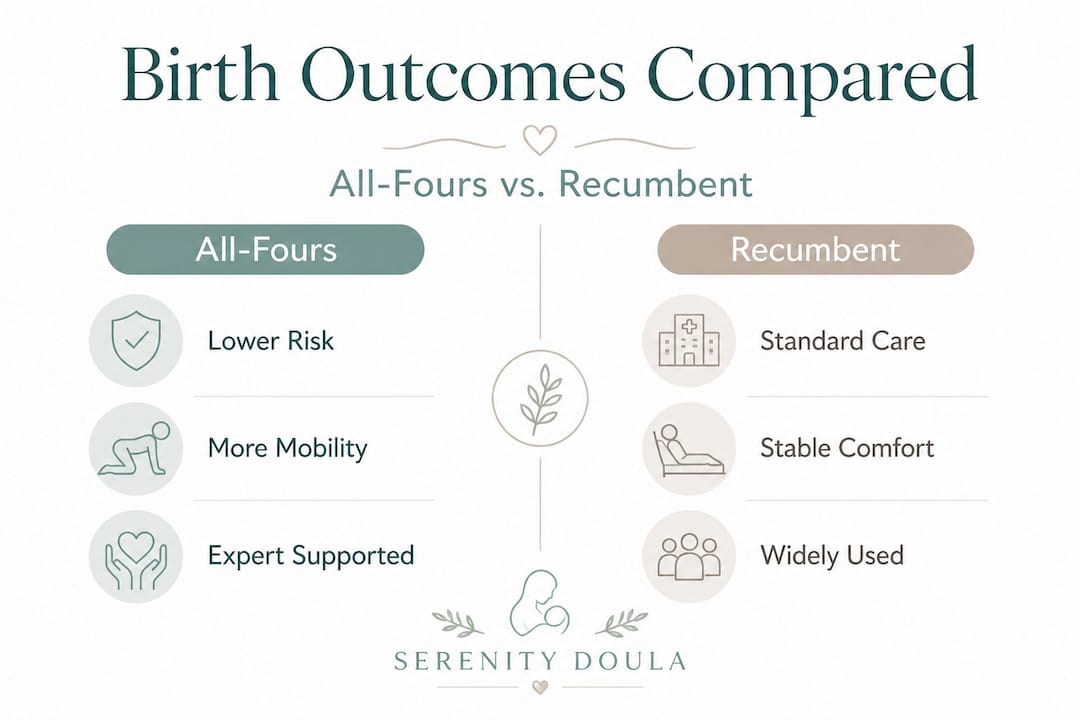
The Cochrane review covering 8 trials and 4,316 women found a relative risk of 0.86 for operative birth in upright positions, meaning a slight trend toward fewer interventions, but this did not reach statistical significance and the evidence quality is rated low. That’s important to know.
What this means for you: The research doesn’t tell us that all fours is definitively better or worse. What it does tell us is that position alone is unlikely to be the deciding factor in your birth outcome. Comfort, support, and communication have a far greater impact on how your labor feels and progresses.
An evidence-based birth approach means staying informed without feeling pressured into any single method. The goal is a birth experience where you feel heard, supported, and genuinely cared for, whatever position that happens to be in.
A doula’s take: Why individual choice matters more than any single position
Here’s something that often gets lost in conversations about birth positions: the research studies populations. Your labor is not a population. It’s yours.
We see this every single time. A mother comes in with a clear idea of the “right” position, and then labor unfolds differently than anyone expected. The mothers who tend to have the most positive experiences are not the ones who stuck rigidly to a birth plan. They’re the ones who stayed flexible, communicated openly with their team, and had support people who helped them adjust in real time.
The obsession with finding the “optimal” position can actually add stress during labor, which is the last thing you need. What matters is that you feel grounded in your choices, supported by your team, and free to change your mind if something isn’t working. Empowered childbirth isn’t a specific posture. It’s a feeling of ownership over your experience, whatever that looks like.
If all fours feels right for you, pursue it. If it doesn’t, there is nothing wrong with lying on your side, semi-reclined, or in whatever position brings you the most comfort. No single position is a magic solution, but the right support system comes very close.
Explore your options with holistic support
If reading this has sparked questions about your own birth preferences, you don’t have to figure it out alone.

At Serenity Doula, our goal is to help you feel prepared, informed, and genuinely supported no matter how your birth unfolds. Whether you’re weighing epidural options, exploring alternative positions, or just trying to understand what your choices even are, we’re here to walk through it with you. Our pregnancy and birth support doula services are designed to meet you where you are. If you’re new to what doulas do or curious about the full range of holistic support options available, we’d love to connect and help you build your birth team.
Frequently asked questions
Is it safe to try the all-fours position with an epidural?
It’s safe for many mothers, especially those with a low-dose mobile epidural and an attentive care team, but eligibility depends on your individual mobility and your facility’s protocols.
Will giving birth on all fours reduce my chance of a C-section with an epidural?
Current studies show very little difference, with the Cochrane review finding only a small, non-significant trend toward fewer operative births in upright positions with low-quality evidence.
What kind of support will I need to use the all-fours position with an epidural?
You’ll need hands-on assistance from your nurse and birth partner to reposition safely, along with pillow or peanut ball support to hold the position comfortably without straining your arms.
Does all-fours speed up pushing with an epidural?
The evidence does not show a consistent reduction in second stage duration for all-fours versus other positions when an epidural is in use, so it’s best to focus on comfort rather than expecting a faster labor.