

TL;DR:
- The second trimester benefits from personalized self-care plans based on individual needs and preferences.
- Routine habits like hydration, gentle movement, and emotional support promote physical and mental well-being.
- Flexibility and trusting one’s intuition are key to sustainable, empowering pregnancy self-care.
The second trimester often arrives with a wave of relief. Morning sickness fades, energy creeps back, and your bump becomes undeniably real. But with that shift comes a whole new set of questions: What should you be eating? Is that back pain normal? How do you actually take care of yourself and your baby in a way that feels right for you? It can feel like a lot to sort through on your own. The good news is that building a personalized self-care plan for these middle months does not have to be complicated. This guide walks you through every step, from assessing your needs to verifying that your plan is working, so you can move through your second trimester feeling grounded, confident, and genuinely supported.
Table of Contents
- Assess your needs and preferences for a personalized plan
- Essential self-care practices and healthy routines
- Safety, troubleshooting, and common mistakes
- How to know your plan is working: Verification and adjustment
- Changing your self-care mindset: What most guides miss
- Ready to get holistic support for your journey?
- Frequently asked questions
Key Takeaways
| Point | Details |
|---|---|
| Personalize your plan | Start with a needs assessment and adapt routines to your health, preferences, and provider’s input. |
| Follow healthy routines | Daily self-care habits and regular checkups support your wellbeing and your baby’s development. |
| Stay flexible | Treat your plan as a living document—adjust as your symptoms or support needs shift. |
| Know warning signs | Contact your provider immediately with any severe or unusual symptoms during pregnancy. |
| Seek holistic support | Consider enlisting a doula or wellness professional for extra guidance and emotional support. |
Assess your needs and preferences for a personalized plan
Once you’ve recognized the importance of self-care in the second trimester, the next step is taking a closer look at your unique needs. No two pregnancies are alike, which is exactly why a one-size-fits-all checklist often falls short.
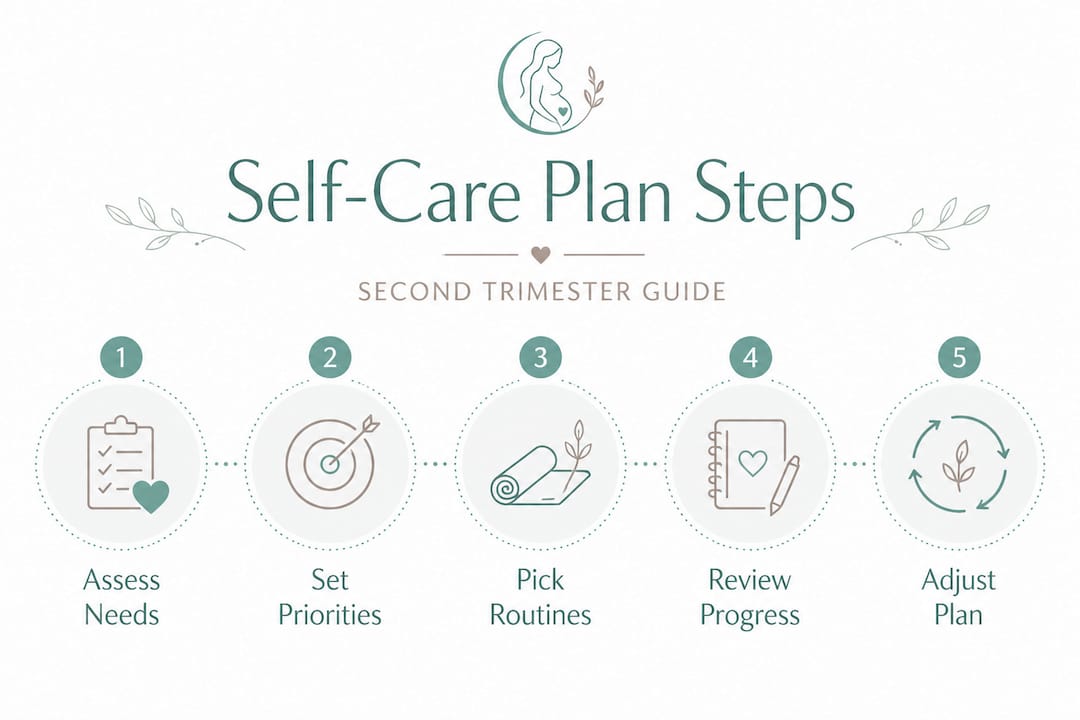
A tailored prenatal care approach, as recommended by ACOG (the American College of Obstetricians and Gynecologists), begins with a comprehensive needs assessment covering your medical history, current symptoms, social support, and personal preferences. This is the foundation that makes everything else work.
Why start with an assessment?
Think of it like building a house. You would not skip the blueprints. Knowing where you are right now helps you choose the right habits, ask the right questions at your prenatal visits, and avoid doing too much or too little.
Here is what to consider when assessing your needs:
- Medical history: Do you have any chronic conditions, a history of preterm labor, or pregnancy complications? These factors shape what activities and nutrition plans are safest for you.
- Current symptoms: Are you dealing with round ligament pain, heartburn, swelling, or anxiety? Your symptoms are data points that tell you where to focus.
- Social support: Who is in your corner? A partner, family member, close friend, or doula can all play meaningful roles in your care. Knowing your support network helps you lean on it intentionally.
- Mental health: Stress, mood changes, and prenatal anxiety are more common than many people realize. Identifying where you are emotionally is just as important as tracking your physical symptoms.
- Personal preferences: Do you prefer gentle yoga or walking? Journaling or talking things out? Your self-care plan should reflect what actually feels good to you, not just what sounds ideal.
Exploring prenatal emotional support early in your planning process can help you recognize emotional patterns that influence your physical wellbeing. Many families also find that reviewing evidence-based birth frameworks helps them feel more informed and less overwhelmed as they build their plan.
| Assessment Area | Questions to Ask Yourself |
|---|---|
| Medical history | Any complications, chronic conditions, or past pregnancy losses? |
| Current symptoms | What physical discomforts are most present right now? |
| Social support | Who can you call on for help or encouragement? |
| Mental health | How is your stress level and emotional wellbeing? |
| Personal preferences | What wellness activities feel sustainable for you? |
Pro Tip: Write your assessment answers down before your next prenatal visit. Sharing this with your provider opens up more meaningful conversations and supports true shared decision-making in your care. If you are navigating a higher-weight pregnancy, the plus-size pregnancy guide offers specific insights worth exploring.
Essential self-care practices and healthy routines
With your unique needs clarified, let’s translate them into practical daily and weekly self-care actions. The second trimester is often the ideal window to build habits that will carry you through the rest of your pregnancy and into postpartum recovery.
Daily habits worth prioritizing:
- Hydration: Aim for at least eight to ten cups of water per day. Dehydration during pregnancy can trigger Braxton Hicks contractions (practice contractions the uterus makes to prepare for labor) and increase fatigue.
- Nutrition: Focus on iron-rich foods, calcium, folate, and healthy fats. Your baby’s brain development is especially active during the second trimester.
- Skincare: Moisturize your belly daily to support skin elasticity as your bump grows. Use fragrance-free options when possible.
- Gentle movement: Walking, swimming, or prenatal yoga for 20 to 30 minutes most days supports circulation, mood, and sleep quality.
- Prenatal vitamins: Take them consistently. According to ACOG prenatal care guidelines, daily prenatal vitamins alongside a dental check and regular moisturizing are core hygiene and health practices during this stage.
Weekly habits to build in:
- Attend prenatal visits every four weeks if you have a low-risk pregnancy.
- Schedule a mental health check-in with yourself, your partner, or a counselor.
- Connect with a trusted friend, a support group, or your doula.
- Review any new symptoms or concerns to bring to your next appointment.
Statistic spotlight: Studies consistently show that pregnant people who receive regular emotional and informational support report lower levels of stress and greater satisfaction with their birth experience. Community and connection are not luxuries. They are evidence-backed tools.
Here is a quick comparison of popular wellness approaches in the second trimester:
| Wellness Practice | Physical Benefits | Emotional Benefits | Time Commitment |
|---|---|---|---|
| Prenatal yoga | Flexibility, reduced back pain | Calm, body awareness | 30 to 60 min, 2-3x/week |
| Daily walking | Circulation, stamina | Mood boost, energy | 20 to 30 min daily |
| Mindfulness and meditation | Lowered cortisol | Reduced anxiety, better sleep | 10 to 15 min daily |
| Social connection | Indirect immune support | Reduced isolation | Varies |
| Journaling | N/A | Emotional processing, clarity | 10 to 20 min daily |
Pro Tip: You do not need to do all of these. Pick two or three practices that already feel close to your lifestyle and build from there. Sustainable consistency beats an ambitious plan you cannot keep up with. You can also browse emotional support resources for ideas on how to stay grounded between appointments.

Safety, troubleshooting, and common mistakes
While following healthy routines, it is equally important to recognize potential challenges and safety considerations. Even the most thoughtful plan needs room for troubleshooting.
Top 5 common second trimester self-care mistakes:
- Skipping prenatal visits because you feel well. Feeling good is wonderful, but many important screenings happen during these appointments regardless of how you feel. Gestational diabetes testing, anatomy scans, and blood pressure monitoring are all time-sensitive.
- Overcommitting to a rigid routine. If your plan feels like a chore, you will abandon it. Rigid schedules can spike anxiety rather than reduce it.
- Ignoring new or unusual symptoms. Round ligament pain is normal. Sharp, persistent pain is not. The second trimester comes with its own set of warning signs that deserve attention.
- Not factoring in social determinants of health. Stress from housing insecurity, relationship strain, or financial pressure is a real part of prenatal wellness. ACOG’s updated guidance explicitly recommends screening for social determinants to provide equitable, truly personalized care.
- Making decisions without provider input. New supplements, exercises, or treatments should always be discussed with your healthcare provider before you start.
Warning signs that require prompt medical attention:
- Vaginal bleeding or unusual discharge
- Fever above 100.4°F
- Severe abdominal pain or cramping
- Sudden swelling in your hands or face
- Decreased fetal movement after 20 weeks
- Signs of urinary tract infection (burning, frequency, or cloudy urine)
“Plans should be personalized via shared decision-making, flexible enough to adjust as your pregnancy evolves, and provider-approved at every major step.” — ACOG, 2025
Think of your self-care plan as something written in pencil, not carved in stone. Life changes. Your body changes. Your plan should be able to change with you. If you want to understand more about routine pregnancy assessments, learning about cervix checks during pregnancy can help you feel more prepared and less surprised at upcoming appointments.
How to adapt your plan as life changes:
- Revisit your assessment every four to six weeks.
- Keep a short symptom log so you can track patterns over time.
- Flag any changes in your support system and adjust your reliance accordingly.
- Give yourself permission to simplify during high-stress weeks without calling it a failure.
How to know your plan is working: Verification and adjustment
Once you’ve developed healthier habits and learned what to avoid, checking your progress helps keep your plan effective and reduces stress. Knowing your plan is actually working is just as important as the plan itself.
Signs your self-care plan is on track:
- Your energy levels feel more stable across the day.
- You are sleeping better or falling asleep more easily.
- You feel emotionally grounded more often than anxious or overwhelmed.
- Your prenatal appointments are going well and you feel informed about your progress.
- You are managing physical discomforts rather than being derailed by them.
Questions to ask your provider or doula at each visit:
- Is my weight gain on a healthy track for my body and pregnancy?
- Are there any new precautions I should know about this month?
- Is there anything in my recent labs or screenings I should adjust my habits for?
- How is my baby’s position and development looking?
| Milestone | What to Check | Who to Involve |
|---|---|---|
| Weeks 14 to 18 | Symptom changes, nutrition habits | OB or midwife |
| Weeks 18 to 22 | Anatomy scan results, emotional wellness | Provider and partner or doula |
| Weeks 22 to 27 | Glucose screening prep, energy, sleep | Provider and support team |
| End of second trimester | Third trimester readiness, birth plan beginnings | Full care team |
According to ACOG’s tailored prenatal care model, the most effective prenatal plans are built around regular reassessment and shared decision-making between you and your care providers. This is not a “set it and forget it” process. It is a living, evolving practice.
Pro Tip: At the end of each month, spend 10 minutes reviewing your symptom log and checking in with your emotional state. Ask yourself: what is working, what feels hard, and what do I want to adjust? That simple reflection is one of the most powerful things you can do. As you approach your final weeks, starting your third trimester preparation checklist early gives you a head start on what comes next. It also helps to begin thinking about your postpartum care plan now, while you have the bandwidth to be thoughtful about it.
Changing your self-care mindset: What most guides miss
Having covered all the practical steps, let’s look at a deeper shift that can make your entire experience feel truly supported and empowering. This is the piece that most guides skip over.
Here is what we have seen again and again while supporting families through pregnancy: the people who struggle most with self-care are not the ones who lack information. They are the ones who feel like they are failing because they cannot keep up with an ideal version of a plan. A rigid checklist can quietly become a source of shame.
Real self-care in the second trimester is not about perfection. It is about honoring the rhythm of what this season actually looks like for you. Some days, drinking enough water and getting outside for a 15-minute walk is everything. Other days, calling a friend and crying it out is the most nourishing thing you can do. Both count.
We also want to name something that does not get said enough: your intuition is a legitimate part of your care plan. When something feels off in your body, even if you cannot put it into words, that feeling deserves attention. Bring it to your provider. Write it down. Trust it.
The families we support who feel the most empowered are the ones who have learned to hold expert guidance and their own inner knowing at the same time. They use their prenatal emotional support guide as a resource, not a rulebook. They adapt. They rest. They ask for help without apologizing for it.
That is the real goal of a second trimester self-care plan. Not a spotless checklist, but a genuinely sustainable practice that makes you feel more like yourself, even as everything changes.
Ready to get holistic support for your journey?
Whether you are refining your plan or ready for extra guidance, it helps to know there are resources designed to walk with you every step of the way.

At Serenity Doula, we offer pregnancy and birth support that goes far beyond the basics. Our doulas provide emotional reassurance, physical comfort techniques, and personalized guidance that hold you between appointments and beyond. We also offer childbirth education classes to help you and your partner feel genuinely prepared, not just informed. When you pair a strong self-directed plan with the kind of warm, evidence-informed support that a doula provides, the second trimester starts to feel a lot less like something to get through and a lot more like something to actually experience. Explore our prenatal emotional support services and reach out to schedule your consultation. You deserve to feel seen, supported, and confident in this season.
Frequently asked questions
How often should I see my provider in the second trimester?
Most people with low-risk pregnancies should attend a prenatal checkup every four weeks during the second trimester, though your provider may recommend more frequent visits based on your individual situation.
Is it safe to exercise in the second trimester?
Most moderate exercise is safe during a low-risk pregnancy, but always discuss new activities with your healthcare provider since tailored recommendations depend on your medical history and current symptoms.
What are the warning signs to call my doctor about?
Contact your provider right away if you experience severe pain, vaginal bleeding, fever, sudden swelling, or decreased fetal movement, as these require prompt evaluation regardless of how far along you are.
What if my needs or symptoms change mid-pregnancy?
Your self-care plan should be treated as a flexible, living document. Discuss any significant changes with your provider and adjust your plan through shared decision-making rather than trying to manage everything on your own.
How can a doula support my self-care plan?
A doula offers emotional, informational, and practical support that personalizes your care between provider visits, helping you build confidence, process your experience, and adapt your plan as your pregnancy evolves.