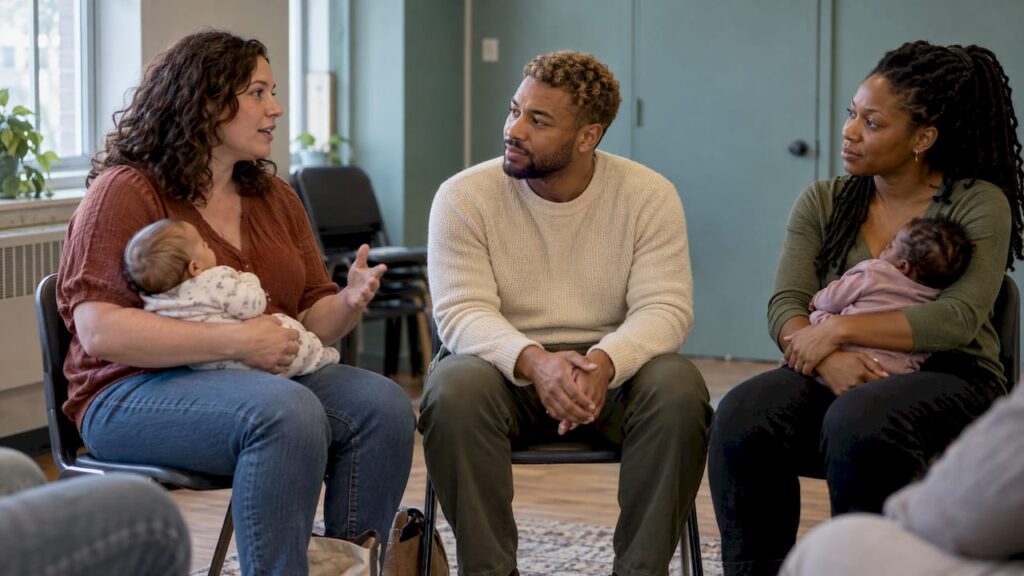
You don’t have to carry the early weeks alone, and in this region you have more options than you might think. Philadelphia hospitals, city programs and community spaces all run groups for new parents, and Bucks, Montgomery and Mercer counties each have their own entry points. This guide walks you through where to look, what to ask, when a feeling deserves a call, and how one-to-one postpartum support at home can hold you between group meetings. We are Serenity Doula, and we serve families in Newtown, Doylestown and across Bucks County.
TL;DR
- Hospital systems such as Jefferson and Penn Medicine run new-parent groups and classes, and some are open to the broader community, not only their own patients.
- Free drop-in meet-ups exist in Philadelphia, and peer groups for specific needs (partners, NICU families, loss, neurodivergent parents) are available too.
- The National Maternal Mental Health Hotline (1-833-943-5746) is free, confidential and open 24/7 in English and Spanish.
- In Bucks County, Montgomery County and Mercer County, start with county and state directories, then ask your OB or midwife what they recommend.
- A postpartum doula can support you at home alongside any group.
Table of Contents
- Postpartum groups in Philadelphia
- Finding a group in Bucks County
- Montgomery County and Mercer County resources
- Baby-Friendly hospitals in the Philadelphia area
- When a feeling deserves a call
- How a postpartum doula fits alongside a group
- Our perspective
- FAQ
- Sources
Postpartum groups in Philadelphia
Philadelphia has the widest range, so it is the best place to start even if you live in the suburbs. Many groups are virtual, which helps when you are nursing every two hours.
Hospital-based groups. Jefferson Health’s Parent & Family Education page lists a New Mom Support Group, a New Parent Adjustment Group, a NICU Family Support Group, a Pregnancy & Infant Loss Support Group and a Dad Lab group for fathers. It also lists a Mommy and Me class for babies from six weeks to pre-crawling, and a course on the physical, emotional and relational changes after birth. These are open to Jefferson patients and the wider community. Jefferson also offers a weekly peer-support group for parents and babies led by a board-certified lactation consultant.
Penn Medicine offers virtual and in-person parenting classes at its labor and delivery hospitals, including postpartum adjustment, infant massage and bonding, and a class called Beyond Birth, with babies welcome. Children’s Hospital of Philadelphia’s Bright Beginnings program pairs weekly breastfeeding support from a certified lactation consultant with monthly infant-parent group sessions during baby’s first year. Families get details at their newborn’s wellness visit at the Karabots Pediatric Center.
Community meet-ups. The Nesting House in Mt. Airy hosts free community groups with no registration. There is a weekly new baby meet-up on Wednesday mornings, a monthly breastfeeding support group on the fourth Tuesday, and a monthly group for neurodivergent parents. Check the page for the current location and season, since the meeting place changes between summer and the rest of the year.
Culturally specific support. The Philly Birth Fund runs a weekly doula-led virtual postpartum group that focuses on supporting Black families. Its ground rules include confidentiality and no medical advice.
Therapist-led groups. Private counseling practices in the region run time-limited groups for new moms and for non-birthing parents, usually with registration by email. They tend to run in cycles, so ask when the next one starts.
Finding a group in Bucks County
Bucks County families often tell us the same thing: there is no single list, so it feels like nothing exists. Here is a simple route.
- Call Postpartum Support International. The Pennsylvania Department of Health directs parents to PSI at 1-800-944-4773 (call or text, 8am to 11pm ET) to connect with local groups and organizations.
- Ask your provider a few questions. Does the practice or its hospital run a new-parent group? Which lactation consultants do you refer to? Who would you want me to call if I’m struggling?
- Consider the drive. Many Bucks County parents find Philadelphia hospital groups reachable, and virtual options remove the commute altogether.
- Add one-to-one support. A group gives you peers. Home support gives you someone who knows your baby, your house and your birth story.
We help with that last piece, including home breastfeeding visits for Bucks County families and the first two weeks of postpartum doula support.
Montgomery County and Mercer County resources
Montgomery County, PA. The county’s Maternal, Child and Family Health resources page lists free postpartum depression services through a central referral system (call 1-888-404-0620 or use the referral form). It also lists the WIC Breastfeeding Warmline (855-427-5666) and La Leche League (800-525-3243). The county’s Office of Community Connections has Navicates, trained professionals who link residents to mental health, food and housing help at 215-278-3522, with offices in Lansdale, Norristown, Pottstown and Willow Grove.
If you are expecting there, our guide to prenatal support in Montgomery County is a good companion.
Mercer County, NJ, and Princeton. New Jersey’s Regional Maternal Mental Health Resource Directory lists perinatal mental health providers, including a practice in Hightstown, and the statewide Family Health Line at 800-328-3838, option 2, on weekdays. Penn Medicine Princeton Health also posts a calendar that has included a virtual Pregnancy & Postpartum Support Group, so check it for the current schedule.
Baby-Friendly hospitals in the Philadelphia area
Some of you asked about Baby-Friendly hospitals. The designation is a breastfeeding education and support program sponsored by the World Health Organization and UNICEF, as Jefferson Health describes. Baby-Friendly USA’s facility list includes the Hospital of the University of Pennsylvania, Pennsylvania Hospital, Thomas Jefferson University Hospital, Jefferson Abington Hospital, Jefferson Einstein Philadelphia Hospital, Temple Women & Families Hospital and Chester County Hospital. Designations can change, so confirm on the list. For you, the useful question is practical: what feeding support will I have in the hospital, and who do I call once I’m home?
When a feeling deserves a call
Blues and depression can look alike at first, so it helps to know the timeline. Philly Loves Families, run by the Philadelphia Department of Public Health, explains that baby blues often begin two to three days after birth and fade within about two weeks. Postpartum depression symptoms tend to appear from about two weeks after birth through the first year and affect roughly 10 to 20 percent of new mothers.
The Pennsylvania Department of Health notes that baby blues are a normal adjustment. It becomes a perinatal mood and anxiety disorder (PMAD) when symptoms last more than a few weeks or get in the way of daily life. It lists peer support groups, therapy and medication among the common options.
Please reach out right away if:
- Your sadness, anxiety or intrusive thoughts last beyond two weeks or make daily life hard. Call your OB, midwife or primary care provider, or the National Maternal Mental Health Hotline at 1-833-943-5746 (call or text, free, 24/7).
- You have thoughts of hurting yourself or your baby. Have someone take over baby’s care, then go to an emergency room or call 911, as Philly Loves Families advises.
We are doulas, not clinicians, so we never diagnose. What we do is help you notice how you are doing and bring those observations to your provider. Questions to ask them: How will we check in on my mood after delivery? Which perinatal mental health specialists do you refer to? If you are worried about intrusive thoughts, our page on postpartum OCD explains what it can look like.
How a postpartum doula fits alongside a group
Groups are wonderful for feeling less alone. They meet weekly or monthly, though, and the hard moments happen at 3 a.m. A postpartum doula comes to you, or joins you virtually, between those meetings. Our Postpartum Care service offers in-home and virtual support for mothers and newborns, with guidance for partners too. If you want to plan ahead, how to create a postpartum care plan is a good place to begin.

Partners and grandparents have a role as well. See our tips on family involvement after birth and new dad postpartum tips.
If you are still expecting, our Childbirth Education classes are private and personalized. Penn Medicine suggests taking childbirth classes in the second or early third trimester, so the weeks before delivery are a good time to build your circle.
Our perspective
After more than ten years as a birth doula in Bucks County, I can tell you what I notice most: the families who feel steadiest are rarely the ones with the most information. They are the ones who knew, before the baby arrived, exactly who they would call.
A group can be that first call. So can a lactation consultant, a provider, or a doula who already knows your birth story. I encourage every family to line up two or three of these before delivery, the way you would pack a hospital bag.
At Serenity Doula we offer high-touch, evidence-based care that follows your preferences, whether your birth is natural, medicated or a cesarean. Postpartum is the same: nonjudgmental, personal, and built around what your household needs right now. You deserve to feel seen, not just checked on.
Alexis Wallace
FAQ
Are postpartum support groups only for people with postpartum depression?
No. Many groups are simply for new parents who want to share, ask questions and meet others at the same stage. Others focus on a specific need, such as NICU stays, loss, breastfeeding or non-birthing parents. If you are unsure which fits, ask the group’s facilitator.
Can partners join a postpartum support group?
Sometimes. Some groups are open to non-birthing parents, and Jefferson lists a Dad Lab group for fathers. Others are created just for non-birthing parents, so check each group’s description before you register.
Do I need a referral or insurance to join?
It depends on the group. Community meet-ups such as those at the Nesting House don’t require registration, while therapist-led groups usually require sign-up and may have fees. Ask each program about cost and registration, and ask your insurer what it covers.
When should I start looking for a group?
Before the baby arrives, if you can. Many families find it easier to line up a group and a few support contacts during the third trimester than in the foggy first weeks. Ask your provider what they recommend for your situation.
How is a postpartum doula different from a support group?
A group connects you with other parents on a set schedule. A postpartum doula offers one-to-one support at home or virtually, tailored to your family. Many parents use both.
When you’re ready, we’d love to talk. You can book a free consultation with us to talk about birth, postpartum and the support that suits your family.
Sources
- Jefferson Health: Parent & Family Education
- Jefferson Health: Baby-Friendly Breastfeeding Services
- Jefferson Health: Obstetrics
- Penn Medicine: Childbirth Classes and Parenting Education
- Children’s Hospital of Philadelphia: Bright Beginnings
- Nesting House: Community Groups
- Philly Birth Fund: Postpartum Support
- Philly Loves Families: Mental and Emotional Support
- Pennsylvania Department of Health: PMADs
- Montgomery County, PA: MCH Resources
- New Jersey Regional Maternal Mental Health Resource Directory
- Penn Medicine Princeton Health Calendar
- Baby-Friendly USA: Facilities by State