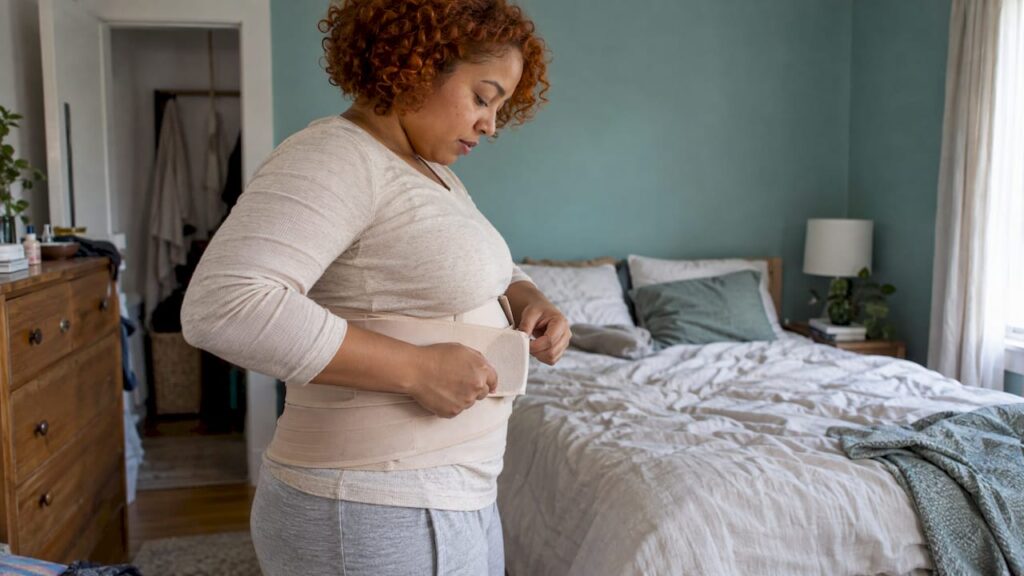
Abdominal binding after birth means wearing a wrap, band or binder around your belly for gentle support while your body recovers. Used lightly and for a limited time, it can make moving, sitting up and caring for your baby feel more comfortable. It will not close ab separation or shrink your waist, so think of it as a supportive friend, not a fix. Here is how to use one well, and what to ask your provider.
TL;DR
- A belly wrap can add stability and comfort, especially after a C-section, according to Cleveland Clinic.
- Wrap from the hips upward, aim for gentle compression, and take it off if you feel pain, numbness or pressure on your pelvic floor.
- Binding does not heal diastasis recti. Cleveland Clinic notes it can remind you to engage your core and use good posture.
- Ask your OB or midwife how long to wear one, and about a pelvic floor physical therapist if a gap remains.
Table of Contents
- What a postpartum belly wrap can and can’t do
- How to put on a belly wrap
- How long to wear it, and can you sleep in it?
- Binding after a C-section
- Checking for diastasis recti
- Does binding help ab separation?
- Our perspective on wraps and recovery
- Support beyond the wrap
- FAQ
- Sources
What a postpartum belly wrap can and can’t do
In the early days, your ligaments are still stretched and your uterus is still shrinking. Cleveland Clinic explains that a belly band can offer stability, support posture and help you feel more held together during that time.
One ob-gyn quoted in SELF compares it to pressing a pillow against your abdomen when you stand or sit up. That feeling of support may help you move around more as the days go by.
What it can’t do is just as important. Cleveland Clinic says a band won’t make your waist smaller or help you lose weight, and you don’t need to spend $100 on one that promises otherwise. Your body is doing something remarkable. It does not need to be shaped back.

How to put on a belly wrap
The direction matters. WebMD advises starting at the hips and wrapping up, because wrapping downward can push pressure toward the pelvic floor.
- Lie on your back or stand, whichever is comfortable.
- Start at your hips and wrap upward.
- Choose a wrap that sits under your ribs and above your hips.
- Check that you can take a full, deep breath.
- Aim for light compression. Pelvic floor experts quoted by Care.com say to tighten just enough for gentle support and no more.
Pro Tip: Waist trainers are rigid and restrictive, so they are not postpartum tools, as one pelvic floor practice explains.
How long to wear it, and can you sleep in it?
Sources vary a little. Healthline reports that experts suggest wearing wraps for about 2 to 12 weeks, since extended wear can have adverse effects. After a C-section, one hospital recovery guide advises 6 to 8 weeks.
For sleep, Cleveland Clinic recommends not keeping it on for long stretches overnight. Wearing it all day, every day, may also keep your muscles from re-engaging naturally.
Take it off right away if you notice pain, too much pressure, poor circulation, or itching or a rash, per WebMD. Tell your provider about any feeling of heaviness or pressure in your vagina.
Questions to ask your provider:
- How long should I wear a binder, given how I delivered?
- Is it okay to wear one if my incision looks red or is separating? (The Care.com article advises speaking with your provider first in that case.)
- Which style fits my body?
Binding after a C-section
Recovery after cesarean takes about six weeks, and Cleveland Clinic notes an abdominal binder can add support and avoid stress on sutures. SELF reports that ACOG recommends binders for incision pain, and that studies found less pain among moms who used them.
The same hospital guide suggests wearing it while upright and moving, not lying down or sitting, and pairing it with diaphragmatic breaths. Its job is to support, not flatten.
If you’re planning a cesarean, see our 48 to 72 hour breastfeeding plan after cesarean and our guide to skin to skin after a cesarean.
Checking for diastasis recti
Diastasis recti is a separation of the abdominal muscles. A 2026 systematic review reports it persists in up to 60% of women postpartum, so you are far from alone.
A common at-home check, described by Banner Health:
- Lie on your back, knees bent, feet flat.
- Place fingers just above your belly button.
- Lift your head and shoulders slightly.
- Feel for a gap.
A gap wider than two finger widths should be confirmed by a provider. Ranges differ: one pelvic health practice says one to two fingers is generally within the normal range, and that tension matters as much as width. A two-finger gap with good tension may function better than a narrow one with none.
Statistic Spotlight: SELF reports that most cases resolve on their own within a few months. If you still see an obvious gap after eight weeks, WebMD suggests talking with your doctor, who will likely suggest physical therapy.
Does binding help ab separation?
Not on its own. A network meta-analysis in Scientific Reports found binders had moderate to low effectiveness in reducing the gap, while exercise that trains deep and superficial abdominal muscles together did better. Another 2026 review found structured exercise reduced the gap, with starting under three months postpartum doing better than waiting.
For movement, Banner Health lists pelvic tilts, deep breathing and bird dog as gentle options, and advises skipping sit-ups, crunches and heavy lifting early on. Cleveland Clinic adds that anything making your belly bulge, cone or dome is worth avoiding. Ask your provider when you’re cleared and whether a pelvic floor physical therapist is right for you.

Good posture supports healing too, and this piece on posture in recovery is a helpful companion read. Many parents also enjoy gentle, instructor-led core work later on, such as reformer Pilates classes, once cleared by their provider.
Our perspective on wraps and recovery
In my years supporting Bucks County families, from Newtown to Doylestown, I’ve seen how much a wrap can matter in the first weeks, and how often it gets oversold.
We see it as one small comfort inside a bigger plan: rest, nourishment, gentle breathing, help at home, and a provider who listens. At Serenity Doula, our approach is evidence-based and nonjudgmental, whether your birth was natural, medicated or surgical.
We’ll help you talk through questions for your OB or midwife, so you feel grounded in what’s right for your body, not pressured by a trend. You deserve to feel seen, not carried along alone.
Alexis Wallace
Support beyond the wrap
Recovery goes more smoothly with a plan. Our postpartum care is available in-home and virtually, and covers recovery for you and your newborn. You can also read how to create a postpartum care plan and what to expect from postpartum body changes.

If you’d like calm, high-touch guidance before and after your baby arrives, we’d love to hear from you. You can book a free consultation through our website.
FAQ
How long should you wear a belly bind postpartum?
Sources suggest roughly 2 to 12 weeks for most wraps, and some C-section guidance says 6 to 8 weeks. Wear it in comfortable stretches rather than constantly. Ask your provider what fits your recovery.
Can I sleep in my abdominal binder?
Cleveland Clinic advises against wearing it for prolonged periods overnight. Remove it if it causes pain or affects circulation. Your provider can advise on your situation.
How can I check for ab separation after birth?
Lie on your back with knees bent, lift your head and shoulders slightly, and feel above your belly button for a gap. If it measures more than two finger widths, ask a provider to confirm.
Can a belly wrap flatten my tummy after a C-section?
No. Its purpose is support and comfort for your incision and posture, not shaping. Gentle movement, rest and your provider’s guidance matter more.
Sources
- Should You Try Postpartum Belly Wrapping? (Cleveland Clinic)
- Diastasis Recti (Cleveland Clinic)
- C-Section Recovery Timeline and Aftercare (Cleveland Clinic)
- Postpartum Belly Wraps: Risks, Benefits, Types, and Safety (WebMD)
- Do Postpartum Belly Bands and Wraps Actually Help (SELF)
- Postpartum Belly Binding (Healthline)
- Postpartum belly binding (Care.com)
- The Postpartum Belly Band (The Vagina Whisperer)
- Cesarean Section Recovery (NM Health)
- Diastasis Recti (Banner Health)
- Diastasis Recti Self-Test (Radiant Pelvic Health)
- Non operative management of postpartum Diastasis Recti (PMC)
- Comparison of rehabilitation strategies (Scientific Reports)
- The Role of Posture in Recovery
- Reformer Pilates for Adults