
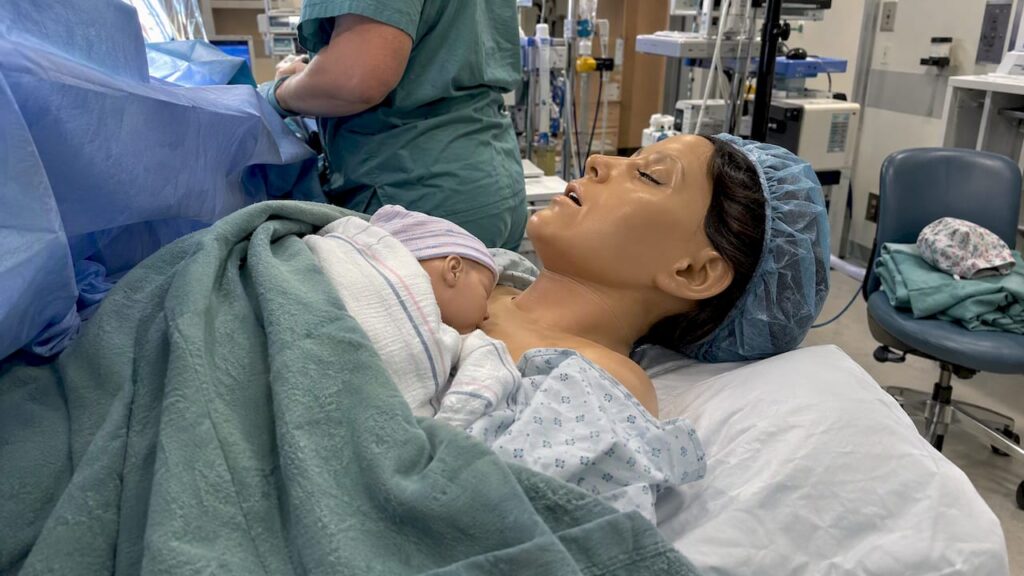
Yes, many families can hold their baby skin to skin after a cesarean, sometimes right in the operating room. It is not automatic everywhere, so it helps to know what the research says, what makes it safe, and what to ask your care team before the day arrives. You are not asking for a luxury. You are asking for something ACOG describes as feasible and evidence-based in the operating room.
TL;DR
- Skin to skin means your naked newborn rests on your bare chest. After a cesarean it can often begin in the OR or in recovery, depending on your hospital and how you and baby are doing.
- Research links it with better breastfeeding starts, and one 2025 trial found lower pain scores and higher satisfaction.
- Safety comes first: someone must watch baby’s airway and position the whole time, especially while you feel groggy.
- Ask your provider about your plan early, and write your preferences down so your support person can speak up for them.
Table of Contents
- What skin to skin after a cesarean looks like
- What the research says
- Keeping you and baby safe
- Questions to ask your provider before your cesarean
- Our perspective: what I see in the room
- After the OR: the first days at home
- How we can support you
- FAQ
- Sources
What skin to skin after a cesarean looks like
Skin to skin is simple. Your baby, dried and wearing perhaps a diaper and a hat, lies on your uncovered chest with a warm blanket over both of you. After a vaginal birth this usually happens within moments. After a cesarean, the team has more to do first: finishing the surgery, monitoring you, and checking baby.
That is why planning matters. Some hospitals place baby on your chest while you are still on the table. Others begin in the recovery area. Either can be a good experience. What you want to avoid is a default of “baby goes to the warmer, you go to recovery, and we will reunite you later” when nobody asked whether another way was possible.

If you deliver at Trinity Health St. Mary in Langhorne or another Bucks County or Mercer County hospital, policies and operating room habits differ between hospitals and even between surgeons. Ask. A kind, specific question usually gets a kind, specific answer.
What the research says
You deserve real numbers, not just encouragement. Here is what recent studies found.
Breastfeeding. ACOG notes that cesarean birth is associated with lower breastfeeding rates, and that skin to skin in the operating room is linked with less need for formula supplementation. A 2024 systematic review and meta-analysis found that immediate or early skin to skin after cesarean shortened the time to first attachment by about 52 minutes on average and increased breastfeeding within the first two hours.

Pain and satisfaction. In a 2025 randomized controlled trial, mothers who had immediate skin to skin after a cesarean reported significantly lower postoperative pain scores and higher satisfaction than those who did not. The researchers framed it as a humanization strategy, a way of softening the distance surgery can put between you and your baby.
Bonding and mood. A randomized trial in China that included skin to skin as part of a wider newborn care approach found enhanced attachment and a possible trend toward better postpartum mental health scores. That trend is a hint, not a promise, and the study was of a package of practices, not skin to skin alone.
Statistic Spotlight: Across the 2024 meta-analysis, early skin to skin after cesarean was associated with a relative risk of 4.86 for breastfeeding within the first two hours.
These are group results. Your own recovery, your baby’s needs and your medical situation will shape what is right for you. Your provider is the person to decide that with you.
Keeping you and baby safe
The dreamy photos leave out the most important part. Right after surgery you may be shaky, drowsy or nauseated from medication. A newborn on a drowsy parent needs a watchful adult.
Evidence Based Birth’s review of the research on skin to skin after cesarean points out that your level of awareness must be assessed and monitored by nursing staff. It also recommends teaching parents and doulas to spot warning signs such as pale or bluish color, labored breathing or limp tone.
Here is what safe usually includes:
- A clear airway. Baby’s head is slightly extended, with nose and mouth uncovered and visible, often called the sniffing position.
- A designated watcher. Your partner, a doula or a nurse has one job: watching baby’s face and breathing while you rest.
- Phones down. Photos can wait until the first hour or two has passed.
- A plan for stepping in. If you become too sleepy, someone can move baby to your partner’s chest right away.
Pro Tip: Ask your provider, “If I am too groggy to hold the baby safely, can my partner do skin to skin instead?” Many hospitals welcome this, and it is a lovely way to include a partner.
Questions to ask your provider before your cesarean
Whether your cesarean is planned or you simply want to be prepared in case, bring these to a prenatal visit. They are questions, not demands.
- Is skin to skin in the operating room possible at this hospital, and under what conditions?
- If not in the OR, how soon can it start in recovery?
- Can my support person or doula be with me, and who is allowed in the OR?
- Can the monitors and surgical drape be placed so baby can reach my chest?
- What would make you recommend baby go to the warmer first?
- What happens if baby needs extra care? Can we still have contact as soon as it is safe?
It helps to know what is happening in your body, too. ACOG explains in its cesarean FAQ that the incision passes through the skin and abdominal wall and the muscles are separated, so recovery takes real rest. Holding your baby is gentle, but you will need help with everything else.
Our perspective: what I see in the room
As a working doula, I have sat with many families who felt their cesarean meant they had “lost” the first hour. They had not. What changes the experience is rarely the surgery itself. It is whether someone planned for connection.
We prepare families in advance. We write down skin to skin preferences in plain language, talk through the safety steps so your partner feels confident, and practice what to say if plans shift. On the day, we are the calm voice holding the details so you can simply be with your baby. If baby cannot come to your chest right away, we remind you that bonding is built over weeks, not decided in a single hour. If you are worried about feeling connected, our guide on what to do if you do not feel bonded right away may help.
We also never judge. Planned, unplanned, medicated, surgical: every birth deserves support and respect.
— Alexis Wallace
After the OR: the first days at home
Skin to skin does not end in the hospital. Many parents keep doing it for weeks, and partners can too. It can settle a fussy baby and make feeding easier while your incision heals.
A few practical thoughts for the first days:
- Use pillows to protect your abdomen, and recline instead of sitting upright.
- Keep a helper nearby for lifting and positioning.
- Ask your provider which pain control and activity limits are right for you.
- Read our 48 to 72 hour breastfeeding plan after cesarean if you plan to nurse.
- If you want the basics first, our parent’s guide to skin to skin after birth covers positions and timing.
How we can support you
If you are planning a cesarean, or want to be ready for one, our pregnancy and birth doula support includes preparing your preferences, helping you speak with your provider, and being present on the day. Our childbirth education covers cesarean birth too, so surgical birth is never an afterthought. For recovery at home, we offer postpartum care, in person or virtual. Not sure what a doula does alongside your doctor or midwife? Start with what a doula does.
We serve families in Newtown, Doylestown and across Bucks and Montgomery Counties, with care in Philadelphia and Burlington Counties as well. If you would like to talk it through, we would love to meet you. Book a free consultation and tell us how you hope those first moments will feel.
FAQ
Can mom do skin to skin immediately after a C-section?
Often, yes. ACOG describes it as a feasible practice in the operating room. Whether it happens depends on your hospital, your health and your baby’s condition, so ask your provider early.
Does skin to skin after a C-section help with breastfeeding?
The research points that way. A 2024 meta-analysis linked early skin to skin after cesarean with faster first attachment and more breastfeeding in the first two hours. It does not guarantee an easy start, so extra feeding support is still worth having.
What if I cannot hold my baby right away?
Your partner or support person may be able to do skin to skin first, and you can begin as soon as you feel alert and your team agrees. Bonding keeps growing in the days that follow, and many parents catch up on skin to skin at home.
Is skin to skin safe when I am groggy from anesthesia?
It can be, with precautions. Baby needs a clear airway and an adult watching at all times, and your nurse should be monitoring how alert you are. Ask your provider and hospital what their process is.
Sources
- ACOG: Optimizing Support for Breastfeeding as Part of Obstetric Practice
- ACOG: Cesarean Birth FAQ
- Systematic review and meta-analysis: skin-to-skin contact and breastfeeding after cesarean (PubMed)
- Randomized controlled trial: skin-to-skin contact as a humanization strategy in cesarean delivery (PMC)
- Randomized trial of early essential newborn care after cesarean in China (PMC)
- Evidence Based Birth: The Evidence for Skin to Skin Care after a Cesarean