
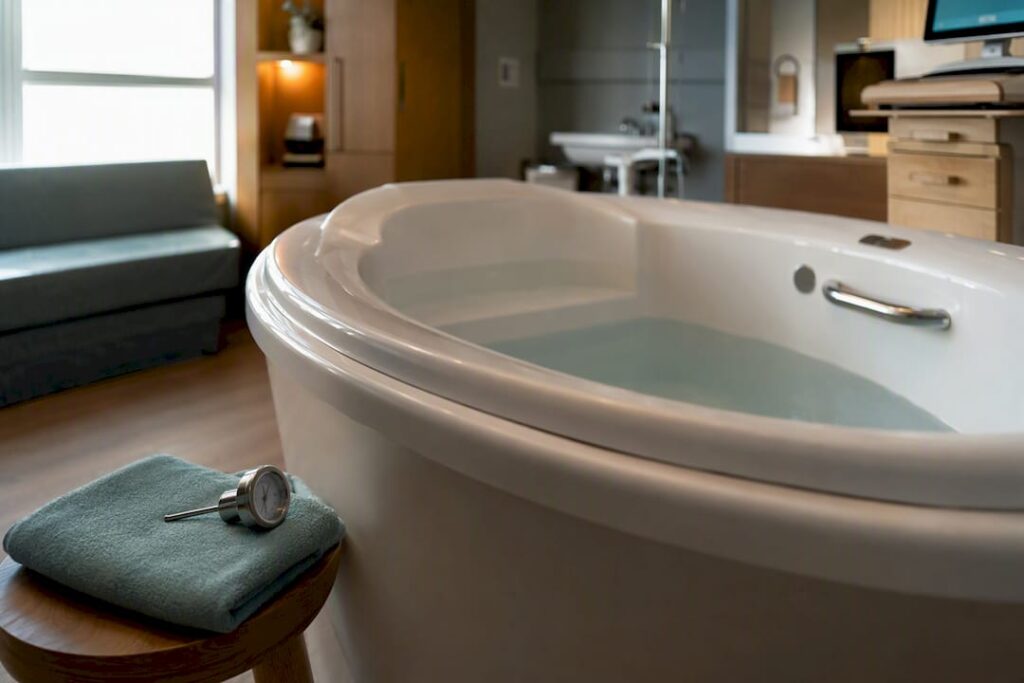
In Philadelphia, you can labor in water at several major hospitals and with home-birth midwives, but most hospital policies still ask you to get out of the tub before the baby arrives. The evidence supports water immersion for labor pain and progress, not necessarily for delivery itself. Your next steps: ask your hospital for its written hydrotherapy policy, book a consult with a doula who knows local protocols, and decide early whether a home or birth-center water birth fits your risk profile.
TL;DR:
- Water immersion during labor can shorten the first stage and reduce epidural rates but has no proven benefit for the baby during delivery.
- Hospitals in Philadelphia typically allow labor in water but generally require delivery to occur on land, with policies subject to change and protocol specifics.
- Home water births require low-risk pregnancies, careful planning, and a clear transfer plan to a hospital if needed, with costs often out-of-pocket and insurance coverage varying.
- Confirm availability of tubs, protocols for moving from water to land, and emergency transfer details at your chosen hospital before you plan to use water for labor.
- Support from a knowledgeable doula and clear communication with providers greatly enhance water birth experiences, whether at a hospital or at home.
Table of Contents
- What Is Water Birth Philadelphia Families Are Actually Asking About?
- How Do Philadelphia Hospitals Handle Water Labor Policies?
- What Does Home Water Birth Near Philadelphia Involve?
- What Does Water Labor and Home Birth Cost in Philadelphia?
- How Do You Choose Providers for Water Labor Support?
- What I Do to Prepare Families for Water Labor
- Who Provides Water Birth Support in Philadelphia?
- What Postpartum Care Looks Like After a Water Birth
- An Editorial Take on Water Birth Planning in Philadelphia
- How Serenity Doula Supports Your Water Labor Plan
- Sources
- FAQ
What Is Water Birth Philadelphia Families Are Actually Asking About?
Most people say “water birth” when they mean two different things, and the distinction matters more than it sounds. Laboring in water, sometimes called hydrotherapy, means using a tub or pool during contractions, usually in the first stage of labor before you’re fully dilated. Delivering in water means the baby is actually born underwater, which is a different clinical situation entirely.
The American College of Obstetricians and Gynecologists supports offering immersion during first-stage labor for low-risk patients, but its committee opinion stops short of endorsing water delivery. ACOG points to insufficient evidence of newborn benefit and recommends birth happen on land.
The research backs a specific, narrower benefit than most marketing suggests:
- Water immersion during labor may shorten the first stage and reduce your odds of needing an epidural, according to systematic-review evidence.
- Trials show inconsistent results on other maternal outcomes.
- No study has shown a clear benefit to the newborn from being born in water.
- Rare but serious neonatal complications have appeared in case reports, which is why ACOG calls for strict facility protocols wherever immersion is offered.
Pro Tip: Ask your provider directly, “Do you support labor in water, delivery in water, or both?” The answers are not interchangeable, and a “yes” to one doesn’t mean yes to the other.
How Do Philadelphia Hospitals Handle Water Labor Policies?
Big local systems generally treat water immersion the same way ACOG does: welcome it for labor, redirect you to land for delivery. Penn Medicine’s Pennsylvania Hospital lists hydrotherapy tubs in some of its private birthing suites alongside standard pain-management options and NICU backup. Jefferson Health advertises similar setups, with private suites, hydrotherapy tubs at select facilities, and midwifery and doula support built into its maternity care.
Before you assume a hospital’s tub means a water delivery, confirm three things directly with labor and delivery staff:
- Whether a hydrotherapy tub is actually available on the unit you’d be assigned to, not just pictured on the website.
- What the protocol is for moving from tub to bed once you’re fully dilated, and how much notice you’ll get.
- What their NICU transfer capacity and emergency response time look like if something unexpected comes up.
Policies shift, staff turn over, and a tub advertised online isn’t a guarantee it will be open the night you arrive. Call ahead, ideally during a tour or prenatal visit, and get the answer in writing if you can.
What Does Home Water Birth Near Philadelphia Involve?
Home water birth and birth-center water birth work differently from a hospital stay, both in setup and in who’s watching over you. A midwife typically brings or advises on a birthing pool, and you or your support team handle filling, heating, and cleaning it, often with guidance on water temperature and hygiene built into your prenatal appointments.
Eligibility is not a formality. Midwives attending home water births generally require:
- A low-risk pregnancy with no major complications
- Term gestation, usually 37 weeks or beyond
- A baby in head-down (cephalic) position
- A clear, pre-arranged transfer plan to a hospital if labor stalls or risk factors emerge
Water temperature is monitored throughout labor, and most midwives keep continuous or frequent checks on your vitals and the baby’s heart rate even in a home setting. For a broader comparison of hospital, birth center, and home settings, this guide to birthing environments walks through the tradeoffs in more detail.
Pro Tip: Many transfers from home labor to a hospital happen for unremarkable reasons, like slow progress or a request for an epidural, not emergencies. Planning your transport route and knowing your backup hospital’s intake process ahead of time turns a stressful moment into a smooth one.
What Does Water Labor and Home Birth Cost in Philadelphia?
Costs vary more than most people expect, and insurance behaves differently depending on where you give birth. Doula fees in the Philadelphia area vary widely depending on experience and package inclusions, with some doulas charging higher rates for specialized services. Home-birth midwifery services often run higher, reflecting the extended prenatal, birth, and postpartum care midwives provide outside a hospital system.
A few things to keep in mind as you budget:
- Hospital hydrotherapy is typically bundled into your standard labor and delivery care, not billed separately.
- Home birth and freestanding birth-center fees are frequently out-of-pocket or only partially reimbursed, depending on your plan.
- When you call your insurer, ask specifically about coverage for licensed midwife services and out-of-network reimbursement, since many plans handle home birth differently from hospital birth.
- Request the exact CPT and diagnosis codes your provider will bill under, then confirm those codes against your plan’s coverage before labor day, not after.
How Do You Choose Providers for Water Labor Support?
Choosing who supports your water labor is as much about communication style as it is about credentials. Start with your hospital or birth center:
- Confirm tub availability on the actual unit and shift you’d likely be assigned to.
- Ask their explicit policy on second-stage immersion, since “we have a tub” doesn’t mean delivery in it is permitted.
- Ask about tub cleaning protocols between patients and how often staff have supported water labor in the last year.
Then turn the same scrutiny toward your midwife or doula:
- Ask how many water labors they’ve personally supported and what their role is during tub setup and monitoring.
- Confirm they have a clear, rehearsed transfer plan if you need to move to a hospital.
- Ask who monitors water temperature and how often, since comfort and safety both depend on it staying in a safe range.
Walk away if a provider can’t describe a transfer plan, gives vague answers about monitoring, or bristles when you bring up the ACOG evidence. A confident, evidence-literate provider will welcome the question, not deflect it.
What I Do to Prepare Families for Water Labor
As your doula, I oversee tub setup, keep an eye on water temperature, and stay alert to hygiene details most families never think to ask about. I also advocate for your preferences in real time and coordinate with your clinician if a transfer to land or to the hospital becomes necessary. Before labor, we walk through your hospital’s actual written policy together and build your questions into your prenatal visits, so nothing about water labor feels like a surprise on the day.
— Alexis Wallace
Who Provides Water Birth Support in Philadelphia?
Finding the right team for water labor in Philadelphia means combining a hospital or birth center with the right philosophy, a midwife if you’re planning a home birth, and a doula who bridges the two. Rather than a single directory, think of your search in three tiers.
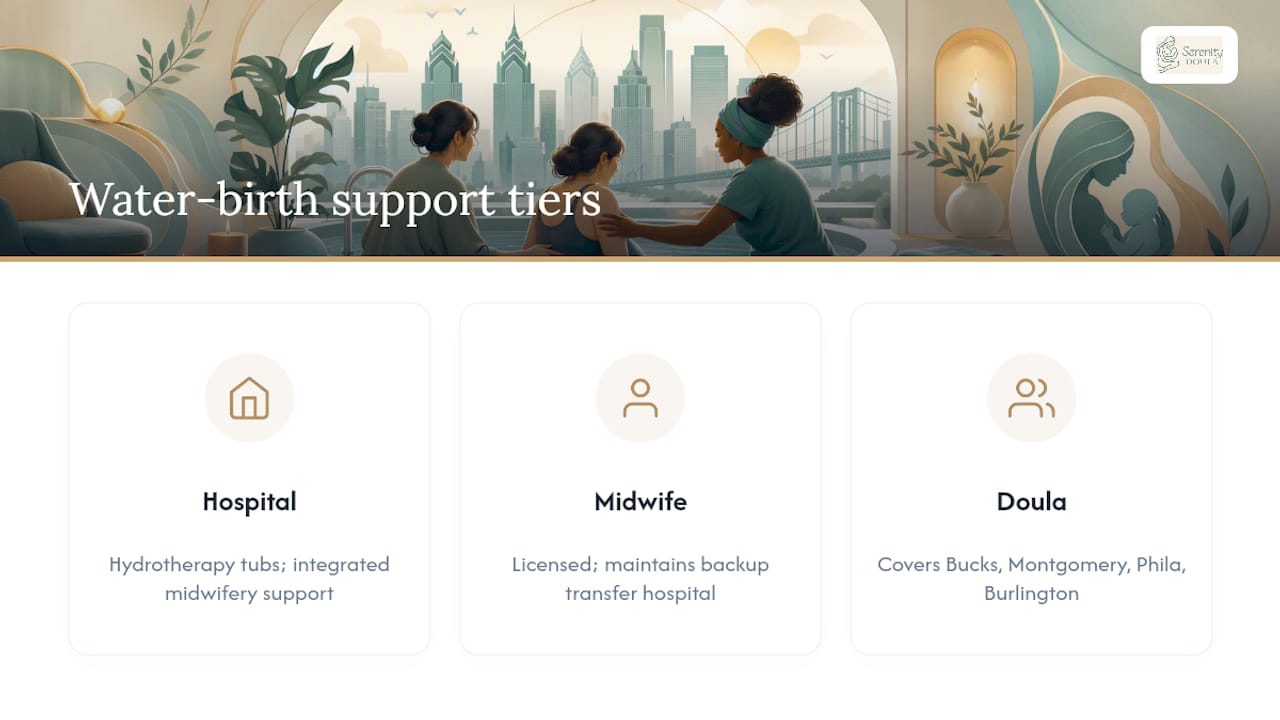
Hospital systems offering hydrotherapy tubs in at least some birthing suites include Penn Medicine’s Pennsylvania Hospital and Jefferson Health facilities, both of which pair hydrotherapy options with integrated midwifery and doula support. Temple Health’s maternity units also commonly offer hydrotherapy for labor comfort, though tub availability and protocols vary by campus and should be confirmed directly.
Licensed home-birth midwives practicing in and around Philadelphia typically work independently or in small group practices, and most maintain formal relationships with a backup hospital for transfers. When you’re vetting one, ask for their state license number, their transfer hospital, and how many water births they’ve attended in the past year.
Doulas fill the gap between clinical care and your actual experience in the room. A doula can serve families across Bucks, Montgomery, Philadelphia, and Burlington Counties, and work alongside whichever hospital, birth center, or home-birth team you choose. A doula’s job isn’t to replace your OB or midwife. It’s to make sure your preferences translate into specific, answerable questions for whoever is catching your baby.
If you’re still deciding between a midwife and an OB for your overall care, this comparison of doula and midwife roles breaks down how each fits into a water-labor plan.
What Postpartum Care Looks Like After a Water Birth
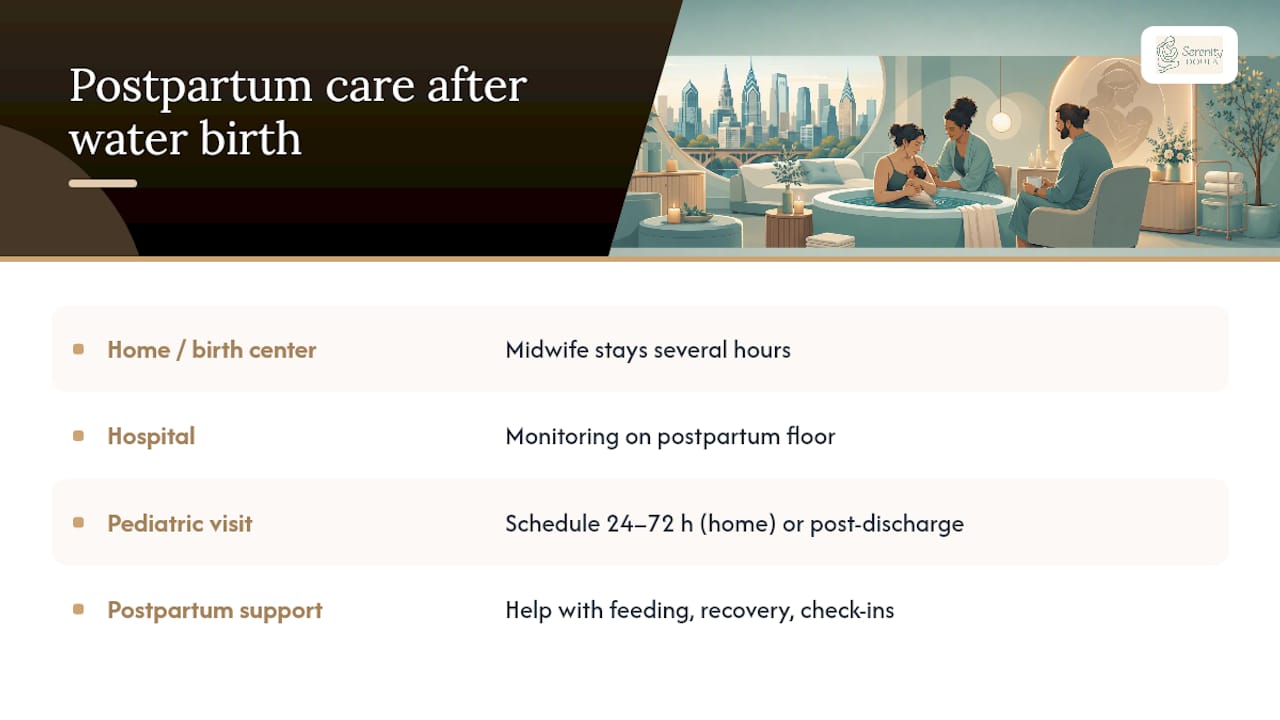
Recovery after a water birth follows the same general timeline as any vaginal birth, but a few details are specific to the setting. If you delivered at home or at a birth center, your midwife typically stays for several hours after birth to monitor bleeding, help with the first latch, and confirm the baby is transitioning well before heading home. Hospital water-labor patients usually have this initial monitoring built into standard postpartum floor care.
Pediatric follow-up matters regardless of where you gave birth. Philadelphia families have strong options for early newborn care, including Children’s Hospital of Philadelphia’s outpatient network and a wide range of independent pediatric practices throughout Bucks, Montgomery, and Philadelphia Counties. Schedule that first pediatric visit, usually within 24 to 72 hours of a home birth or shortly after hospital discharge, before labor day if you can. It’s one less decision to make while you’re exhausted and adjusting.
Postpartum support in the first weeks looks different for every family, but common needs after any birth, water or otherwise, include help with newborn feeding, physical recovery, and simply having someone check in who isn’t a stranger reading your chart for the first time. In-home postpartum care can cover everything from newborn care education to helping you rest while someone else handles the details. If you delivered at home, ask your midwife directly what her practice’s postpartum visit schedule looks like and how she coordinates with your chosen pediatrician.
An Editorial Take on Water Birth Planning in Philadelphia
The conventional advice on this topic tends to oversell water birth as a single package: pick it, and you get pain relief, a shorter labor, and a gentler entry into the world for your baby. The evidence doesn’t support that framing. Water immersion during labor has a real, modest benefit backed by systematic review, mostly around comfort and reduced epidural use. Delivery in water is a separate decision with thinner evidence behind it, and ACOG is candid about that gap.
What gets lost in most guides is how much this decision depends on logistics, not just preference. A hospital’s tub means little if their protocol pulls you out at nine centimeters. A home birth sounds appealing until you’ve priced out what your insurance will and won’t reimburse. Prioritize the policy conversation before the packing list. Call your hospital, ask your midwife pointed questions, and bring a doula into the planning early enough that she can help you interpret what you hear back.
— Alexis Wallace
How Serenity Doula Supports Your Water Labor Plan
Serenity Doula is the direct, high-touch alternative to piecing together your birth plan alone. Rather than guessing at hospital policy or navigating home-birth logistics without a guide, you get a Bucks County doula who has spent years translating exactly this kind of research into a plan built around your hospital, your midwife, and your preferences.

A free consultation with Serenity Doula covers your hospital’s hydrotherapy policy, your birth preferences for water labor or home birth, and a realistic look at what to prepare for either path. Serenity Doula offers Pregnancy & Birth Doula support, personalized childbirth education, and in-home postpartum care for families throughout Bucks, Montgomery, Philadelphia, and Burlington Counties, including areas around Newtown, Doylestown, and facilities like Trinity Health St, Mary. Before you finalize a hospital or home-birth plan, pack your hospital bag with help from this hospital bag checklist, and get started with a free consultation to talk through your specific water-labor questions.
This article is general information, not a substitute for advice from a qualified doctor. Consult a qualified healthcare professional about your own circumstances before acting on anything here.
Sources
- Immersion in Water During Labor and Delivery | ACOG
- Immersion in water during labour and delivery — PubMed
- Labor and delivery at Pennsylvania Hospital | Penn Medicine
- Obstetrics and maternity care | Jefferson Health
FAQ
Do Any Hospitals Allow Water Birth?
Most Philadelphia-area hospitals allow labor in water but ask patients to move to a bed for delivery, following ACOG’s recommendation that birth occur on land. True water delivery is more common through home-birth midwives or select birth centers.
Which Hospital in Philadelphia Is Best for Giving Birth With Water Labor Options?
Both Penn Medicine’s Pennsylvania Hospital and Jefferson Health facilities offer hydrotherapy tubs in select birthing suites with integrated midwifery support. The right fit depends on your specific birth preferences, so confirm tub availability and policy directly with each hospital.
How Much Does a Water Birth Cost in the USA?
Doula fees in the Philadelphia area vary widely depending on experience and package inclusions, with some doulas charging higher rates for specialized services, while home-birth midwifery fees tend to run higher due to extended prenatal and postpartum care. Hospital hydrotherapy is usually included in standard labor and delivery charges rather than billed separately.
Will Insurance Cover a Water Birth?
Hospital hydrotherapy for labor is generally covered as part of standard labor and delivery care, but home-birth midwifery and doula services are often out-of-pocket or only partially reimbursed. Call your insurer before labor, ask specifically about licensed midwife coverage, and request the CPT codes your provider plans to bill under.
What Does Serenity Doula Charge for Birth Support?
Current pricing for Serenity Doula’s Pregnancy & Birth Doula services is available directly on the site, since packages vary based on your specific needs and timeline. A free consultation is the fastest way to get a clear answer for your situation.