

Aim to start your doula search by late first to early second trimester if you want a birth doula, and start thinking about postpartum support during pregnancy rather than after your baby arrives. ACOG points to this window because experienced doulas book months out, and earlier hires simply have more time to build trust before labor day. That said, later hires are still possible. Even families who reach out at 36 weeks or already have a due date on the calendar have real options, including Serenity Doula.
TL;DR:
- Hiring a doula between late first and early second trimester maximizes the chances of securing experienced support and building rapport before labor.
- Late bookings after 36 weeks limit choices to doulas with lighter caseloads, but last-minute options like condensed prep or virtual support still exist.
- Postpartum doulas should ideally be booked during pregnancy, around 20 to 28 weeks, to ensure availability and proper integration into postpartum care.
- The quality and outcomes of doula support depend more on prenatal contact duration than on reaching a specific gestational week; early, substantive meetings are key.
- Hospital policies on doula access vary, so confirming support policies beforehand helps prevent surprises during delivery.
Table of Contents
- When to Hire a Doula: A Trimester-by-Trimester Guide
- When to Book a Postpartum Doula, and Why the Timing Differs
- Why Timing Actually Shapes Your Birth Experience
- Your Doula Hiring Timeline: When to Search, Interview, and Sign
- What Doula Care Costs and What Your Contract Should Cover
- Hospital and Birth Center Policies That Affect Doula Attendance
- Hired Late? Realistic Options Close to Your Due Date
- How I Schedule Clients, and Why I Recommend Booking Early
- Where Standard Advice on Doula Timing Falls Short
- Ready to Book? Here’s What Working With Serenity Doula Looks Like
- Sources
- FAQ
When to Hire a Doula: A Trimester-by-Trimester Guide
Timing isn’t one fixed date. It shifts depending on how far along you are, how in-demand your preferred doula is, and how much prep time you want before your due date. Here’s what to expect if you’re searching now, whatever week you’re in.
Late first trimester to early second trimester (late first to early second trimester)
This is the sweet spot, and for good reason. ACOG’s own guidance flags this window because it’s when most doulas still have open calendars, especially the ones with years of experience and strong local reputations… Search now and you’ll typically have:
- Your pick of experienced doulas rather than whoever happens to be free
- Time for multiple prenatal visits, which is where real rapport gets built
- Room to swap doulas if the first match doesn’t feel right, without panic
Mid to late second trimester (20 to 28 weeks)
You still have solid options here, but the easy breathing room starts to shrink. Popular doulas in Bucks County and the greater Philadelphia area often book well in advance. If you’re at 24 weeks and just starting to look, move with a bit more urgency. Schedule interviews within one to two weeks rather than letting them drift.
Third trimester (28 to 36 weeks)
Searching now means fewer choices, but it does not mean no choices. Some doulas keep a lighter caseload specifically to accommodate later bookings, and cancellations happen. What matters most at this stage is speed: ask directly whether a doula is available for your due date before you invest time in a full interview. If she’s booked, ask for referrals. Reputable doulas usually know who else has openings.
Near 36 weeks, or already in labor
This is the tightest window, but it isn’t a dead end. Some doulas offer condensed prenatal preparation, sometimes a single intensive session covering comfort measures, advocacy, and what to expect. A handful offer virtual, on-call support for families who can’t secure in-person coverage in time. It’s not the same as months of relationship-building, but it beats going in without any support at all.

Pro Tip: If you’re past 32 weeks and haven’t started looking, call rather than email. Doulas juggling multiple due dates often respond to phone calls faster, and a five-minute conversation tells you more about availability than a week of back-and-forth messages.
When to Book a Postpartum Doula, and Why the Timing Differs
Postpartum doula hiring timing differs from birth doula hiring and is often considered during pregnancy or early postpartum. Birth doulas get hired around a due date. Postpartum doulas get hired around a return home date, which is harder to plan for and easier to underestimate.
The smart move is securing postpartum support during pregnancy, ideally by the same 20 to 28 week window you’d use for a birth doula. Here’s why families do it that way:
- Overnight and daytime postpartum doulas with strong reputations fill their calendars early, just like birth doulas
- Arranging care before delivery means no one is scrambling to research options during the newborn haze
- You can build the schedule around realistic recovery needs instead of guessing after the fact
Postpartum doula support schedules vary with some families having multiple shifts per week initially, others using overnight support, or engaging doulas on-call as needed. None of these are one-size-fits-all, which is exactly why it helps to talk through the options before your baby arrives rather than after.
If you’re reading this postpartum and wishing you’d booked earlier, don’t panic. Short-notice postpartum support exists. Community doula programs, local postpartum agencies, and even hospital-affiliated resources at facilities like Trinity Health St. Mary can sometimes place a doula within days rather than weeks. It’s worth a phone call even if you assume it’s too late.
Why Timing Actually Shapes Your Birth Experience
The timing conversation isn’t just about calendar logistics. It connects directly to outcomes that ACOG and Cochrane researchers have studied for years.
Continuous one-to-one labor support, the kind a doula provides, is associated with real, measurable differences in birth experience. According to ACOG’s committee opinion on limiting intervention during labor, continuous support correlates with a lower cesarean rate and shorter labor duration on average according to ACOG’s committee opinion, along with higher reported satisfaction.
Continuous labor support has been associated with improved birth outcomes and no known harms, based on ACOG’s guidance on limiting interventions during labor.
Here’s the part that connects directly to your hiring timeline: those outcomes aren’t just about who shows up on delivery day. They’re shaped by what happens beforehand. Multiple prenatal visits give you time to establish trust, align on your preferences, and walk through what labor might actually look like for you, not a generic version of labor. A doula you met once in your ninth month knows far less about your specific fears, birth history, and communication style than one who’s spent three or four sessions with you.
It’s worth being honest about what the evidence doesn’t yet show. A PCORI systematic review found real benefits tied to doula support, including improvements in maternal anxiety and breastfeeding initiation, but also flagged significant gaps in the research when it comes to exact timing and dose. A more recent systematic review published through JAMA Network reached a similar conclusion: doula care shows consistent associations with better outcomes, but studies rarely report how much prenatal contact happened or when it started. So while nobody can hand you a precise formula (“three visits equals X% better outcome”), the practical takeaway holds up: more time together before labor tends to translate to better-prepared support during it.
Your Doula Hiring Timeline: When to Search, Interview, and Sign
Knowing the general window helps, but a concrete sequence helps more. Here’s how a search-to-contract timeline typically unfolds when you start at the recommended point.
- Weeks 10 to 14: Start researching. Ask your OB or midwife for referrals, browse local directories like DONA International’s database, and read reviews of a few Bucks County or Philadelphia-area providers.
- Weeks 14 to 18: Book two or three consultations. Most doulas offer a free initial call or meeting. Treat this like an interview, not a formality.
- Weeks 18 to 22: Compare, decide, and sign. Once you find the right fit, lock in your contract and deposit before that doula’s calendar fills further.
- Weeks 28 to 36: Attend your scheduled prenatal visits. This is where the real relationship-building happens, not just the paperwork.
- Weeks 36 and beyond: Confirm on-call details. Reconfirm phone protocols, backup coverage, and what happens if labor starts on a holiday or in the middle of the night.
When you’re actually in the interview seat, a handful of questions separate a strong match from a rushed decision:
- What is your on-call window, and how many other clients share it around my due date?
- Who is your backup doula, and have I met her or reviewed her experience?
- How many prenatal visits are included, and what do we cover in them?
- What is your policy for a birth that runs long, or one that ends in a transfer or cesarean?
- What certifications or training do you hold, and how many births have you attended?
Clinical overviews like Cleveland Clinic’s guide to doula care recommend asking exactly these kinds of questions before signing anything, precisely because vague answers here tend to predict problems later.
Compatibility matters just as much as credentials. Watch for how a doula responds when you ask a pointed question. Someone who gets defensive about backup plans or dodges questions about her cesarean rate experience is telling you something important. You want a doula who answers directly, even when the answer is “I don’t have a lot of experience with that yet, but here’s how I’d handle it.”
Pro Tip: Ask every doula the same five questions, in the same order, and write down the answers right after each call. It’s easy to remember how a conversation felt and forget the specifics, and the specifics are what actually differ between providers.
What Doula Care Costs and What Your Contract Should Cover
Fees vary based on region, experience level, and what’s included, but families in higher cost-of-living areas like Bucks County should expect birth doula packages to vary widely in cost, with postpartum care typically billed hourly or in blocks. What drives the range: years of experience, number of included prenatal visits, whether photography or placenta encapsulation is bundled in, and how large the doula’s service area is.
A solid contract, no matter who you hire, should spell out:
- The exact on-call window (usually a set number of weeks around your due date)
- Who the backup doula is and what her experience level looks like
- Cancellation and rescheduling terms, including what happens with early or late deliveries
- Number of included prenatal and postpartum visits, and what each one covers
- Payment structure, including deposit amount and final payment timing
If cost is a concern, ask directly about sliding scale pricing, payment plans, or community-based doula programs. Medicaid reimbursement for doula services is expanding in a growing number of states, and PCORI’s research on doula support specifically highlights this shift as a meaningful access point for families who couldn’t otherwise afford continuous support. It’s worth a quick call to your insurance provider to ask what’s covered before assuming it isn’t.
Hospital and Birth Center Policies That Affect Doula Attendance
Nothing derails a well-timed doula hire faster than discovering, on delivery day, that your birth site has a policy you didn’t know about. Facility rules on doulas vary more than most families expect.
Some hospitals classify doulas as part of your support team with no restriction beyond standard visitor limits, so it’s important to understand if your hospital performs paternity testing at birth and how their policies may affect your birth logistics. Others cap the total number of people allowed in a delivery room, which can force a choice between your partner, your doula, and other family. According to ACOG’s own guidance, policies differ enough between facilities that it’s worth confirming directly rather than assuming.
Before you finalize your birth plan, check:
- Whether your birth site counts a doula toward a visitor cap or treats her as separate support staff
- Whether your hospital or birth center requires advance notification or credentialing for outside doulas
- What the policy looks like if your birth shifts from a planned vaginal delivery to a cesarean
If you’re delivering at a facility like Trinity Health St. Mary or another Bucks County hospital, a quick call to labor and delivery well before your due date settles this. Bring your doula into the conversation with your OB or midwife early too. When your whole care team, doula included, is on the same page about your birth plan, coordination on the actual day goes far more smoothly than trying to introduce everyone for the first time mid-labor.
Hired Late? Realistic Options Close to Your Due Date
If you’re reading this at 37 weeks with no doula booked, take a breath. You still have workable paths forward, just fewer of them.
Some doulas offer condensed prenatal preparation designed specifically for late hires, sometimes a single two- or three-hour intensive covering comfort techniques, communication strategies, and what to expect. It’s not the same depth as months of visits, but it gives you and your doula enough shared understanding to work well together.
- Ask any doula you contact whether she offers a late-booking or intensive package
- Look into hospital-affiliated or community doula programs, which sometimes have more flexible last-minute availability
- If a birth doula truly isn’t available, prioritize postpartum-focused support instead, since that window is often easier to fill on short notice
- Use the time you do have to prepare your birth partner directly, walking through comfort measures and your preferences together
Pro Tip: If you can’t find in-person coverage in time, ask about virtual or phone-based doula support. It’s not a full substitute for someone in the room, but a doula coaching your partner through contractions by phone is far better than facing early labor with no outside guidance at all.
How I Schedule Clients, and Why I Recommend Booking Early
Families often ask me why I push the 12 to 20 week window so hard. Here’s my honest answer: it’s not about urgency for urgency’s sake. It’s that the families who start early get three or four prenatal visits instead of one, and that difference shows up in the delivery room.
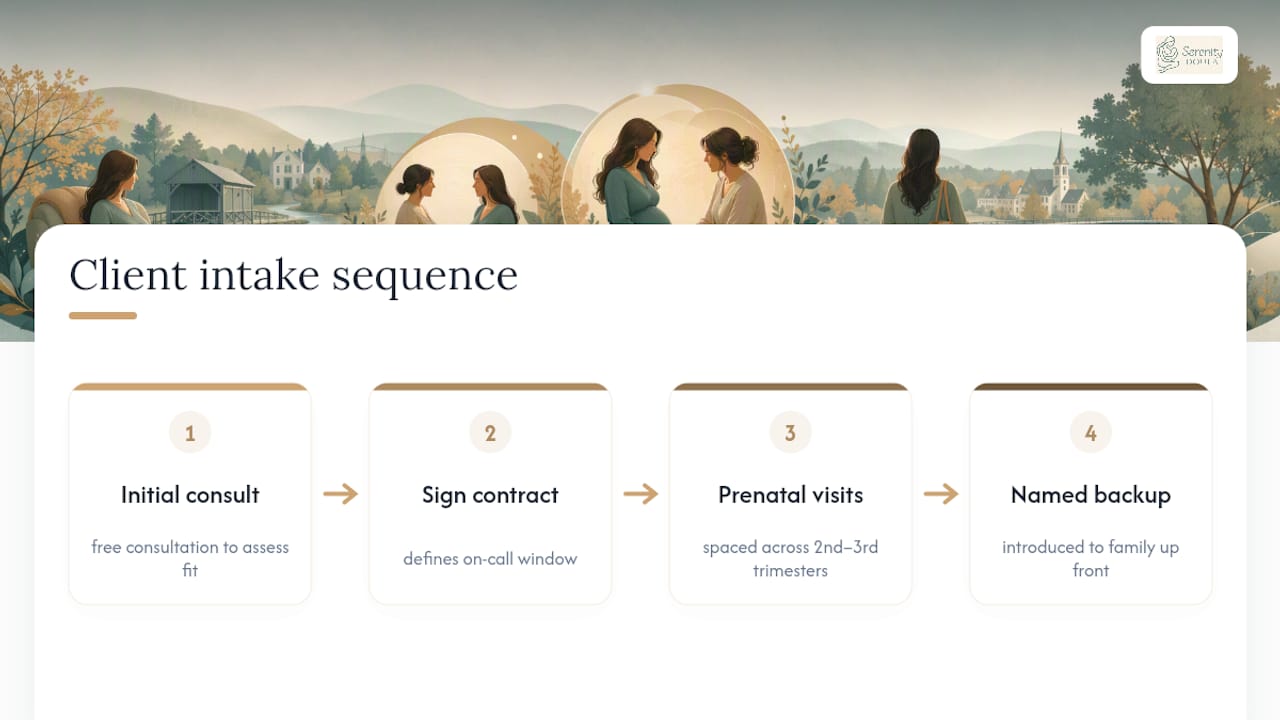
My intake process typically includes an initial consultation, a signed contract with a defined on-call window, and a series of prenatal visits spaced through the second and third trimesters. Backup coverage is always named and introduced, never a mystery you discover at 2 a.m.
I do work with families who reach out later. A client who called at 34 weeks last year got a condensed two-visit prep plan instead of four, and it worked because we moved fast and stayed focused on what mattered most for her specific birth history. Late isn’t ideal, but it’s rarely too late.
If you’re anywhere in your pregnancy and wondering where you stand, a free consultation with Serenity Doula is the easiest way to find out.
Where Standard Advice on Doula Timing Falls Short
Most articles on this topic hand you a single number, “book by 20 weeks,” and call it done. That’s not wrong, but it’s incomplete. The research actually supports something more specific: it’s not the calendar date that drives better outcomes, it’s the number of substantive prenatal touchpoints you get before labor starts.
A family who books at 22 weeks but has four real conversations with their doula is often better prepared than a family who signed a contract at 14 weeks and then didn’t hear from their doula again until 38 weeks. Timing matters because it buys you the opportunity for preparation, not because there’s something magic about a specific week.
Where I’d push back on conventional wisdom: don’t chase the earliest possible booking just to check a box. Chase the doula who will actually use that time well, someone who schedules real visits, answers your questions thoroughly, and treats the prenatal period as relationship-building rather than paperwork. A rushed early hire with a distracted doula helps you less than a thoughtful hire at 24 weeks with someone who shows up fully present.
— Alexis Wallace
Ready to Book? Here’s What Working With Serenity Doula Looks Like
Serenity Doula gives Bucks County families the kind of high-touch, evidence-based support that a rushed, last-minute search rarely delivers, birth doula care built around real prenatal relationships, postpartum packages that start before your due date rather than after, and private childbirth education classes tailored to your actual questions instead of a generic curriculum.
When you reach out, your consultation walks through your due date, your birth site (whether that’s Trinity Health St. Mary or another facility in Newtown, Doylestown, or greater Bucks County), and what kind of support fits your family. From there, reserving your on-call window is straightforward: a signed service agreement outlines your prenatal visit schedule, backup coverage, and postpartum options, so nothing is left vague. Families who want more preparation before labor often pair a birth doula package with private childbirth education, building both the relationship and the knowledge base at the same time.
If you’re unsure whether now is the right time to start, it usually is. Schedule a free consultation with Serenity Doula and find out what your options look like at exactly the week you’re in.
This article is general information, not a substitute for advice from a qualified doctor. Consult a qualified healthcare professional about your own circumstances before acting on anything here.
Sources
- I’m an Ob-Gyn. Here’s Why I Had a Doula Help With My Delivery. | ACOG
- Impact of doula support during pregnancy, childbirth, and beyond: systematic review | PCORI
- Systematic review: doula support during pregnancy, childbirth, and postpartum
- Doula – Cleveland Clinic
FAQ
How far in advance should I hire a doula?
Aim for late first to early second trimester for a birth doula, since ACOG notes experienced doulas often book months ahead. Postpartum doulas are worth arranging around the same window or by the third trimester at the latest.
How do I know if I need a doula?
If you want continuous emotional and physical support through labor, help communicating with your care team, or extra hands during the postpartum weeks, a doula fills a role your OB, midwife, or nursing staff typically can’t cover alone. Ask your provider whether continuous labor support fits your specific birth plan.
How much should I pay my doula?
Birth doula packages vary widely in cost depending on experience and region, with postpartum care usually billed hourly or in blocks. Ask about sliding scale options or community programs if cost is a barrier, since Medicaid coverage for doula services is expanding in some states.
What are the pros and cons of hiring a doula?
The documented benefits include lower cesarean rates, shorter labor, and higher satisfaction, according to ACOG’s committee opinion. The tradeoffs are cost and the need to plan ahead, since the best-matched, most experienced doulas book up early, which is exactly why earlier hiring tends to produce better outcomes.