

Co-parenting a newborn works best when partners chase fairness, not a stopwatch. Claim one repeatable task each, agree on a simple night plan before you’re too tired to negotiate one, and hold a two-minute daily check-in so nobody keeps a silent tally. Research on the transition to parenthood backs this up, and so does every family Serenity Doula has coached through the fourth trimester.
TL;DR:
- Assign specific tasks like bottle support, diaper stations, and laundry to reduce decision fatigue during the first week at home.
- Rotate nighttime responsibilities and prepare a go-bag with essentials to minimize exhaustion and streamline late-night cares.
- Use shared logs and block shifts for feeding and sleep to improve coordination and reduce disagreements about who did what.
- Practice calming techniques like the 90-second pause and check-ins to de-escalate conflicts without adding stress to exhausted partners.
- Seek early legal advice for formalizing parental rights and complete practical paperwork to prevent future co-parenting legal conflicts.
Table of Contents
- Your First-Week Co-Parenting Checklist
- How Do You Divide Newborn Care Fairly?
- What Sleep and Routine Strategies Actually Work?
- How Do You Communicate Without Escalating?
- When Should You Worry About Emotional Health?
- What Does a Doula Actually Do for Partner Teamwork?
- What Legal Factors Shape Co-Parenting Decisions?
- A Doula’s Honest Take on What Actually Helps
- Let Serenity Doula Help You Divide the Load, Not Just Survive It
- Sources
- FAQ
Your First-Week Co-Parenting Checklist
The first seven days home set the pattern for everything after. Instead of dividing tasks by gender roles or guesswork, claim specific jobs before exhaustion makes decisions harder.
- Bottle prep or pumping support: one partner owns the setup, cleaning, and restocking.
- Diaper station: stock two locations (bedroom and living area) so nobody hunts for supplies at 3 a.m.
- Visitor manager: one partner handles texts, timing, and politely ending visits that run long.
- Laundry rotation: newborn laundry piles up fast; assign it a day, not a “whenever.”
- Shared tracking tool: a feeding and sleep log app keeps both partners working from the same information instead of memory.
For nights, try a simple template: Partner A takes the first soothing pass until 1 a.m., Partner B takes over until sunrise, and whoever isn’t “on” wears earplugs and actually sleeps. Pack a small basket with snacks, phone charger, and burp cloths near the changing area so late-night runs downstairs aren’t part of the plan.
Pro Tip: Prep a “go bag” for 2 a.m. feeds: water bottle, snack, and a burp cloth, stashed right where you’ll be sitting. Small friction removed at 3 a.m. saves real energy.
How Do You Divide Newborn Care Fairly?

Couples who feel their division of labor is fair report lower parenting stress and higher relationship satisfaction, even when the actual split isn’t a precise 50/50. That finding matters more than most sleep-deprived partners realize: a rigid tally of who changed how many diapers tends to backfire, while a flexible sense of “we’re both showing up” holds relationships together.
A workable rubric looks like this:
- Assign by skill and energy, not gender default. If one partner is a deeper sleeper, they take the late shift; if one is better at swaddling, they own bedtime.
- Rotate the task everyone dreads. Whether that’s the 4 a.m. wake-up or the diaper blowouts, alternating prevents resentment from calcifying.
- Protect recovery windows fiercely. The birthing parent needs predictable stretches of uninterrupted rest, especially in the first two weeks, and protecting that window is one of the highest-impact things a partner can do.
A simple starter grid: diapering (default: whoever’s awake, swap anytime), feeding support (default: birthing parent for breastfeeding, partner for burping/settling after), and nighttime soothing (default: split by shift, swap if one partner has an early workday). The specifics matter less than agreeing on them out loud, ideally before the baby arrives.
What Sleep and Routine Strategies Actually Work?
Newborns don’t sleep like adults, and expecting otherwise sets couples up for frustration. Realistic goals focus on safety and feeding consistency, not a full night’s sleep by week three.
- Use a shared log. Apps that track feeding and sleep times help non-birthing parents participate meaningfully and cut down on “who did what” arguments by creating a neutral record both partners trust.
- Try block shifts instead of splitting every wake-up. One partner sleeps in a separate room for a four to five hour block while the other is “on,” then you switch.
- Practice paced handoffs. Whoever is ending their shift gives a thirty-second update (last feed time, mood, anything unusual) so the next partner starts informed, not guessing.
- Keep safe sleep non-negotiable. Ask your pediatrician about the current guidance on sleep positioning and room-sharing before you finalize any night plan.
Pro Tip: Set a “good enough” bar for the first six weeks: baby fed, baby safe, both adults got at least one four-hour stretch. That’s success, not a compromise.
How Do You Communicate Without Escalating?
Exhausted partners argue about small things because small things are all the bandwidth they have left. Co-regulation, the practice of calming each other’s nervous systems before problem-solving, works better than diving straight into logistics.
Try the 90-second pause: when tension spikes, stop talking about the issue and just breathe together or sit in silence for a minute and a half. It’s long enough for stress hormones to start settling, according to therapist-informed postpartum guidance. From there, use RAVE: Reflect back what you heard, Accept the feeling without arguing it, Validate that their exhaustion is real, and Explore a solution together.
- Run a two-minute daily check-in: “What was hard today, what worked, what do you need tomorrow?”
- Add a weekly five-minute planning talk to look at the coming week’s appointments, visitors, and shift swaps.
- Use repair language early: “I’m frustrated, not at you, at how tired we both are” defuses more than silence does.
- If a conversation gets heated, name it and pause: “Let’s revisit this after nap time” is not avoidance, it’s strategy.
When Should You Worry About Emotional Health?
Some sadness, worry, and overwhelm are normal in early parenthood. Persistent or severe symptoms are not something to push through alone.
- Mood swings that don’t ease after two weeks
- Persistent sadness, tearfulness, or numbness most of the day
- Anxiety that interferes with eating, sleeping, or caring for the baby
- Feeling disconnected from the baby or from your partner
- Any thoughts of self-harm or harming the baby
If symptoms are severe or you’re worried about safety, contact a medical provider or emergency services right away rather than waiting for a scheduled visit. For milder but persistent concerns, ask your OB or midwife about a postpartum depression screening (ACOG recommends screening at multiple points in the first year), and consider whether a therapist, a postpartum doula, or a local peer support group would help both partners, not just the one carrying the diagnosis.
What Does a Doula Actually Do for Partner Teamwork?
A postpartum doula isn’t there to replace a partner. She’s there to build that partner’s confidence faster than a book or a video ever could. Doula-led coaching pairs hands-on skills (soothing techniques, swaddle wraps, bottle prep) with relationship coaching, like how to actually ask for help without it feeling like failure.
- Bedside coaching on soothing techniques while the partner practices, not just watches
- Modeling calm responses during a hard crying stretch
- Teaching specific skills: swaddling, burping positions, safe bath routines
- Managing visitor logistics so the couple isn’t negotiating boundaries mid-exhaustion
- Coordinating referrals to lactation consultants, pelvic floor therapists, or mental-health support when needed
Doula support tends to matter most with a first baby, a harder physical recovery, limited family nearby, or when a couple senses strain building between them. Structured couple-focused programs measurably increase father involvement and satisfaction, and that same principle drives how in-home doula coaching works.
What Legal Factors Shape Co-Parenting Decisions?
Even married, cohabiting partners face practical legal questions worth settling before the baby arrives. Hospitals and pediatric offices typically require both parents’ names on file for medical decision-making, and unmarried partners may need to complete a voluntary acknowledgment of paternity or parentage form, depending on the state, to secure both legal parents’ rights.
Custody and legal parentage questions differ significantly for unmarried couples, same-sex couples using assisted reproduction, and blended families with children from previous relationships. If either partner isn’t the biological or legally recognized parent, an attorney can clarify what steps, like second-parent adoption or a parentage judgment, protect that relationship formally.
Beyond parentage, practical paperwork matters too: healthcare proxies, updated wills, and beneficiary designations on life insurance and retirement accounts often go untouched during pregnancy and then get overlooked entirely once a newborn arrives. A short conversation with a family law attorney, ideally before delivery, saves a lot of stress later. None of this replaces legal advice specific to your situation, but raising these questions early, alongside your care team and your attorney, keeps co-parenting logistics from colliding with legal gaps down the road.
A Doula’s Honest Take on What Actually Helps
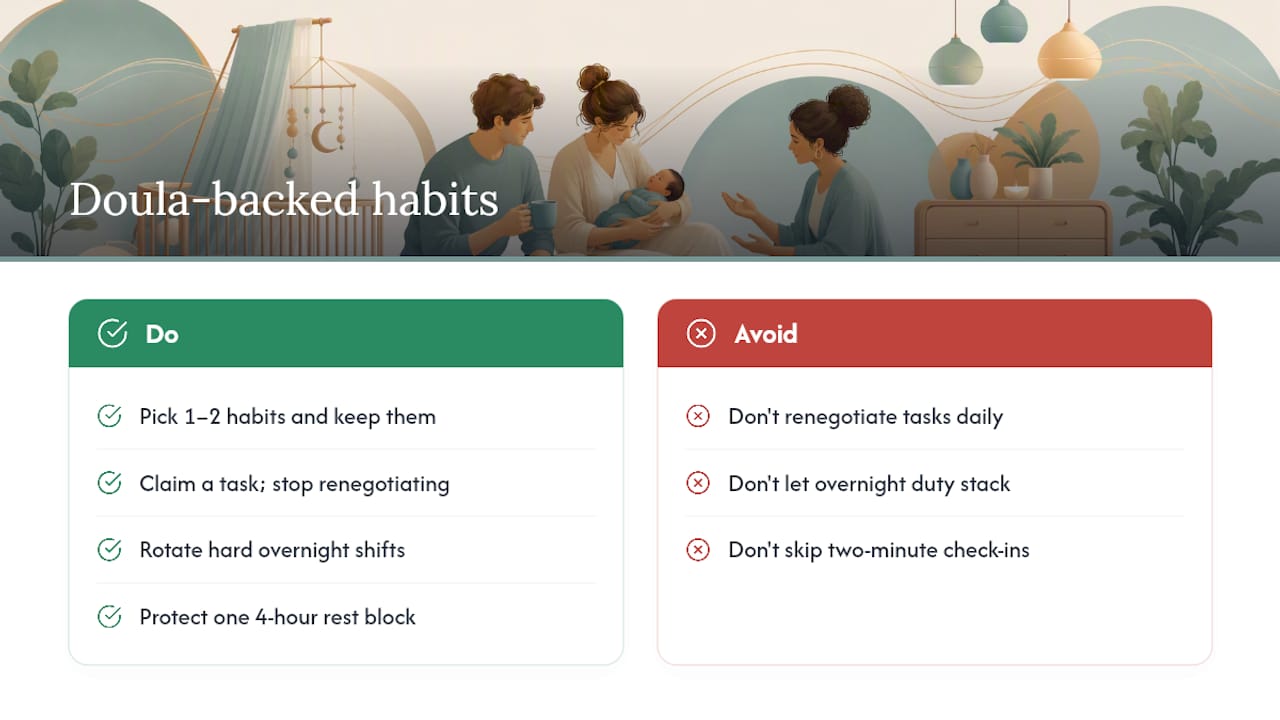
The couples who do best aren’t the ones with a perfect spreadsheet. They’re the ones who pick one or two habits and actually keep them: claim a task and stop renegotiating it daily, rotate who takes the hard overnight shift so resentment doesn’t build in one direction, and protect at least one four-hour rest block for the recovering parent no matter what.
One family I worked with in Bucks County almost gave up on their night plan by day four because it felt unfair in the moment. We adjusted it slightly, added the two-minute check-in, and by week two they told me the fighting had nearly stopped. Fairness isn’t a formula. It’s a feeling you build with small, repeated proof that both of you are showing up.
— Alexis Wallace
Let Serenity Doula Help You Divide the Load, Not Just Survive It
Serenity Doula gives Bucks County partners something a parenting app or a well-meaning relative can’t: a trained professional in your home, teaching both of you the skills and the communication habits that make co-parenting a newborn feel manageable instead of chaotic.

A free consultation covers your specific situation, birth history, recovery needs, and whether in-home or virtual postpartum support fits your family best, whether you’re near Newtown, Doylestown, or anywhere else in Bucks County. Services that directly support partner teamwork include hands-on postpartum doula care, partner-focused childbirth education classes that walk both of you through what the fourth trimester actually looks like, and the same step-by-step partner workflow referenced throughout this guide. If you’re also thinking ahead to pediatric care, early dental health guidance is worth a look once your baby’s first teeth start coming in.
Book your free consultation today and find out what a doula-led plan for your family could look like before the baby arrives.
Sources
- Prenatal Expectations and Postpartum Reality: How Gender Egalitarianism in Infant Care Division Shapes Parenting Stress and Relationship Functioning
- Couple-focused transition to parenthood programs improve father involvement and satisfaction
- B2H mHealth intervention supporting postpartum care and partner engagement
FAQ
What Is the Best Way to Co-Parent a Newborn?
Prioritize perceived fairness over a strict 50/50 split, claim specific repeatable tasks, and hold short daily check-ins; research shows fairness perception predicts satisfaction more reliably than exact task counts.
How Do We Split Nighttime Feedings Fairly?
Use block shifts rather than splitting every wake-up. One partner sleeps four to five uninterrupted hours while the other is “on,” then you switch, with a shared tracking app to hand off information without waking anyone unnecessarily.
What Are Warning Signs of Postpartum Depression in a Partner?
Watch for persistent sadness, severe anxiety, disconnection from the baby, or any thoughts of self-harm lasting more than two weeks; bring these to your provider promptly, or contact emergency services if safety is a concern.
When Should We Hire a Postpartum Doula?
Doula support helps most with a first baby, a difficult physical recovery, limited family help nearby, or visible strain between partners; a free Serenity Doula consultation can clarify if the timing fits your family.
How Can New Dads or Non-Birthing Partners Build Confidence Fast?
Hands-on coaching in soothing, swaddling, and bottle routines builds confidence faster than reading alone; see practical bonding tips for non-birthing partners for specific starting points.