

Pregnancy commonly shifts moods, intimacy, time, and roles between partners, but strong partner support and simple communication habits blunt most of the strain. Higher relationship quality during pregnancy predicts better psychological wellbeing through the transition to parenthood, and partner presence at birth correlates with a more positive birth experience. Start this week with one small move:
- Put a 15-minute weekly check-in on the calendar, no phones, no logistics talk allowed.
- Invite your partner to sit in on your next prenatal visit, even virtually.
Key Takeaways
Pregnancy reliably shifts emotional rhythms, intimacy, and household roles between partners, but early communication habits and shared prenatal involvement measurably soften the strain.
| Point | Details |
|---|---|
| Partner presence changes outcomes | Continuous partner support during labor correlates with a more positive birth experience and fewer interventions. |
| Decline isn’t universal | A meaningful share of couples, close to 46% in one study, retain high satisfaction throughout the transition. |
| Small habits beat big gestures | Weekly check-ins, shared prenatal visits, and explicit task-sharing reduce common conflict triggers. |
| Screen for mood and money stress | Prenatal depressive symptoms and financial strain predict worse marital satisfaction up to 52 weeks postpartum. |
| Structured support works | Serenity Doula pairs childbirth education and hands-on labor coaching to help both partners feel prepared, not just informed. |
Table of Contents
- Why Supportive Relationships Matter During Pregnancy
- Common Ways Pregnancy Changes a Marriage
- Practical Ways to Protect Your Relationship During Pregnancy
- When Do Pregnancy Relationship Changes Need Professional Help?
- Evidence Summary and a Doula’s Perspective
- Impact on Extended Family Relationships and Social Support
- Changes in Future Planning and Life Goals as a Couple
- Effects of Pregnancy Complications or High-Risk Pregnancies on the Marriage
- Cultural or Societal Expectations Influencing Marital Changes During Pregnancy
- Why Childbirth Education and Doula Support Help Couples Through Pregnancy
- Sources
- FAQ
Why Supportive Relationships Matter During Pregnancy
The evidence here is more specific than “communication is good.” Couples who report higher relationship quality during pregnancy show measurably better psychological wellbeing as they move into parenthood, and continuous partner presence during labor is linked to a higher chance of a low-intervention birth. The mechanism is what researchers call dyadic coping: when one partner absorbs some of the stress load, cortisol and anxiety responses in the other partner tend to soften, and decisions in the birth room get made from a calmer baseline rather than a reactive one.
That matters practically, not just emotionally.
- A partner who feels informed asks better questions during appointments.
- A mother who feels supported reports less fear going into labor.
- Couples who rehearse roles beforehand argue less in the moment.
Strengthening the relationship now is not a “nice extra” tacked onto pregnancy prep. It is groundwork that pays off twice: once during birth, and again during the sleep-deprived, identity-shuffling weeks after.
Common Ways Pregnancy Changes a Marriage
Most couples experience some combination of the following, and recognizing the pattern early is half the battle.
- Emotional volatility on different timelines. Hormonal shifts, physical discomfort, and the sheer weight of the unknown mean one partner may feel deeply bonded to the pregnancy by week 10 while the other is still processing that it is real.
- Communication pitfalls. Avoidance (“I don’t want to stress her out”) and silent assumptions (“he should just know I need help”) are the two most common conflict triggers a doula hears about in prenatal sessions.
- Intimacy shifts by trimester. Nausea and fatigue often reduce physical closeness early; body-image concerns and physical discomfort reshape it again in the third trimester. Neither partner’s shifting interest is a verdict on the relationship.
- Role and identity changes. The shift from “couple” to “parents” often exposes an uneven mental load. One partner researching pediatricians, tracking appointments, and reading every book is a common early flashpoint.
- Money and logistics stress. Nursery costs, insurance questions, and lost income during leave frequently surface as the loudest arguments, even when the real issue underneath is fear.
A systematic review and meta-synthesis of couples navigating the transition to parenthood found six recurring themes: an adjustment phase, an intense focus on the baby, communication shifts, intimacy changes, relational strain, and, importantly, relationships that came out stronger. Strain is common. It is not universal, and it is not permanent.
- Not every couple declines. One study tracking couples through this transition found that a substantial share, roughly 46%, retained high satisfaction and commitment throughout.
Practical Ways to Protect Your Relationship During Pregnancy
Small, repeatable habits outperform big gestures here. Try building in a few of these before the third trimester gets crowded:
- Run a 10-minute daily check-in: one high, one low, one thing you need from your partner tomorrow.
- Schedule a “non-baby” date once a week, even a 20-minute walk where the topic is banned.
- Keep a shared gratitude note, even three lines a week, to counteract the tendency to only notice friction.
- Bring your partner to at least one prenatal visit and one childbirth class so decisions feel shared rather than delegated.
- Negotiate household roles out loud, in specific terms (“you handle bottles and laundry, I handle diaper changes and pediatrician calls”) rather than assuming it will sort itself out.
Structured premarital and prenatal counseling topics can give couples a script for these conversations if they are struggling to start them alone. A brief antenatal prevention program tested in controlled research produced a meaningfully less steep decline in relationship satisfaction from pregnancy into postpartum compared with couples who didn’t take part, which tells you these conversations are trainable skills, not personality traits.
Pro Tip: Ask your partner one specific question before your next birth class: “What part of labor are you most nervous about supporting me through?” You’ll often learn something you didn’t know after months of being together.
Reviewing our step-by-step guide to supporting a partner through labor together, even once, tends to surface fears neither partner had said out loud yet.
When Do Pregnancy Relationship Changes Need Professional Help?
Normal adjustment looks like friction, tiredness, and the occasional short fuse. It should not look like any of the following:
- Frequent, intense fights that don’t resolve or that escalate week over week.
- Weeks of emotional withdrawal or stonewalling from either partner.
- Thoughts of self-harm or hopelessness, which warrant an immediate call to your provider or a mental-health professional.
- Any pattern of control, intimidation, or physical harm, which calls for a domestic violence hotline, not couples counseling.
Prenatal depressive symptoms, financial strain, and an uneven household burden all predict worse marital satisfaction through 52 weeks postpartum, which is exactly why screening early matters more than waiting to see if things improve on their own. Ask your OB or midwife about a mental-health screening at your next visit, and consider a couples therapist who specifically works with the perinatal period. A first session usually just maps what’s going well and where the pressure points are, no diagnosis required to walk in the door.
Evidence Summary and a Doula’s Perspective
The research converges on one point: pregnancy is a prevention window, not just a waiting period. Structured prenatal skills programs produce a measurably softer decline in satisfaction, partner presence at birth correlates with better outcomes, and most couples who put in the work retain strong relationships.
In ten years of prenatal sessions, the couples who do best aren’t the ones with zero conflict. They’re the ones who practiced saying the hard thing out loud before labor started, so it wasn’t the first time they’d done it under pressure.
A simple plan for this month:
- Pick one habit from the list above and commit to four weeks, not forever.
- Bring one fear each to your next check-in instead of solving it alone.
— Alexis Wallace
Impact on Extended Family Relationships and Social Support
Pregnancy rarely stays contained to two people. Parents, in-laws, and close friends often step up their involvement right as a couple is trying to figure out their own new rhythm, and the collision creates friction that has nothing to do with the marriage itself.

Boundary-setting becomes a couple’s project, not an individual one. If your mother wants to be in the delivery room and your partner disagrees, that conversation needs to happen between the two of you first, with a shared answer, before either of you fields the request solo. Couples who present a united front to extended family report less resentment later than couples who let one partner absorb all the pushback.
Social support still matters enormously, just in the right dose. A grandparent who offers to freeze meals or take an older sibling for an afternoon is buffering your stress the same way a supportive partner does. A relative who shows up uninvited to “help” during a fragile postpartum window can do the opposite. Deciding together who gets an open invitation and who gets a gentle “not yet” protects the relationship more than either partner might expect.
For Bucks County families, this often plays out across a wider radius: grandparents in Doylestown, siblings near Newtown, a birth team that includes providers at Trinity Health St, Mary. Naming who’s involved in which part of the process, prenatal visits, the birth itself, postpartum help, before the baby arrives prevents a lot of well-meaning chaos later.
Changes in Future Planning and Life Goals as a Couple
A pregnancy tends to compress the timeline on decisions couples used to leave open-ended. Where you’ll live, how you’ll split career ambitions, whether one partner scales back work, all of it moves from “someday” to “figure it out in the next six months.”
This is where mismatched expectations surface hardest. One partner may have always assumed they’d return to work full-time at six weeks; the other may have quietly pictured a longer leave. Neither assumption is wrong, but leaving it unspoken until the baby arrives is one of the more common regrets couples describe in postpartum sessions.
Treat this the way you’d treat a financial plan: write it down, revisit it, and expect to revise it. A useful exercise is mapping out the first year in three phases, the first six weeks, months two through six, and month six onward, and naming what each partner needs from the other in each phase. It won’t be accurate in every detail, but the exercise itself builds the habit of planning together instead of drifting into decisions by default.
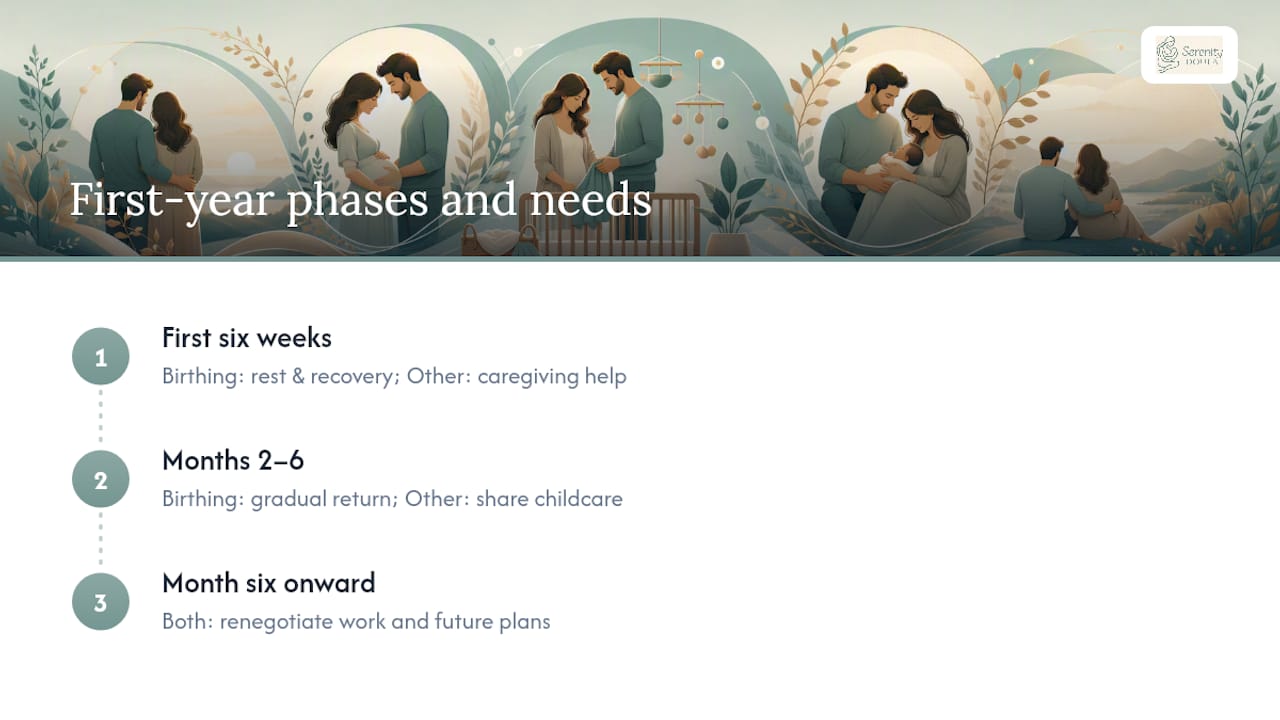
Couples who do this early tend to also renegotiate longer-term goals, a move, a career change, a second child, with less anxiety, because they’ve already proven to each other they can plan as a team under pressure.
Effects of Pregnancy Complications or High-Risk Pregnancies on the Marriage
A high-risk diagnosis, gestational diabetes, preeclampsia, a placenta issue, or a NICU stay ahead, changes the emotional math of a marriage almost overnight. Fear becomes a near-constant background presence, and the two partners often experience it on different clocks: one may want to talk through every scenario, the other may cope by focusing only on the next appointment.
This mismatch is normal, not a sign of disconnect. What tends to help is naming the difference out loud: “I process by talking it through, you process by getting quiet, and neither of us is doing it wrong.” Couples who skip that conversation often mistake a partner’s silence for indifference, when it’s usually just a different coping style under the same fear.
Practical logistics multiply fast with a complicated pregnancy, extra appointments, bed rest, hospital stays, and financial strain from missed work. This is exactly the scenario where a prenatal emotional support plan built with a doula or counselor earns its place, because it gives both partners a steady third party to lean on instead of leaning entirely on each other in a moment when both tanks are running low.
Ask your maternal-fetal medicine team directly: what does the next six weeks likely look like, and what should we plan for as a couple, not just medically. Getting a shared, realistic picture reduces the anxiety that comes from each partner privately imagining worst-case scenarios alone.
Cultural or Societal Expectations Influencing Marital Changes During Pregnancy
Expectations about who “should” feel what during pregnancy run deep, and they don’t always match what a couple actually experiences. The mother is expected to glow with certainty; the partner is expected to be endlessly patient and endlessly employed. When reality doesn’t match the script, either partner can feel like they’re failing at a role they never fully agreed to.
Gender norms around household labor often resurface hardest here, even in couples who split things evenly before pregnancy. Cultural or family-of-origin expectations about who handles the baby, who returns to work, and who manages the extended family can quietly override what a couple had actually decided between themselves.
Naming these outside pressures for what they are, expectations, not requirements, gives couples room to build their own version of the roles instead of inheriting one by default. A short conversation (“whose family’s version of ‘how this should go’ are we actually following right now?”) can defuse a surprising amount of tension before it turns into a fight about dishes.
Why Childbirth Education and Doula Support Help Couples Through Pregnancy
Serenity Doula gives Bucks County couples a structured, guided version of everything this article just walked through, instead of leaving partners to figure out communication, role-sharing, and labor preparation entirely on their own.
A free consultation covers where you both are right now: your due date, your birth preferences, and where your partner feels confident or unsure about their support role. From there, birth doula support pairs prenatal visits with hands-on labor coaching for both of you, and private childbirth education sessions give partners a low-pressure space to ask the questions they’ve been avoiding. Families near Newtown and Doylestown often start with a single consultation just to see whether the fit feels right, no pressure to commit further. If you’re weighing whether this kind of support makes sense for your situation, our guide on what a doula actually does is a good place to start. Book a free consultation to talk through your due date, your questions, and what partner involvement could look like for your specific pregnancy.
Sources
- Partner support and relationship quality as potential resources for childbirth and the transition to parenthood | BMC Pregnancy and Childbirth
- Partners Now Parents / prevention program study (PMC)
- Relationship satisfaction and commitment in the transition to parenthood: A couple‐centered approach
FAQ
Why do men change when their partner gets pregnant?
Partners often shift under the weight of new financial pressure, uncertainty about their support role, and their own emotional processing of impending fatherhood, not because the relationship is failing. Naming that shift out loud usually reduces the distance it creates.
Is it common for couples to break up during pregnancy?
Some couples do separate during pregnancy, but research shows a substantial share retain high satisfaction and commitment through the transition, meaning decline is common but far from universal.
I’m pregnant and I can’t stand my husband. What can I do?
Sharp irritability toward a partner during pregnancy is common and often tied to hormonal shifts, exhaustion, or unspoken resentment over unequal mental load. A short daily check-in or a session with a couples therapist who works with expecting parents can surface the real issue faster than waiting it out.
How do you deal with relationship problems during pregnancy?
Start with a scheduled weekly check-in, bring your partner into at least one prenatal appointment, and negotiate household roles explicitly rather than assuming they’ll sort themselves out. If conflict is frequent and intense, or if you notice signs of depression or unsafe behavior, involve a therapist or your provider promptly rather than waiting for postpartum.