

Dealing with infertility is one of the most emotionally exhausting experiences a person or couple can face, and the first thing worth knowing is this: what you’re feeling right now is a completely normal response to a genuinely hard situation. CDC demographic data confirms that fertility problems are far more common than most people realize, which means you are not carrying this alone. The two most grounding things you can do right now are give yourself permission to grieve and ask your provider for a focused evaluation. Everything else builds from there.
Your next 72 hours, step by step:
- Message one trusted person (a partner, close friend, or therapist) and say simply: “I need some support right now.”
- Call your OB-GYN or primary care provider and request a fertility evaluation, or ask for a referral to a reproductive endocrinologist (REI).
- Try one grounding exercise today: five slow breaths, a short walk, or ten minutes of journaling without editing yourself.
- Bookmark RESOLVE: The National Infertility Association for peer support and coping resources you can access tonight.
Grief, frustration, and hope can all exist at the same time. ACOG recognizes infertility as a medical condition and calls for patient-centered counseling as a standard part of care, so asking for emotional support alongside medical testing is not extra — it belongs in the same conversation.
Key Takeaways
Coping with infertility takes both immediate emotional grounding and a clear medical plan — the two reinforce each other and neither works as well alone.
| Point | Details |
|---|---|
| Normalize your feelings first | Grief, anxiety, and frustration are expected responses; ACOG recommends psychosocial support as standard care. |
| Know your evaluation timeline | Under 35: seek evaluation after 12 months; age 35–39: after 6 months; age 40+: consult an REI promptly, without waiting. |
| Ask for semen analysis early | Male-factor issues contribute to roughly half of infertility cases; CDC lists semen analysis as a standard first step. |
| Get professional emotional support | 30–40% of women in fertility care experience depression or anxiety; a therapist with infertility experience helps. |
| Serenity Doula supports the whole path | Emotional preparation, partner coaching, and appointment prep are available for Bucks County families. |
Table of Contents
- How do you cope with infertility day to day?
- Talking with your partner, family, and friends about infertility
- When should you seek a medical evaluation for infertility?
- How do you handle social situations when you’re going through infertility?
- Where can you find counseling and support groups for infertility?
- Questions to bring to your fertility and mental-health appointments
- Validating grief and exploring alternative paths to family
- What I’ve seen work, from a doula’s perspective
- Serenity Doula is here for you during this season
- Sources
- FAQ
How do you cope with infertility day to day?
Coping with infertility is not a single act; it’s a set of small, repeatable practices that protect your emotional reserves across what can be a long process. Studies cited by ACOG found that 30–40% of women in fertility care experienced depression or anxiety, which means psychological support is not optional — it’s part of treatment. The strategies below are drawn from clinical psychosocial guidance and RESOLVE’s recommended approaches.
- Start therapy early, not after a crisis. A therapist experienced in reproductive health can help you process grief, manage medication side effects, and prepare for difficult decisions. Psychiatric care during fertility treatment covers everything from grief differentiation to readiness for donor gametes.
- Join a peer support group. Hearing from others who are living the same cycle of hope and disappointment reduces isolation faster than almost anything else. RESOLVE maintains a national directory of infertility support groups, both in-person and online.
- Practice mindfulness tailored to infertility. Generic meditation apps can help, but body-scan practices specifically designed for fertility-related anxiety address the particular stress of waiting for test results or cycle outcomes.
- Schedule fertility-related tasks into a defined window. Checking lab portals, researching clinics, and reading forums at all hours keeps your nervous system in a constant state of alert. Contain it: one 30-minute window per day.
- Protect your sleep. Hormonal treatments and anxiety both disrupt sleep. Ask your provider whether any medications you’re taking affect sleep quality, and build a consistent wind-down routine.
- Plan for medication side effects before they hit. Fertility medications can cause mood swings, bloating, and fatigue. Knowing this in advance — and having a plan (a rest day, a supportive person on call) — reduces the emotional shock.
- Set a social media boundary. Pregnancy announcements and baby photos are everywhere. Muting or unfollowing accounts during treatment cycles is a reasonable act of self-care, not avoidance.
- Move your body gently. Light walking, yoga, or swimming supports mood regulation without the intensity that can feel counterproductive during treatment.
- Lean on prenatal emotional support resources that address the emotional arc of the path to parenthood, not just the clinical steps.
- Ask your clinic directly what psychosocial support is built in. Clinics that document routine counseling offerings tend to produce better patient-reported experiences.
Pro Tip: When you call your fertility clinic for the first time, ask: “What emotional and financial resources are available if a cycle doesn’t work, and who on staff coordinates them?” That single question tells you a great deal about how the clinic treats the whole person, not just the diagnosis.
RESOLVE and Planned Parenthood both offer referral pathways to counselors and support groups. If you’re not sure where to start, RESOLVE’s “Find a Therapist” directory filters by infertility specialization and insurance acceptance.
Talking with your partner, family, and friends about infertility
Partners almost always cope differently, and that difference can feel like a fracture when it’s actually just two people processing the same pain on different timelines. The most protective thing you can do for your relationship is name that difference out loud before it becomes a source of conflict.
Scripts for common situations:
- Telling a close friend: “We’ve been dealing with some fertility challenges. I’m not ready to share all the details, but I wanted you to know so you understand if I seem off sometimes.”
- Responding to “When are you having kids?”: “We’re working on it — it’s a bit more complicated than we expected. Thanks for asking.”
- Asking family for privacy: “We’d really appreciate it if you didn’t ask for updates. We’ll share news when there’s something to share.”
Boundary-setting in practice:
- If your partner wants less information shared with family, defer to the more private person. Oversharing can’t be undone.
- When you need space from a well-meaning but exhausting conversation, it’s fine to say: “I appreciate your concern. I’m not up for talking about it today.”
- Ask for specific supportive behaviors: “It would help me if you just listened without offering solutions right now.”
One area couples often avoid is the impact of fertility treatment on sexual intimacy. Timed intercourse, procedures, and emotional weight can shift sex from connection to task. Raising this with your provider or therapist is not awkward — it’s one of the most common concerns in fertility care, and there are practical ways to address it. For partners navigating this together, this partner support guide offers a useful framework for shared coping.
When should you seek a medical evaluation for infertility?
The answer depends on your age and circumstances, and the timelines below come directly from clinical guidance. According to StatPearls, earlier evaluation is recommended for patients 35 and older, with prompt referral for those 40 and above.
| Situation | Recommended action |
|---|---|
| Under 35, trying for 12 months without success | Request a fertility evaluation from your OB-GYN |
| Age 35–39, trying for 6 months without success | Request evaluation and ask about REI referral |
| Age 40 or older | Seek an REI consultation promptly, without waiting |
| Any age with known risk factors (PCOS, irregular cycles, prior pelvic surgery, male-factor concerns) | Request evaluation immediately, regardless of how long you’ve been trying |
Tests you can expect at an initial evaluation:
- Semen analysis for the male partner — CDC guidance lists this as a standard first step, since male-factor issues contribute to roughly half of infertility cases.
- Ovarian reserve testing: AMH (anti-Müllerian hormone) and antral follicle count (AFC) give a picture of egg quantity. One important note: ACOG cautions that AMH and AFC measure quantity more than quality and should be treated as one piece of information, not a verdict.
- Ovulation assessment: blood progesterone levels or cycle tracking to confirm ovulation is occurring.
- Hysterosalpingogram (HSG): an X-ray procedure to check whether the fallopian tubes are open.
On insurance and costs: coverage for fertility testing and treatment varies widely by state and plan. Ask your insurance coordinator specifically about diagnostic testing coverage (often covered separately from treatment), and ask your clinic about sliding-scale fees or patient-assistance programs. PCOS is the most common cause of female infertility, and many diagnostic tests related to it are covered under general gynecological care codes.
How do you handle social situations when you’re going through infertility?
You are allowed to skip the baby shower. You are allowed to leave early. You are allowed to say no to the holiday gathering where someone will inevitably ask about your family plans. Setting firm limits around triggering events is not antisocial — it’s how you protect the emotional energy you need for treatment.
Deciding whether to attend an event:
- Ask yourself: “Will I regret not going, or will I feel relieved that I stayed home?” Trust the honest answer.
- If you do attend, plan your exit in advance. Drive yourself so you can leave when you need to.
- Give yourself permission to feel whatever comes up — envy, sadness, and genuine happiness for someone else can coexist.
One-line responses that work:
- “We’re focusing on some personal things right now — thanks for understanding.”
- “That’s a topic we’re keeping private for now.”
- “I’m so happy for them. I’m going to step outside for a minute.”
Event-planning checklist:
- Identify one or two safe people at the event who know your situation and can run interference.
- Ask the host in advance to skip the “who’s next?” conversations if you’re close enough to do so.
- Build in a recovery plan for after: a quiet evening, a favorite meal, a call with a supportive friend.
- For holidays, consider creating a new tradition that centers your relationship rather than the family-expansion narrative.
Where can you find counseling and support groups for infertility?
Professional support genuinely improves emotional outcomes during fertility treatment. Research on psychosocial care in fertility clinics shows that clinics offering documented counseling and support-group referrals produce better patient-reported experiences. The question is knowing where to look and how to evaluate whether a resource is the right fit.
Where to start:
- RESOLVE: The most established U.S. infertility organization. Their website lists peer-led support groups by state, a therapist directory, and a helpline.
- Planned Parenthood: Offers reproductive health counseling and referrals, including for those navigating fertility concerns.
- Psychology Today’s therapist finder: Filter by “infertility” under specialty to find licensed counselors in your area.
- Your fertility clinic: Ask directly whether they have an on-site counselor or a list of preferred mental-health providers. Maternal mental health support during reproductive challenges is a recognized clinical need, not an add-on.
Therapist-selection checklist:
- Does this therapist have specific experience with infertility, pregnancy loss, or reproductive trauma?
- Do they accept your insurance, or offer a sliding-scale fee?
- Are telehealth sessions available? (Especially useful during treatment cycles when travel is hard.)
- Do they use a trauma-informed approach?
- Are they affirming of LGBTQ+ families and diverse paths to parenthood? Serenity Doula’s LGBTQ+ inclusive care guide outlines what affirming care looks like in practice.
Questions to bring to your fertility and mental-health appointments
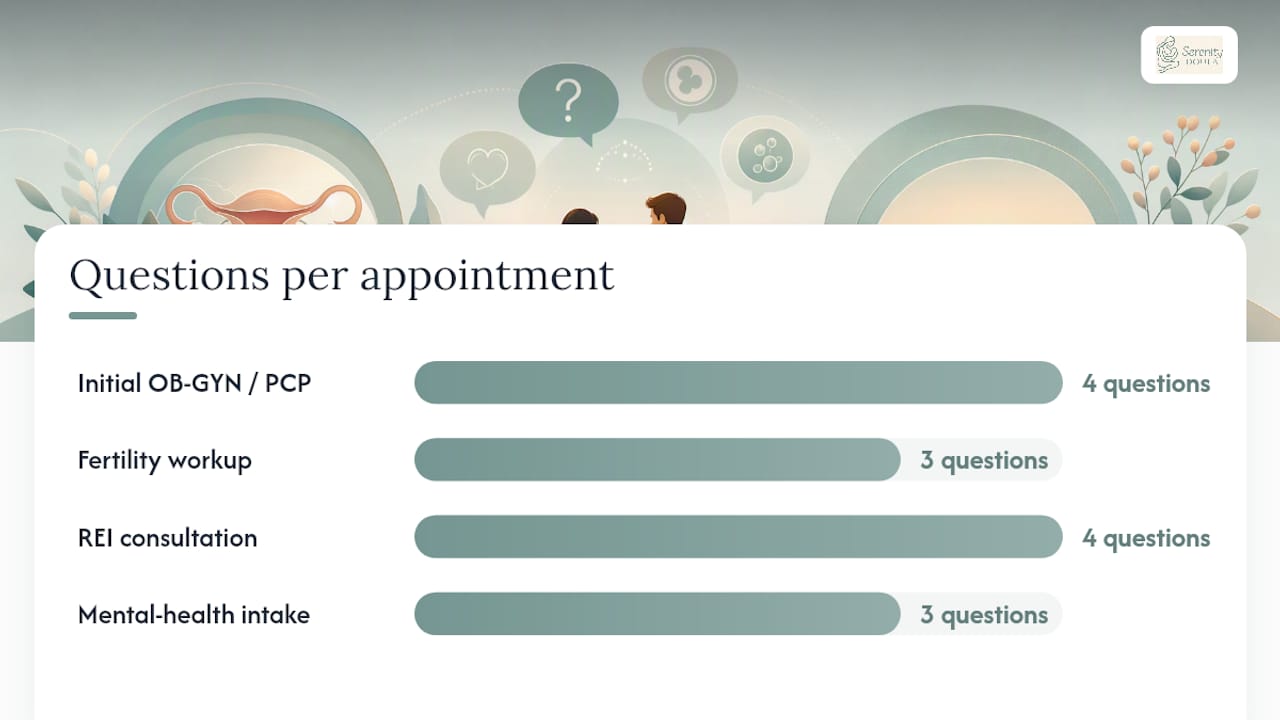
Walking into an appointment without a list means walking out with half the answers. A simple tracking sheet — cycle dates, medications, prior test dates, and your questions written out — leads to clearer decisions and faster next steps.
At your initial OB-GYN or primary care visit:
- “Based on my age and history, when do you recommend I start a fertility evaluation?”
- “Should my partner have a semen analysis at the same time?”
- “What tests will you order first, and what are you looking for?”
- “Do you have a referral relationship with an REI in this area?”
At your fertility workup:
- “What do my AMH and AFC results actually mean for my situation — not just the numbers, but the clinical picture?”
- “Are there any structural issues (fibroids, polyps, tube blockages) that need to be addressed before we try treatment?”
- “What are the next steps if these results come back normal but we still aren’t conceiving?”
At your REI consultation:
- “What treatment options make sense for our specific diagnosis?”
- “What are the realistic success rates for someone my age at this clinic?”
- “What does a failed cycle look like emotionally and logistically, and how does your team support patients through it?”
- “What does this cost, and what does our insurance cover?”
At your mental-health intake:
- “Have you worked with patients going through IVF or fertility treatment before?”
- “How do you approach grief after a failed cycle or pregnancy loss?”
- “Can we work on communication strategies for me and my partner?”
Pro Tip: Before any appointment, write your top three questions on a card and hand it to the provider at the start of the visit. Providers move faster when they know what you need — and you’re far less likely to leave having forgotten the thing that mattered most.
Turning answers into a 90-day plan:
- After each appointment, write down the three most concrete next steps the provider named.
- Assign a date to each one (schedule the HSG, call insurance, start the supplement).
- Review the list with your partner or support person weekly.
Validating grief and exploring alternative paths to family
Grief is not a sign that something has gone wrong with how you’re coping. It’s the appropriate response to loss, and infertility involves many kinds of loss: the loss of an assumed timeline, the loss of a pregnancy, the loss of a version of the future you had pictured. Most people move through phases of shock, anger, sadness, and gradual acceptance, often cycling back through them more than once. All of that is normal.
When the path forward feels unclear, it helps to know the full range of options, described without pressure:
- Donor eggs or sperm: Using eggs or sperm from a screened donor through your fertility clinic. Vitrifying 15 oocytes for women under 35 was associated with an 85.2% modeled probability of a live birth in one cited analysis, which gives a sense of what fertility preservation can offer.
- Embryo donation: Receiving donated embryos from another family who completed their own IVF cycle. Lower cost than a full IVF cycle and a meaningful option for many families.
- Gestational carrier: A person who carries a pregnancy using your embryo (or a donor embryo). Requires legal agreements and a fertility clinic experienced in third-party reproduction.
- Adoption: Domestic infant adoption, international adoption, and foster-to-adopt each have different timelines, costs, and processes. An adoption attorney or licensed agency can walk you through the specifics.
- Foster-to-adopt: Fostering with the intent to adopt if parental rights are terminated. Often the most accessible path financially, and one that meets a genuine need.
- Choosing a childfree life: For some people, after careful reflection, a fulfilling life without children is the right answer. This is a valid choice, not a consolation prize, and grief counseling can help you arrive at it with clarity rather than resignation.
For any of these paths, ask: “What does the first concrete step look like, and who do I contact to take it?” That question cuts through the overwhelm.
What I’ve seen work, from a doula’s perspective
The clients I’ve supported through fertility challenges — in Bucks County, at Trinity Health St. Mary, and beyond — almost always say the same thing in retrospect: they wish they had asked for emotional support sooner. Not after the third failed cycle. Not after the diagnosis landed. Sooner.

What tends to help most isn’t the grand gesture. It’s the small, consistent things: a partner who shows up to one appointment just to listen, a therapist who has been through this with other patients and doesn’t flinch; a tracking sheet that makes the next appointment feel less chaotic. I’ve watched clients walk into REI consultations with a list of questions and walk out with a clear plan for the first time in months. That shift — from passive patient to informed participant — changes everything about how the process feels.
If you’re wondering whether a doula has any role during fertility treatment, the answer is yes, in a specific way. A doula can help you prepare questions for appointments, translate clinical language into plain English, and hold the emotional thread between visits when your medical team is focused on the clinical picture. That kind of support doesn’t replace your fertility specialist. It makes every appointment with them more productive.
Ask your provider: “What does emotional support look like at this clinic, and who specifically provides it?” If the answer is vague, that’s useful information too.
Serenity Doula is here for you during this season
When you’re in the middle of fertility treatment, the gap between appointments can feel the longest. Serenity Doula offers pregnancy and birth support that includes emotional preparation, partner coaching, and care coordination — the kind of steady, personalized presence that helps you feel grounded between clinical visits, not just during them.

Serving families in Newtown, Doylestown, and throughout Bucks County, Serenity Doula brings a warm, evidence-informed approach to every stage of the path to parenthood. Whether you’re still in the evaluation phase or preparing for a first IVF cycle, a free consultation is a low-stakes way to talk through where you are and what kind of support would actually help. Book your free consultation here and let’s figure out the next step together.
Sources
Start with RESOLVE or the CDC if you want immediate, practical help. Both are free, authoritative, and written for patients rather than clinicians.
- Infertility: Frequently Asked Questions | Reproductive Health | CDC
- Infertility: Disparities and Access to Services | ACOG
- Age-Related Fertility Decline – StatPearls – NCBI Bookshelf
- Coping With Infertility: 8 Strategies to Help You Through
- Stacks
- Psychiatric aspects of infertility and infertility treatments | PubMed
- Anticipatory Counseling Regarding Ovarian-Factor Fertility Decline | ACOG
This article is general information, not a substitute for advice from a qualified doctor. Consult a qualified healthcare professional about your own circumstances before acting on anything here.
FAQ
How do you cope emotionally with infertility?
Start with professional support early — a therapist experienced in reproductive health, a peer support group through RESOLVE, and clear boundaries around social triggers. ACOG recommends routine psychosocial care as part of fertility treatment, not a separate add-on.
What is the most common cause of infertility?
CDC guidance identifies PCOS (polycystic ovary syndrome) as the leading contributor to female infertility; male-factor issues, including low sperm count or motility, contribute to roughly half of all cases overall.
What should you do if you think you are infertile?
Request a fertility evaluation from your OB-GYN or primary care provider. If you’re under 35, the standard recommendation is to seek evaluation after 12 months of trying; if you’re 35 or older, StatPearls guidance recommends evaluation after 6 months, with prompt REI referral at 40 and above.
At what age does fertility decline most significantly?
Fertility begins declining gradually in the early 30s and more steeply after 35. StatPearls notes that ovarian reserve testing (AMH and AFC) can help assess egg quantity, though these tests measure quantity more than quality and should be interpreted alongside a full clinical picture.
Does dealing with IVF stress require special support?
Yes. IVF cycles involve hormonal medications, waiting periods, and the real possibility of a failed cycle, all of which create specific emotional pressures. A therapist with fertility experience, a peer group, and a support person at appointments can each reduce that load — and asking your clinic what emotional resources they provide during a failed cycle is one of the most useful questions you can bring to a first consultation.