

Light spotting after a cervical check is common and usually nothing to panic about. The cervix becomes highly vascular during pregnancy, and even a gentle exam can disturb tiny blood vessels or shift the mucus plug, producing a small amount of pink or brown discharge. According to Cleveland Clinic, spotting after cervical manipulation is expected, but heavy or persistent bleeding is a clinical concern that needs prompt attention.
Here is the short version of what to do:
- If you see light pink or brown spotting after a cervical check, note the time, color, and amount, then monitor. This is usually normal.
- Call your care team right away if bleeding is bright red, heavier than a light period, soaks a pad, or comes with severe pain, fever, or reduced fetal movement.
- Go to the ER or labor and delivery if bleeding is heavy and does not slow down, or if you feel dizzy, faint, or notice your baby has stopped moving.
Table of Contents
- Is that blood from the exam or bloody show?
- How much bleeding after a cervical check is too much?
- What to do right now if you’re bleeding after a check
- Does a cervical check cause dilation or start labor?
- How a doula supports you when bleeding concerns come up
- Key Takeaways
- What most people get wrong about post-exam spotting
- Serenity Doula is here when questions like this come up at 2 AM
- Useful sources and further reading
- FAQ
Is that blood from the exam or bloody show?
This is one of the most common questions families ask, and the confusion is completely understandable. Both can appear after a cervical check, and they can look similar. The key differences are in texture, timing, and what comes next.
| Feature | Exam-related bleeding | Bloody show |
|---|---|---|
| Appearance | Pink or red blood, sometimes watery, little to no mucus | Thick mucus streaked or mixed with pink, brown, or red blood |
| Timing | Starts within minutes to a few hours after the exam | Can appear days to weeks before labor, or at the start of labor |
| Amount | Usually very light, a few spots on underwear or toilet paper | Varies; often a tablespoon or more of mucus |
| Associated symptoms | Mild cramping from the exam itself | May come with irregular contractions or pelvic pressure |
| What it signals | Cervical irritation from the exam | Cervix is softening and beginning to change in preparation for labor |
Cleveland Clinic describes bloody show as a natural sign the cervix is changing in preparation for labor, often appearing as mucus mixed with blood from cervical effacement and dilation. Bloody show can happen hours to days before active labor begins, or right as early labor starts. Exam-related spotting, by contrast, typically fades within a few hours and does not come with escalating contractions.
If you had a cervical check and then noticed bloody show within the next 24–48 hours, the exam may have helped trigger the plug’s release. That is still considered normal, and it does not mean labor is imminent.
How much bleeding after a cervical check is too much?
Light spotting is expected. Anything beyond that deserves a phone call. Here is how to think about the difference:
Call your provider if you notice:
- Bright red blood (not just pink or brown)
- Bleeding that fills or soaks a pad within an hour
- Bleeding that continues for more than a few hours without slowing
- Cramping that feels like strong contractions, not just mild post-exam discomfort
- Fever above 100.4°F
- Decreased fetal movement
Go to labor and delivery or the ER immediately if you have:
- Heavy bleeding that does not slow down
- Severe abdominal or back pain
- Dizziness, lightheadedness, or fainting
- No fetal movement after trying kick counts
ACOG notes that while bleeding early in pregnancy is relatively common, affecting roughly 15–25% of people in the first trimester, later bleeding is less common and warrants prompt evaluation. Painless heavy bleeding late in pregnancy can sometimes indicate placenta previa or another placental issue, which Mayo Clinic identifies as a condition requiring immediate assessment.
Pro Tip: When you call your provider, lead with these four facts: “I had a cervical check at [time], I noticed bleeding [X minutes/hours] later, it looks [color], and it’s [amount, e.g., spotting on tissue / soaking a pad].” That framing gives your care team exactly what they need to triage your call quickly.
What to do right now if you’re bleeding after a check
Stay calm. Most post-exam spotting resolves on its own. Here is a simple checklist to follow:
- Note the time the cervical check happened and the time you first noticed bleeding.
- Put on a pad (not a tampon) so you can accurately track the amount and color of blood.
- Describe the blood: Is it pink, brown, or bright red? Is it mixed with mucus?
- Check fetal movement. If your baby is active, that is reassuring. If movement seems reduced, call immediately.
- Avoid intercourse and internal exams until you have spoken with your provider.
- Call your care team and use this template:
What to have ready when you call:
- Time of the exam
- How soon after the exam bleeding started
- Color and amount (pad-soak estimate works well)
- Whether you have pain, cramping, or contractions
- Fetal movement status
- Any other procedures done at the visit (membrane sweep, Pap smear)
ACOG’s guidance is clear: providers prefer that patients call with concerns rather than wait at home worried. A call that turns out to be nothing is always better than waiting on something serious.
Does a cervical check cause dilation or start labor?
Short answer: no. A cervical check is an assessment, not a treatment. It tells your provider where things stand; it does not move them along. Dilation happens because of uterine contractions and hormonal changes, not because a provider’s fingers measured it.
That said, a few things are worth knowing:
- Membrane sweeps are different. A sweep, which separates the amniotic sac from the uterine wall, can sometimes encourage labor to begin. But a standard cervical check does not do this.
- Frequent checks carry a small infection risk. Repeated internal exams, especially after membranes have ruptured, can introduce bacteria. Recent obstetrics literature discusses how clinicians vary in how often they perform checks, with some limiting them to reduce infection risk.
- You can decline or pause a check. After 37 weeks, many providers offer checks but do not require them. If you are uncomfortable or want to limit exams, that is a conversation worth having. A guide to your rights around cervical checks can help you prepare for that discussion.
Questions to ask your provider about checks:
- “Is this check necessary for my care plan today, or is it optional?”
- “How will the results change what we do next?”
- “How many checks do you typically recommend during labor, and why?”
How a doula supports you when bleeding concerns come up
When you notice bleeding after a cervical check, the first thing that usually happens is a wave of anxiety. That is where having a doula alongside you makes a real difference, not because a doula provides medical care, but because she helps you stay grounded and communicate clearly when it counts.
Here are questions your doula can help you bring to your provider:
- “Is this amount of bleeding expected after the type of check you just did?”
- “When should I call you back, and what specifically should I watch for?”
- “Could this be bloody show, or does it look like exam irritation to you?”
- “Should I come in now, or is it safe to monitor at home for a few hours?”
A doula’s role in these moments includes helping you track timing and fetal movement, sitting with you during a phone call to your provider so you do not miss anything, and supporting your right to ask for informed consent before any repeat exam. Doulas routinely help clients describe bleeding concisely to clinical staff, which speeds up triage and reduces the back-and-forth that can feel so stressful when you are already worried.
Pro Tip: Keep a simple notes app entry or a small notepad in your hospital bag labeled “Symptoms to Report.” When something happens, jot down the time, what you saw, and how you felt. That log is gold when you are on the phone with labor and delivery at 2 AM.
If you are preparing for a late-term appointment at Trinity Health St. Mary in Langhorne, or heading into a prenatal visit in Doylestown or Newtown, knowing what to expect from a cervical exam during pregnancy can help you walk in feeling ready rather than anxious.
Doula support is non-medical. Always contact your clinical care team for any medical concern, including bleeding.
Key Takeaways
Light spotting after a cervical check is common because the pregnant cervix is highly vascular; heavy, bright-red, or persistent bleeding requires an immediate call to your care team or a trip to labor and delivery.
| Point | Details |
|---|---|
| Spotting is usually normal | Pink or brown spotting within hours of a cervical check is a common, expected response to cervical manipulation. |
| Know the red flags | Bright-red bleeding, pad-soaking flow, severe pain, fever, or reduced fetal movement all require an immediate call or ER visit. |
| Document before you call | Note the time of the exam, how soon bleeding started, the color, and the amount so your provider can triage quickly. |
| Checks don’t cause dilation | A cervical check assesses progress; it does not trigger labor or cause dilation on its own. |
| Serenity Doula can help | A Serenity Doula birth doula helps you track symptoms, prepare questions, and communicate clearly with your care team when bleeding concerns arise. |
What most people get wrong about post-exam spotting
Most families I work with in Bucks County are surprised by two things: how vascular the cervix actually is during pregnancy, and how quickly a little blood on the toilet paper can send an otherwise calm person into a spiral. Both reactions are completely understandable.
What I want you to hold onto is this: the fact that you noticed, that you are asking questions, and that you are paying attention to your body is exactly right. The goal is not to never feel worried. The goal is to know what to do with that worry. Light spotting after a check is almost always mechanical and brief. The cervix is doing its job, your provider touched it, and a tiny vessel responded. That is physiology, not a warning sign.
What I do push back on, gently, is the idea that you have to accept every cervical check offered to you without question. You have the right to ask what the check is for, whether it changes your care, and whether you can decline it. A doula’s job is to help you have that conversation without feeling like you are being difficult. You are not being difficult. You are being informed.
Serenity Doula is here when questions like this come up at 2 AM
Bleeding after a cervical check is exactly the kind of moment when having a doula in your corner changes everything. Not because a doula replaces your OB or midwife, but because she is the person who picks up, helps you think through what you are seeing, and makes sure you walk into that phone call with your provider ready and calm.

At Serenity Doula, birth doula support includes being available for exactly these moments: helping you document symptoms, coaching you through the call to labor and delivery, and supporting your right to ask questions and make informed decisions at every check. Families in Bucks County, Montgomery County, and the surrounding area can also access childbirth education that covers what to expect from cervical exams, how to read your body’s signals, and how to communicate clearly with your care team.
Doula support is non-medical. For any bleeding concern, always contact your clinical provider first. When you are ready for the kind of support that holds you between those appointments, book a free consultation with Serenity Doula and let’s talk about how we can support your birth.
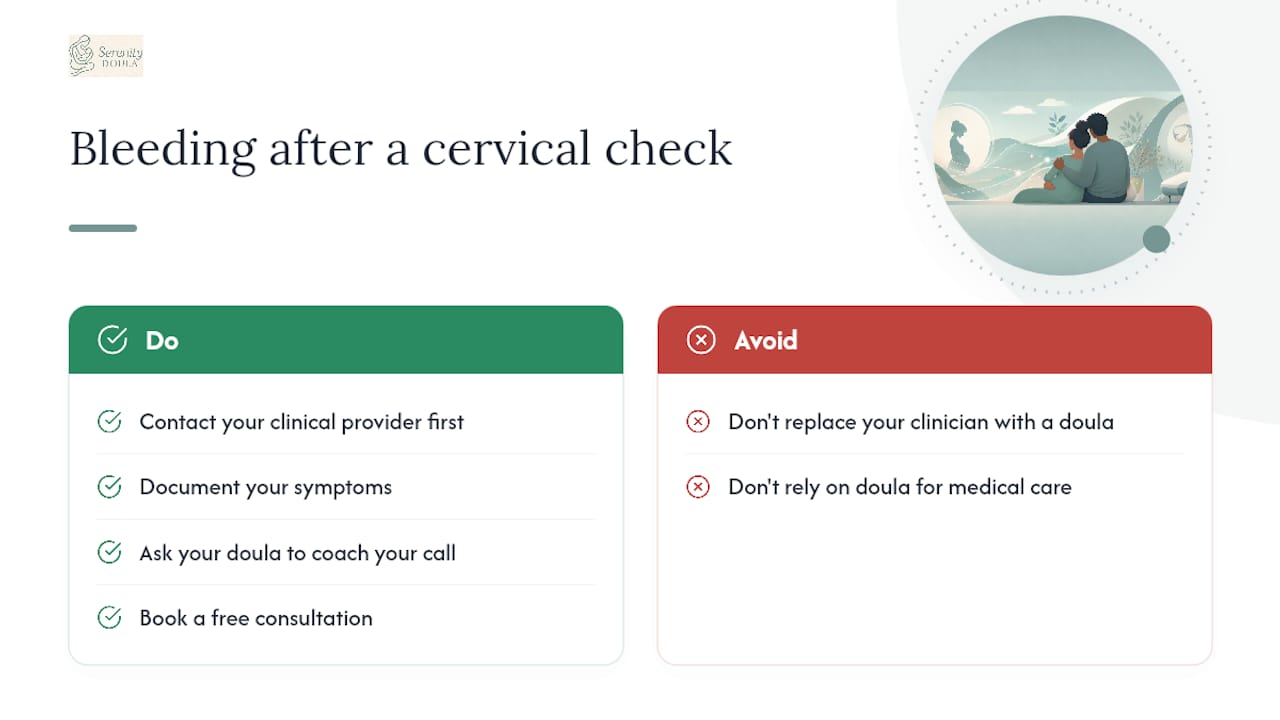
Useful sources and further reading
These are the clinical and educational sources referenced throughout this article. Each one is worth bookmarking for your pregnancy reading.
- Cervical Check: Is It Necessary? Exam, Procedure & Timing
- Bloody show: Pregnancy, Symptoms & Signs of Labor
- Bleeding During Pregnancy – ACOG
- Placenta previa – Symptoms and causes | Mayo Clinic
- What Is a Cervical Check? | UPMC HealthBeat
- Membrane sweep | Cleveland Clinic
- AJOG MFM article (DOI)
This article is educational and does not constitute medical advice. Always contact your care team or a qualified clinical provider for any bleeding concern during pregnancy.
FAQ
Is it normal to bleed after a cervical check during pregnancy?
Yes, light pink or brown spotting after a cervical check is common. The pregnant cervix is highly vascular, and gentle manipulation can break tiny surface vessels or shift the mucus plug, producing brief spotting that typically fades within a few hours.
How much blood is too much after a cervical check?
Any bleeding that is bright red, soaks a pad, or does not slow within a few hours warrants a call to your provider. Bleeding paired with severe pain, fever, or reduced fetal movement is a reason to go to labor and delivery right away.
Does bleeding after a cervical check mean the cervix is dilating?
Not necessarily. Spotting after an exam is usually caused by surface vessel disruption, not by dilation itself. A cervical check measures dilation but does not cause it; dilation happens through contractions and hormonal changes.
What is the difference between exam bleeding and bloody show?
Exam-related bleeding tends to be watery and pink, appearing within minutes to hours of the check. Bloody show is thicker, mucus-heavy, and streaked with blood, and it signals the cervix is changing in preparation for labor, sometimes days before active labor begins.
What should I say when I call my provider about bleeding after an exam?
Tell them the time of the exam, how soon bleeding started, the color and amount, whether you have pain or contractions, and your baby’s movement status. That information lets your care team triage your call quickly and decide whether you need to come in.