If you want placenta capsules nearby, your first move is to find a local specialist who offers documented pickup logistics, a written sanitation protocol, and a clear processing timeline before you go into labor. That combination separates the providers worth calling from the ones worth skipping.
Here is a quick checklist to use on your first phone call or email:
- Service area and pickup: Does the provider cover your hospital or birth location, and do they supply a transport kit?
- Processing location: Is the placenta processed in a dedicated space with documented sanitation, or in a home kitchen with no written protocol?
- Written sanitation policy: Can they email you their hygiene and dehydration protocol before you book?
Pro Tip: Book your encapsulation provider by week 32 at the latest. Hospital paperwork, transport kit pickup, and provider contact details all need to be in place before labor begins.
Table of Contents
- How do you choose a placenta encapsulation specialist near you?
- What happens from pickup to capsule delivery?
- What does placenta encapsulation typically cost?
- What do public health agencies say about safety and evidence?
- How do you handle hospital paperwork and placenta pickup?
- Key Takeaways
- What I tell every Bucks County family before they book
- Serenity Doula handles the coordination so you don’t have to
- Authoritative sources and further reading
- FAQ
How do you choose a placenta encapsulation specialist near you?
The single most useful filter is documentation. Because no federal agency, including the FDA, has established standardized safety guidelines for processing, storing, or transporting placentas for consumption, the burden of due diligence falls entirely on you. A provider who cannot hand you a written sanitation protocol is telling you something important.
What to compare when you shortlist providers
| Option | Service area / pickup | Processing location | Transport method | Sanitation documentation | Turnaround time | Written policies |
|---|---|---|---|---|---|---|
| Serenity Doula | Bucks, Montgomery, Philadelphia, Burlington Counties | Coordinates with vetted local specialists | Doula-facilitated handoff and paperwork | Doula verifies provider protocols; hospital coordination included | Varies by specialist | Consent, coordination checklist, postpartum plan |
| Independent local specialists | Varies by provider; confirm service radius | Home kitchen or off-site lab; ask for photos | Provider-supplied transport kit or client transport | Written protocol varies; always request before booking | Typically 24–72 hours | Consent and refund policies vary widely |
| Birth-center or midwife-linked services | Usually limited to birth center’s catchment area | Often coordinated with vetted local vendor | Handled within midwifery care team | Tighter oversight within clinical setting | Varies | Typically integrated into midwifery consent forms |
| DIY at-home preparation | N/A | Home kitchen | Client transport | Entirely self-managed; no external oversight | Self-determined | None required |
Questions to ask every provider
Ask these before you commit:
- “Do you provide a transport kit, and does it include ice packs and a sealed container?”
- “Where exactly is the placenta processed, and can I see photos of the space?”
- “What is your written dehydration protocol, and at what temperature and duration do you process?”
- “What is your refund policy if I deliver early or the placenta is not releasable?”
- “Do you carry liability insurance?”
A clear answer sounds like: “We process in a dedicated space, dehydrate at [specific temperature] for [specific hours], and can email you our full protocol today.” Vague answers (“we follow best practices”) are a red flag.
Red flags to walk away from: refusal to share written protocols, no refrigerated transfer within the first few hours after birth, turnaround times stated as “whenever it’s ready,” no consent form, and any provider who makes clinical health claims without acknowledging the documented infection risks.
Pro Tip: Ask your provider whether they carry liability insurance and whether their processing space has ever been inspected. Most won’t have a formal inspection on record, but the question itself tells you a lot about how seriously they take safety.
What happens from pickup to capsule delivery?
Knowing the full sequence helps you plan. Here is the typical flow for a local pickup-and-encapsulation service:
- File hospital paperwork — Contact your hospital’s labor and delivery unit to request a placenta release form. At places like Trinity Health St. Mary in Langhorne, this is handled through the nursing staff and requires advance notice.
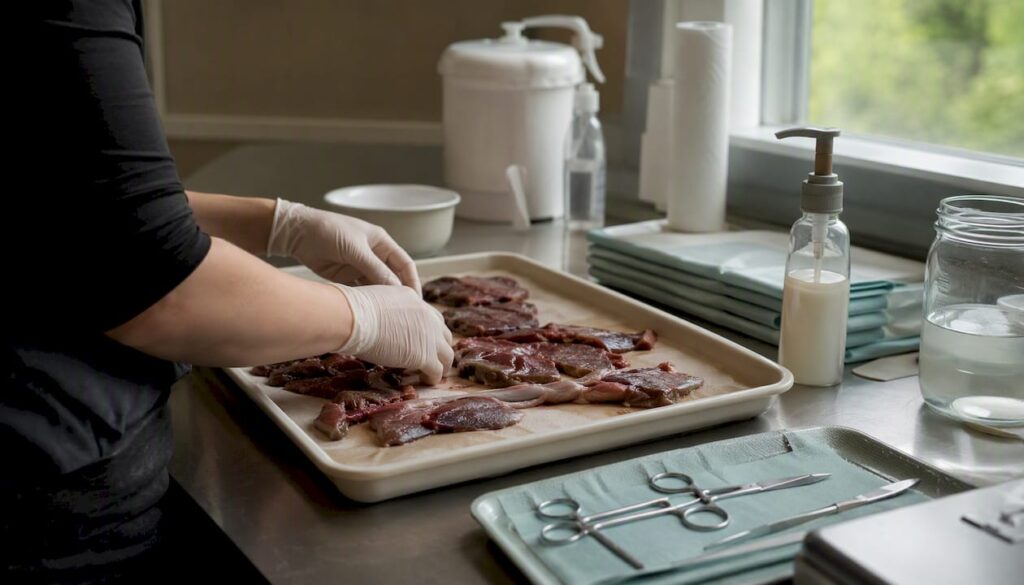
- Processing begins. The typical sequence is cleaning, slicing, dehydration, grinding, and encapsulation. Most placentas yield a typical number of gelatin capsules suitable for consumption, depending on size.
Home kitchen vs. dedicated lab
This distinction matters more than most families realize. A dedicated processing space with documented sanitation is meaningfully different from a home kitchen, even a very clean one. Ask for photos or a video walkthrough of the space. If a provider processes in their home kitchen alongside regular meal prep, that is worth factoring into your decision.
Your booking paperwork should include: a written processing checklist, a signed consent form, and an emergency contact for transfer issues. Doula and midwifery resources consistently recommend having all of this documented before you go into labor, not after.
What does placenta encapsulation typically cost?
Price ranges in the U.S. run roughly $200–$500 for a standard encapsulation service, with some providers in higher-cost metro areas or those offering premium add-ons reaching closer to $1,000.
What’s typically included in the base fee: pickup or transport kit, standard steam-dehydrate processing, encapsulation into gelatin capsules, and return delivery.
Common add-ons that increase the price:
- Placenta tincture (a small portion preserved in alcohol)
- Placenta print or keepsake
- Salve or lotion made from placenta tissue
- Expedited processing or courier pickup
- Lab-grade processing in a certified space
Insurance rarely covers encapsulation services. Most providers require a deposit at booking and have a cancellation policy tied to how far along you are at the time of cancellation. Ask specifically: “What happens to my deposit if I deliver before my due date and the placenta is not releasable?”
Turnaround time is usually 24–72 hours from pickup, though some providers offer same-day or next-day processing for an additional fee.
What do public health agencies say about safety and evidence?
This is where the conversation gets important. Major public health organizations warn that placenta consumption has no proven clinical benefits and carries documented infection risks. That is not a fringe opinion; it is the consensus of the CDC, Mayo Clinic, and Cleveland Clinic.
Key finding: In 2016, the CDC’s MMWR documented a case of late-onset infant Group B Streptococcus (GBS) bacteremia linked to a mother consuming dehydrated placenta capsules. The capsules cultured positive for GBS matching the infant’s strain.
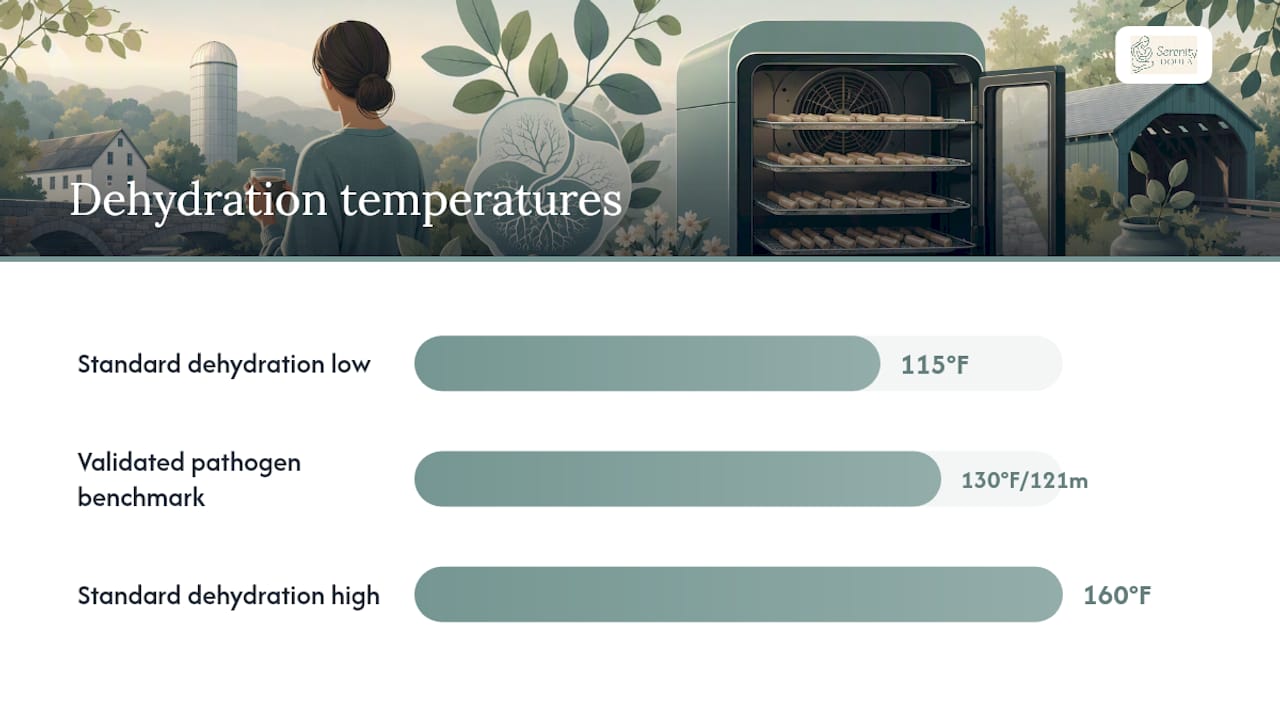
The technical reason this matters: the placenta is not a sterile organ. Standard dehydration temperatures used by many encapsulators (115°F–160°F) are not validated to eliminate pathogens like GBS. Reducing Salmonella counts by 7 log10 requires heating at 130°F for 121 minutes; most encapsulation protocols do not meet that benchmark. Storage at room temperature after processing provides no protection against bacterial regrowth.
Mayo Clinic notes there is no scientific evidence that consuming placenta prevents postpartum depression, increases milk supply, or balances hormones. Peer-reviewed systematic reviews reach the same conclusion: the evidence is weak and largely anecdotal.
| Safety dimension | What the evidence shows |
|---|---|
| Pathogen elimination | Standard dehydration (115°F–160°F) not validated to kill GBS or other pathogens |
| Documented infection | CDC MMWR 2016: infant GBS bacteremia linked to maternal placenta capsule consumption |
| Clinical benefit claims | No peer-reviewed evidence supports PPD prevention, milk supply increase, or hormone balancing |
| Regulatory oversight | No FDA-verified processing standards exist for placenta preparation |
Dr. Salena Zanotti of Cleveland Clinic recommends against placenta consumption and urges families to discuss infection risks with their healthcare provider rather than relying on a non-medical preparer.
Pro Tip: Ask your OB or midwife specifically about GBS status and timing. If you tested GBS-positive during pregnancy, that conversation is especially worth having before you decide.
How do you handle hospital paperwork and placenta pickup?
Hospital policies vary more than most families expect. Some hospitals treat the placenta as medical waste by default and require advance paperwork before they will release it. Others release it with a signed consent form at delivery. Planning ahead and communicating early with your hospital’s labor and delivery unit is the single most important logistics step.
For families delivering at a hospital like Trinity Health St. Mary in Langhorne, contact the labor and delivery unit during your third trimester to ask about their specific release process. Do not assume the nursing staff will know your plan on the day of delivery without prior notice.
Before birth: what to prepare
- Signed placenta release form (obtained from and filed with your hospital)
- Provider’s name, phone number, and pickup instructions written out for nursing staff
- Transport kit in your hospital bag or with your doula
- Written confirmation of your provider’s pickup window
At the hospital: what happens
- Inform your nurse at admission that you have a signed placenta release on file.
- After delivery, the placenta is placed in your transport kit (sealed biohazard bag with ice packs).
- Your doula or a designated person contacts the provider to initiate pickup.
- The placenta should be refrigerated or on ice within one to two hours.
For home births, the logistics are simpler: your midwife typically handles the placenta directly, and coordination with an encapsulation provider can happen immediately after birth. Birth-center or midwife-linked encapsulation services often have this built into their workflow, which makes handoff smoother.
A doula who handles hospital logistics can hold all of this paperwork, communicate with nursing staff, and make sure nothing falls through the cracks during labor.
Key Takeaways
Finding a trustworthy local placenta encapsulation service requires written sanitation protocols, documented pickup logistics, and an honest conversation with your clinician about GBS risk before you book.
| Point | Details |
|---|---|
| Book early and document everything | Confirm service area, written sanitation protocol, and consent form by week 32. |
| Ask about processing location | A dedicated lab with documented protocols is meaningfully safer than an unverified home kitchen. |
| Understand the safety evidence | The CDC links placenta capsules to a documented infant GBS case; no proven clinical benefits exist. |
| Prepare hospital paperwork in advance | File a signed placenta release form with your hospital’s labor and delivery unit before labor begins. |
| Serenity Doula coordinates the logistics | Serenity Doula helps Bucks County families with hospital paperwork, provider coordination, and evidence-based postpartum planning. |
What I tell every Bucks County family before they book
The families I work with in Doylestown, Newtown, and across Bucks County often come to me having already decided they want placenta encapsulation. My job is not to talk them out of it. My job is to make sure they go in with clear eyes.
What I see most often is not a bad provider. It is a gap in coordination. The family books an encapsulation service, but nobody tells the hospital. Or the transport kit is in the car and the nurse on duty has no idea what to do with it. Or the provider’s pickup window is four hours, and the placenta sat at room temperature for two of them. These are not hypothetical scenarios.
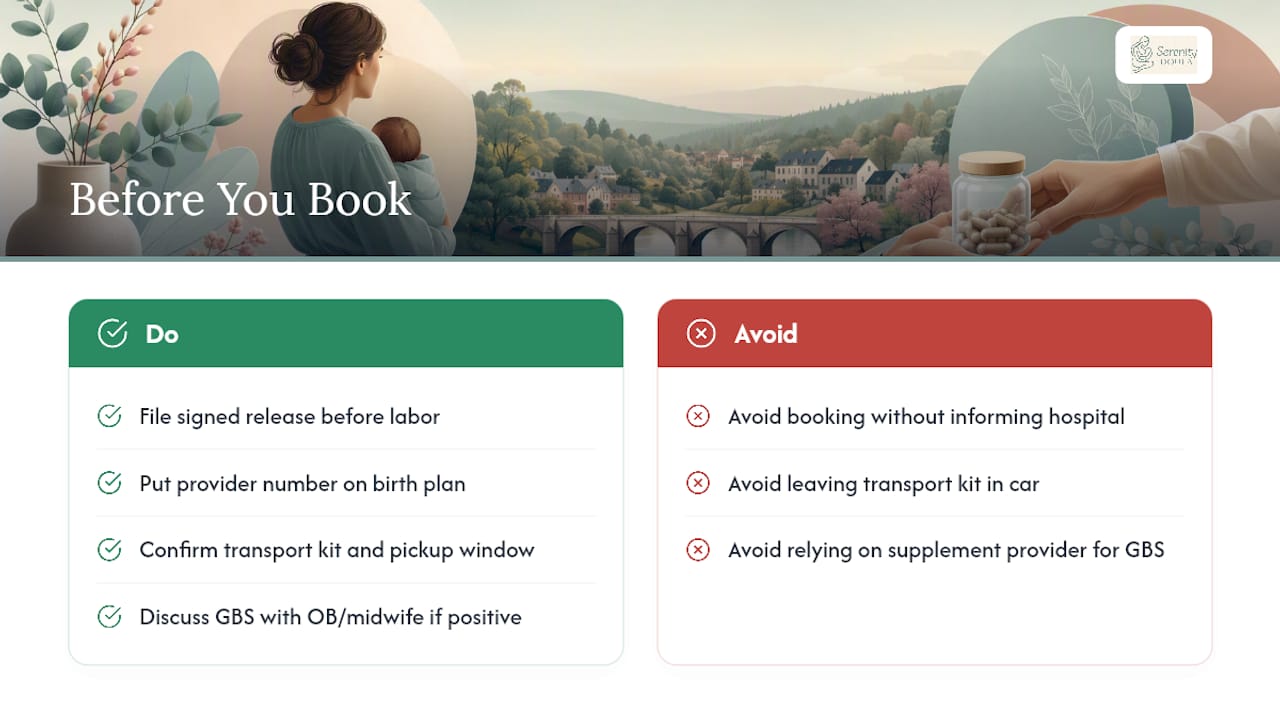
The paperwork piece is where I add the most value. Before a client of mine goes into labor, I have the signed release filed, the provider’s number written on the birth plan, and the transport kit confirmed. When you are in active labor, you should not be thinking about any of this.
I also have honest conversations about the evidence. The CDC’s documented GBS case is real, and families deserve to know about it. I am not here to make that decision for anyone, but I do encourage every client to bring it up with their OB or midwife, especially if they tested GBS-positive. That conversation belongs with a clinician, not a supplement provider.
If you want evidence-based postpartum support that goes beyond capsules, there are well-studied options: doula care, lactation consultation, rest, and nutrition. Those are the supports I lean on most, and the ones with the strongest track record.
Serenity Doula handles the coordination so you don’t have to
Hiring an independent encapsulation specialist means managing the paperwork, the transport kit, the hospital communication, and the pickup timing yourself, often while you are in labor or newly postpartum. Serenity Doula takes that off your plate.
As your birth and postpartum doula serving Bucks, Montgomery, Philadelphia, and Burlington Counties, Serenity Doula handles the hospital coordination, helps you prepare clinic-ready paperwork, and connects you with vetted local specialists when encapsulation is part of your plan. Beyond logistics, the focus is on postpartum recovery strategies that are actually supported by evidence: doula care, lactation support, rest, and nutrition. You get a partner who knows Trinity Health St. Mary’s protocols, knows the questions to ask, and is with you through the whole process.
If you are weighing your options and want to talk through what makes sense for your family, book a free consultation and we can figure it out together.
This article is general information, not medical advice. Please discuss placenta consumption, GBS risk, and postpartum recovery options with your OB, midwife, or healthcare provider.
Authoritative sources and further reading
| Source | What it covers |
|---|---|
| CDC MMWR: Late-Onset Infant GBS Infection, Oregon 2016 | Documented case of infant GBS bacteremia linked to maternal placenta capsule consumption; primary public health citation |
| Mayo Clinic: Eating the Placenta | Clinician summary of evidence gaps and infection risks |
| Cleveland Clinic: What Is Placenta Encapsulation and Is It Safe? | Regulatory status, lack of FDA oversight, and recommendation to consult a healthcare provider |
| WhatToExpect: Placenta Encapsulation | Consumer overview of processing steps and capsule yields |
| Parents: Placenta Encapsulation and Hospital Logistics | Hospital paperwork, transport coordination, and practical planning guidance |
| Nature / PMC: Human Placentophagy Review | Peer-reviewed systematic review of clinical evidence and outcomes |
For hospital-specific release policies, contact your labor and delivery unit directly during your third trimester. For GBS risk and postpartum recovery options, bring the CDC MMWR finding to your next prenatal appointment as a conversation starter.
FAQ
Can you buy placenta capsules without hiring a preparer?
You cannot buy pre-made placenta capsules commercially; each set is prepared from your own placenta after birth. You hire a local encapsulation specialist to process and return them to you.
How much does placenta encapsulation usually cost?
Most U.S. providers charge roughly $200–$500 for a standard service, with some reaching close to $1,000 when add-ons like tinctures, keepsakes, or expedited courier pickup are included. Insurance rarely covers the cost.
Can I legally take my placenta home from the hospital?
In most U.S. states you can request your placenta, but hospitals vary in policy. Some require advance paperwork and a signed release form filed before labor; others treat the placenta as medical waste unless you ask. Contact your hospital’s labor and delivery unit during your third trimester to confirm their specific process.
Is there any clinical evidence that placenta capsules help with postpartum recovery?
No peer-reviewed evidence supports the claim that placenta capsules prevent postpartum depression, increase milk supply, or balance hormones. The CDC has documented a case of infant GBS infection linked to maternal consumption of placenta capsules, and major health organizations including Mayo Clinic and Cleveland Clinic advise discussing the risks with your healthcare provider before proceeding.
How does Serenity Doula help with placenta encapsulation logistics?
Serenity Doula does not process placentas directly, but helps Bucks County families coordinate hospital paperwork, prepare transport kits, and connect with vetted local specialists, so nothing falls through the cracks during labor or the early postpartum period.