
TL;DR:
- Getting an epidural does not require you to remain flat on your back; multiple evidence-based positions support labor progression. Your movement will be limited, but with proper support and tools like the peanut ball, you can actively influence your birth experience and comfort. Preparation, practice, and a supported team are essential for safe, effective repositioning and pushing during epidural labor.
Getting an epidural doesn’t mean you’re locked flat on your back for the rest of your labor. That’s one of the most persistent myths in birth preparation, and it keeps a lot of people from thinking creatively about their options. The truth is that birth positions with epidural use are varied, evidence-backed, and genuinely impactful for how your labor unfolds. Yes, your legs will feel heavy and your movement will be limited. But with the right tools, a prepared support team, and a few key positions in your back pocket, you can actively shape your labor experience even with an epidural in place.
Table of Contents
- Understanding epidurals and their impact on movement and pushing
- Best birthing positions to try with an epidural
- Preparing for labor: training, tools, and support to maximize comfort and effectiveness
- Step-by-step guide to safely changing positions during labor with an epidural
- What to expect during pushing and labor progress with an epidural
- Rethinking epidural births: beyond lying flat and embracing personalized movement
- Empower your birth journey with expert doula support and childbirth education
- Frequently asked questions
Key Takeaways
| Point | Details |
|---|---|
| Epidurals limit movement | Epidurals numb your legs, so moving requires support but still helps labor progress. |
| Side-lying helps labor | Lying on your side with a peanut ball between your legs opens your pelvis and aids pushing. |
| Change positions often | Shifting positions every 30 minutes reduces risks and encourages your baby’s descent. |
| Practice pushing techniques | Pre-birth training improves coordination when numb and helps you push effectively. |
| Support team is vital | Your partner and caregivers assist with safe position changes and provide encouragement. |
Understanding epidurals and their impact on movement and pushing
When an epidural is placed, medication is delivered into the space around your spinal cord, numbing your lower body from roughly the waist down. That includes your legs, your pelvic floor, and the muscles you’d normally use to feel and coordinate a push. According to pelvic health physical therapists, epidurals numb pelvic floor sensation, making pushing coordination harder, though pushing is still very possible with proper technique and support.
What this means practically is that you won’t feel the classic “bearing down” urge the way you would without medication. Instead, you’ll rely on pressure cues, guidance from your nurse or midwife, and your abdominal muscles. Your pushing techniques with epidural will look different but are no less effective when practiced.
Here’s what changes with an epidural in terms of movement and pushing:
- Leg sensation decreases significantly, making standing or walking unsafe without medical clearance
- Repositioning in bed is still possible and actively encouraged by care teams every 30 minutes
- Pushing requires abdominal awareness rather than pelvic floor sensation
- Position changes still matter for labor progress, fetal rotation, and your comfort
- Your support person and nursing staff become essential partners in moving your body safely
The good news? You don’t have to lie flat on your back and just wait. You have options.
Best birthing positions to try with an epidural
Let’s get specific. These are the epidural birth positions that work with your body’s limitations while giving baby the best path through the pelvis.
Side-lying with a peanut ball
This is one of the most recommended epidural labor positions for good reason. Side-lying with knees bent and a peanut ball or pillow between your legs opens the pelvis and reduces pressure on your tailbone. The peanut ball keeps your hips about 90 degrees apart, creating space for baby to descend. Many nurses will rotate you from left to right side every 30 minutes to encourage rotation. You can read more about comfort with side-lying position and how the bed itself supports these setups.

Semi-sitting or supported upright
Semi-sitting and supported upright positions help baby move through the pelvis while you’re bed-bound, using gravity to your advantage. Raise the head of the bed to about 30 to 45 degrees, place pillows behind your back, and flex your knees. This position works especially well during the pushing stage.
Hands-and-knees with assistance
Yes, this is achievable with an epidural. It takes help from nurses, your partner, or your doula to get you safely onto all fours, but it’s worth exploring if baby is posterior (facing your abdomen instead of your spine). The hands-and-knees position with epidural can relieve back pressure and encourage baby to rotate into a better position for delivery.
| Position | Key benefit | Tools needed | Who helps |
|---|---|---|---|
| Side-lying with peanut ball | Opens pelvis, aids descent | Peanut ball, pillows | Nurse or partner |
| Semi-sitting upright | Uses gravity during pushing | Pillows, adjustable bed | Partner |
| Hands-and-knees | Relieves back pressure, aids rotation | Pillows for knees/arms | Nurse and partner |
| Side-lying (no ball) | Rest, reduces fatigue | Pillow between knees | Nurse or partner |
Pro Tip: Ask your hospital about peanut ball availability before your birth. Many labor and delivery units have them, but they’re not always offered automatically. Put it on your birth plan so your nurse knows to bring one.
Preparing for labor: training, tools, and support to maximize comfort and effectiveness
The biggest mistake people make with epidural labor positions? Waiting until the day of birth to figure them out. Preparation before labor begins makes a real difference, especially when your legs are numb and your support team is working to keep everything moving.
Pre-birth pelvic floor physical therapy and practice help coordinate pushing despite numbness, and partners can learn the cues for position changes well in advance. This kind of preparation builds muscle memory, so even when sensation is limited, your body knows what to do.
Here’s how to prepare well before labor day:
- Practice positions at home: Try side-lying with a pillow between your knees, or get comfortable on all fours on your hands and knees. Your body will remember it.
- Involve your partner early: Walk them through what support partner during labor looks like physically, including how to move your legs safely and when to ask the nurse for help.
- Take a childbirth education class: Classes that cover preparing mind and body for labor often include hands-on position practice with and without epidural scenarios.
- Get a peanut ball: Practice using it at home before labor starts so it feels familiar.
- Learn abdominal push cues: Practice bearing down with your abdominals during pregnancy so the coordination feels natural even without pelvic floor sensation.
| Without preparation | With preparation |
|---|---|
| Uncertain about positions in the moment | Confident going into labor |
| Partner unsure how to help | Partner knows exactly what to do |
| May push only on back | Comfortable rotating through multiple positions |
| Peanut ball feels awkward | Peanut ball feels like second nature |
Pro Tip: Ask your doula or childbirth educator to walk you through at least two or three epidural labor positions during your prenatal visits. Practicing while you’re calm and comfortable means you’ll carry that ease right into labor.
Step-by-step guide to safely changing positions during labor with an epidural
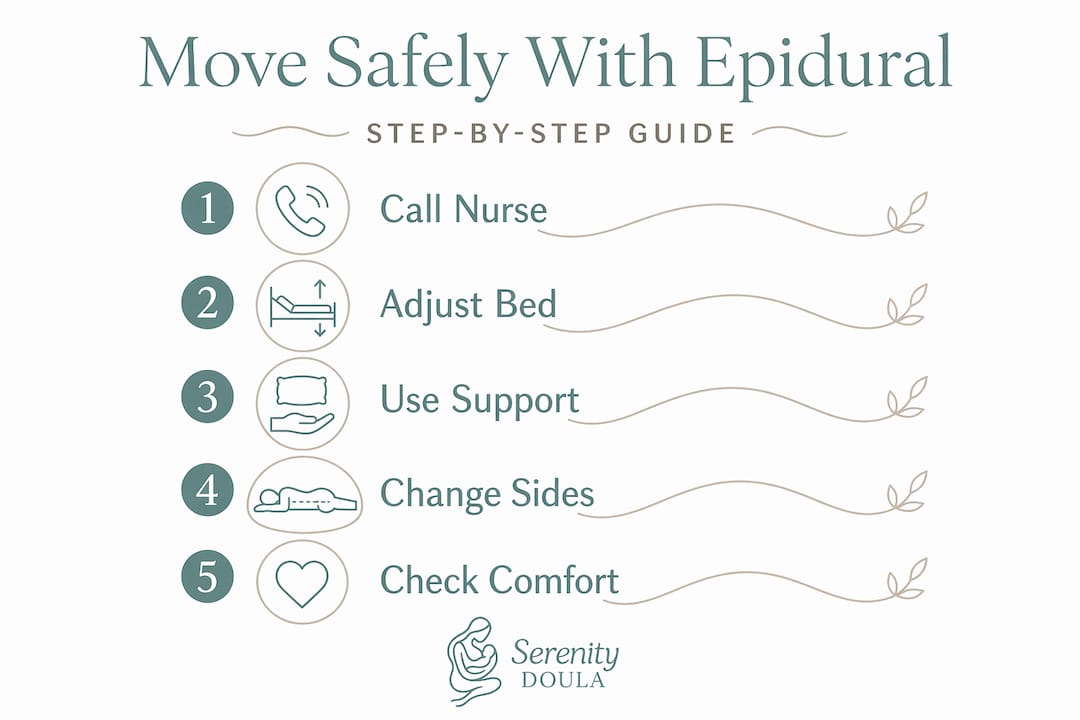
Hospitals require position changes at least every 30 minutes to promote labor progress and avoid risks tied to immobility and fetal malposition. Here’s how to do it smoothly and safely.
- Set a timer every 30 minutes so position changes happen consistently, not just when someone remembers.
- Call your nurse before shifting, especially for any position involving your legs moving significantly.
- Have your partner support your lower legs since you won’t be able to feel or control them well.
- Use pillows and the peanut ball to stabilize your new position once you’re there.
- Adjust the bed head as needed for semi-sitting or more upright positions.
- Focus on your breath during and after each position change, especially if you feel dizzy or disoriented.
- Tell your care team immediately if you notice uneven numbness, significant pressure, or anything that feels off.
“Staying in one position too long during epidural labor can slow progress and increase the chance of baby settling in a less favorable position. Movement, even small shifts, works with your body.” — Pelvic health physical therapy insight
For ongoing comfort measures with epidural, your care team is your greatest resource. Don’t hesitate to ask for guidance between position changes.
What to expect during pushing and labor progress with an epidural
Pushing with an epidural feels different. You won’t feel that overwhelming, almost involuntary urge to push that unmedicated birthing people describe. Instead, you’ll feel pressure, and that pressure is your guide.
You may still feel pressure and the urge to push with an epidural, and the goal is to aim for two to four pushes per contraction, holding each for six to eight seconds. Work with that pressure, breathe deeply between pushes, and trust your team’s coaching.
📊 Statistic spotlight: Epidurals take up to 30 minutes for full pain relief after placement during established labor. That window matters. Use it to settle into your first position and set up your support system before the medication fully takes hold.
A few other things worth knowing about labor progress with an epidural:
- The second stage (pushing) may be longer, but guided pushing in varied positions makes a real difference
- Side-lying pushing is just as effective as pushing on your back, and often more comfortable
- “Laboring down” is an option, meaning waiting for baby to descend before active pushing begins, which reduces fatigue
- Changing positions during pushing keeps things moving and reduces the strain of staying in one place too long
- Your team will tell you when to push, but you can also ask to try a different position if one isn’t feeling productive
For more ideas on partnering movement with your body’s natural process, explore natural birth tips with epidural that complement your epidural experience beautifully.
Rethinking epidural births: beyond lying flat and embracing personalized movement
Here’s something that doesn’t get said enough: the image of the perfectly still, flat-on-her-back epidural birth is a cultural artifact, not a medical requirement. It persists because it’s easy and requires less from everyone in the room. But it doesn’t serve you.
The birthing people who have the most positive epidural experiences are the ones who show up prepared and supported. They’ve practiced positions. Their partners know how to move their legs safely. They’ve asked for the peanut ball. They’ve discussed laboring down with their provider. They’ve taken a class that covered what alternative epidural positions look and feel like before labor began.
What we’ve seen time and again is that the epidural itself isn’t the limiting factor. The limiting factor is almost always a lack of preparation and support. When you have a doula in the room who knows how to reposition you, a partner who knows what to watch for, and a care team that respects your birth preferences, your epidural labor can be active, intentional, and genuinely empowering.
The peanut ball alone is criminally underused. Studies suggest it can shorten labor by a meaningful margin when used consistently with position changes, yet many laboring people never even know to ask for one. That’s a gap we can close together.
You don’t have to earn your birth experience by going unmedicated. Choosing an epidural and choosing to be an active participant in your labor are not opposites. They go beautifully together when you’re informed and supported.
Empower your birth journey with expert doula support and childbirth education
Knowing your options is one thing. Having someone by your side who can guide you through them in real time is another level entirely.

At Serenity Doula, our pregnancy and birth support doulas are trained to assist with position changes, advocate for your comfort, and help your partner step fully into their support role during epidural labor. We also offer childbirth education that covers pushing techniques, comfort tools like peanut balls, and hands-on position practice before your birth day arrives. And we make sure your partner support during labor is confident, informed, and ready. Because a supported birth, whatever form it takes, is always a better birth.
Frequently asked questions
Can I move around during labor with an epidural?
You usually cannot walk safely with an epidural due to numb legs, but changing positions in bed with support every 30 minutes is encouraged to help labor progress.
Is it possible to push effectively with an epidural?
Yes, many people feel pressure and the urge to push with an epidural. Aim for 2-4 pushes per contraction holding six to eight seconds, and changing positions helps coordinate effective pushing.
What is the best position to give birth with an epidural?
Side-lying with knees bent and a peanut ball between legs is often the top choice. Semi-sitting and hands-and-knees with assistance are also strongly recommended for aiding labor progress safely.
How long does it take for epidural pain relief to start working?
Epidurals take up to 30 minutes to provide full pain relief once placed during established labor, so use that window to get settled and supported.
Can I use the hands-and-knees position with an epidural?
Yes, but hands-and-knees requires assistance from nurses, midwives, or partners due to leg weakness from the epidural. It can relieve back pressure and help baby rotate into a better position for delivery.