
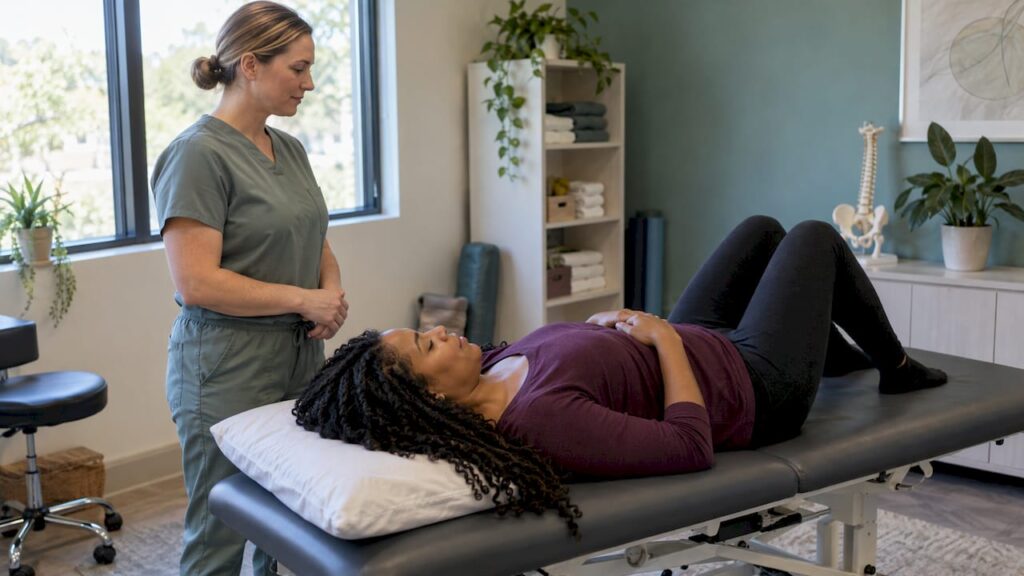
Postpartum pelvic floor therapy is physical therapy that helps the muscles supporting your bladder, bowel and uterus recover after pregnancy and birth. Most families never hear about it until something feels off. You can ask your provider about a referral early, and have a doula beside you who helps you plan for it, so recovery doesn’t become something you carry alone.
TL;DR
- Pregnancy and birth can stretch, strain or tear pelvic floor tissue, and therapy can strengthen weak muscles or release tight ones (UPMC).
- Leaking, pelvic heaviness, bowel control trouble and painful sex are the common signs to raise with your provider.
- Mayo Clinic clinicians believe access to physical therapy should be offered in the first days after delivery and again two to six weeks after discharge (Mayo Clinic).
- A first visit does not use stirrups or a speculum.
- Ask your OB, midwife or primary care provider about a referral at your postpartum visit.
Table of Contents
- What happens to your pelvic floor after birth
- Signs it may be time to ask for help
- When to see a pelvic floor therapist
- What a first visit involves
- How recovery tends to unfold
- Why awareness matters
- Support that holds you after birth
- FAQ
- Sources
What happens to your pelvic floor after birth
Your pelvic floor is a hammock of muscles and connective tissue that supports your bladder, uterus and bowel. Carrying a baby and giving birth can stretch, strain and even tear those muscles and tissues. That can lead to pelvic floor dysfunction, which may include urinary or bowel leakage, pelvic organ prolapse (when an organ presses down into the vagina) and pain (UPMC).
This applies whether you had a vaginal birth or a cesarean. Pregnancy itself loads these muscles for months. Therapy can mean strengthening muscles that are weak, or learning to relax muscles that have become too tight. Both are common, and neither means you did something wrong.
Signs it may be time to ask for help
Talk with your provider if you notice any of these:
- Leaking urine when you sneeze, laugh or cough
- Pressure, heaviness or a bulging feeling in the vagina
- Trouble controlling gas or stool
- Pain with intercourse, once your provider has cleared you for it
These are the symptoms UPMC lists for postpartum pelvic floor dysfunction. Some mothers also begin to worry about leaking, and cut back on fluids or rush to the bathroom “just in case.” Stamford Health clinicians note that these habits can reinforce the problem rather than fix it (Stamford Health). If you catch yourself doing that, it is a good reason to ask for support.
Symptoms can also stay quiet until you return to higher levels of fitness and activity (Mayo Clinic). So feeling fine at three weeks doesn’t mean you can’t ask questions at three months.
When to see a pelvic floor therapist
There is no single right day, and your own provider sets the timing for you. Here is what the guidance describes:
| Stage | What it looks like |
|---|---|
| First days after delivery | Mayo Clinic clinicians believe physical therapy access should be offered 1 to 3 days after delivery |
| Two to six weeks after discharge | Mayo Clinic clinicians believe access should be offered again at this point |
| Whenever symptoms appear | Leaking, pressure, pain or bowel changes are reasons to ask, even months later |
| Before returning to running or workouts | A good moment to ask whether an assessment makes sense |
Some programs, such as UPMC, ask for a referral, which a gynecologist, urogynecologist or primary care doctor can provide. A good question for your postpartum visit: “Would a pelvic floor physical therapy referral be appropriate for me, and when?”
What a first visit involves
Many parents worry most about the exam. Here is the picture. A visit usually includes your medical history and an exam of your back, hips and abdomen. It may also include an internal assessment of the pelvic floor with a gloved, lubricated finger, and no stirrups or speculum are used (UNC Health). The American Physical Therapy Association also notes that you are usually covered, which sets it apart from a standard gynecologic exam (APTA).
You can ask questions at any point and say no to anything. If internal exams feel daunting, our guide to internal exams and your choices walks through consent and comfort.
How recovery tends to unfold
Pelvic floor healing can take anywhere from four weeks to a few months. Baby’s size, how difficult the delivery was and whether you had tears all play a part (UPMC). The muscles and connective tissue are thought to reach their best recovery by four to six months postnatal (APTA).
Rehabilitation usually moves in phases: gentle breathing and pelvic floor activation first, then strength work, then impact-based training (Selman et al., 2022). Small daily habits matter too. ACOG notes that more fiber and avoiding bladder-irritating drinks may help (ACOG).

After a cesarean
A cesarean doesn’t skip pelvic floor strain, since pregnancy itself affects these muscles. APTA says pelvic health physical therapy can aid muscle control, tissue repair and healing of the internal portions of cesarean scars (APTA). Our 6 to 8 week cesarean recovery timeline shows where this fits.
Why awareness matters
APTA points out that low awareness among both patients and medical providers about postpartum pelvic health therapy can lead to avoidable long-term complications (APTA). Knowing the questions to ask is half the work.
Our perspective
In more than ten years of supporting Bucks County families, I’ve learned that the mothers who feel most grounded in recovery are the ones who planned for it before the baby arrived. We build that plan together during pregnancy: which questions to bring to your OB or midwife, who to call if something feels off, and how to protect your own recovery once the baby needs everything.
Postpartum can feel like being held between appointments by no one. Our evidence-based, personalized approach is designed to change that. We help you notice what your body is telling you, put words to it, and take it to your provider with confidence, whether you deliver in Newtown, Doylestown or at Trinity Health St. Mary.
You deserve to feel seen, not just checked off a list.
Alexis Wallace
Support that holds you after birth
Our postpartum care is available in-home and virtually for mothers and newborns, and our Pregnancy & Birth Doula service helps you prepare in advance. Our childbirth education classes include planning for your recovery as a family, with partners included.

For more on what to expect, read our postpartum recovery essentials and postpartum body changes explained.
FAQ
How long does it take for the pelvic floor to strengthen after birth?
Healing can take four weeks to a few months, and it varies with baby’s size, delivery difficulty and tears (UPMC). Recovery is thought to be maximized by four to six months postnatal. Ask your provider what to expect for your birth.
Do I need a referral?
Some programs require one, and a gynecologist, urogynecologist or primary care doctor can provide it (UPMC). Requirements vary by clinic and insurance plan, so ask your provider’s office and your insurer.
Is the exam uncomfortable or invasive?
It may include a gentle internal assessment with a gloved, lubricated finger, with no stirrups or speculum (UNC Health). You stay in control and can pause or decline any part.
Can I wait until I feel symptoms?
Symptoms can stay silent until you return to higher activity levels (Mayo Clinic). Ask your provider at your postpartum visit whether an assessment suits you, symptoms or not.
When you’re ready, we’d love to meet you: book a free consultation and let’s plan your recovery together.
Sources
- UPMC: Pelvic Floor Healing
- Mayo Clinic: Advancing care for childbirth-related pelvic floor disorders
- Mayo Clinic: Physical medicine and rehabilitation news
- Stamford Health: Pelvic physical therapy
- UNC Health: How physical therapy can relieve pelvic pain
- APTA: State of pelvic health PT report
- APTA: Increasing awareness of pelvic health physical therapy
- Selman et al.: Maximizing recovery in the postpartum period
- ACOG: Healing and adjusting after postpartum pelvic organ prolapse