
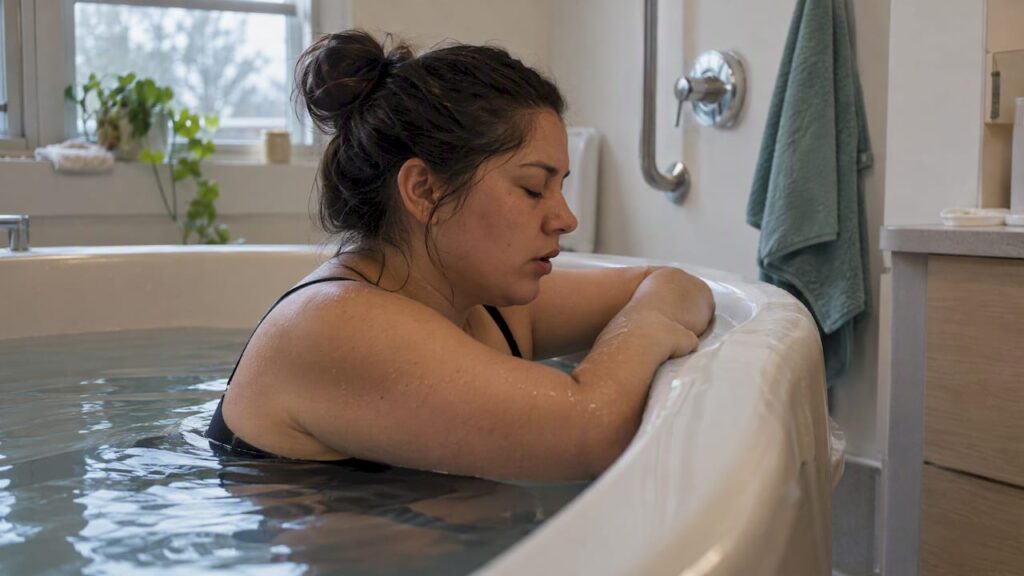
Laboring in warm water can ease pain and help you feel more in control. Giving birth in the water is where the evidence gets thinner and expert opinion divides. For healthy women with uncomplicated pregnancies, the research supports the first part much more strongly than the second. Below we walk through both, plainly, so you can bring good questions to your provider.
TL;DR
- Laboring in water is associated with fewer epidurals and less reported pain in healthy, low-risk pregnancies.
- Birthing in water (the delivery itself) is where ACOG and the research diverge: ACOG recommends that birth take place on land.
- Rare but serious risks, including cord avulsion and infection from poorly cleaned tubs, are real, though uncommon.
- Water is one tool, not an all-or-nothing choice. You can step out of the tub at any time.
- Ask your provider about eligibility, tub cleaning, and the “exit protocol” before labor begins.
Table of Contents
- First, what do people mean by “water birth”?
- The potential benefits
- The potential downsides and risks
- Pros and cons at a glance
- Who may not be a candidate
- Finding a place that offers it near Bucks County
- Our perspective: water is a tool, not a test
- How we can help
- FAQ
- Sources
First, what do people mean by “water birth”?
The phrase covers two different things, and mixing them up causes most of the confusion.
- Water immersion in labor: you spend part of the first stage in a tub or pool, then move to land to push and deliver.
- Delivery in water: the baby is born while you are still in the pool.
Some hospitals and birth settings allow only the first. Ask exactly which one a facility offers. In one hospital-based study of water immersion, about a third of women used water only in the first stage, while most also went into second-stage immersion, and many of those completed delivery in the water.
The potential benefits
Less pain and fewer epidurals
The Cochrane review on immersion in water found that laboring in water may reduce the number of women having an epidural. It did not appear to change the mode of birth or the rate of serious perineal tears. ACOG’s committee opinion likewise notes that immersion in the first stage is associated with decreased use of regional analgesia and may shorten the first stage of labor, with no evidence of increased adverse outcomes for healthy women in uncomplicated pregnancies.
Comfort, movement, and calm
Warmth and buoyancy take weight off your joints, make position changes easier, and often help you relax between contractions. Many clients tell us the water helped them feel grounded when labor felt overwhelming. Relaxation is not a measured outcome in every study, so we treat it as a common experience rather than a guarantee. If you want other options for calming your body, our guide to childbirth relaxation techniques covers several that work with or without a tub.
A sense of autonomy
A pool gives you something to do with labor: a place to move, sway, and settle. That feeling of agency matters. ACOG also lists approaches to limit intervention during labor as a way to help women meet their goals.
The potential downsides and risks
ACOG recommends delivering on land
ACOG supports laboring in water but advises that delivery take place on land, saying water delivery has no proven benefit and may pose risks. Its committee opinion names rare but serious concerns: neonatal water inhalation, cord avulsion (the umbilical cord snapping), and infection.
What the larger studies show
A 2021 cohort study of 17,530 waterbirths in U.S. community births, matched with land births, found comparable or better neonatal outcomes in low-risk women. It also found higher odds of umbilical cord avulsion with waterbirth (adjusted odds ratio 1.57). The takeaway is balanced: waterbirth looks neither as dangerous as some guidelines imply nor as risk-free as some enthusiasts claim.
A 2025 randomized trial of hospital waterbirth enrolled 186 participants, but attrition was 39%, so it is best read as early evidence rather than a final answer.

Infection and tub hygiene
The CDC’s journal documented a fatal Legionella infection in a newborn after a water birth in Texas in 2014. It is an extremely rare event, but it is why we ask about how a tub is cleaned and maintained. You should not have to wonder about it.
As for the worry everyone whispers about: passing stool in the pool is normal, and trained staff remove it quickly with a net. The tub’s disinfection protocol matters far more.
Temperature
Water that is too warm can overheat you and, after birth, your baby. Ask who monitors the temperature and how often.
Pros and cons at a glance
| Potential pros | Potential cons | |
|---|---|---|
| Labor in water | Less pain, fewer epidurals, easier movement, relaxation | Not available for everyone; you may need to leave the tub for monitoring or medical reasons |
| Delivery in water | Some people value a gentle, low-intervention setting | ACOG advises land birth; rare risks include cord avulsion, inhalation, infection |
| Setting | Calm, private feeling | Policies and equipment vary widely by facility |
Who may not be a candidate
Water immersion is generally studied in healthy women with low-risk pregnancies. Whether you qualify depends on your medical history and how your pregnancy is going, and that is a decision for your obstetrician or midwife, not for a blog post. Good questions to bring:
- Based on my health history, would I be eligible for immersion in labor? For delivery in water?
- What would make you ask me to leave the tub?
- How is the tub cleaned and disinfected between uses?
- Who monitors the water temperature?
- How is my baby’s heart rate monitored while I’m in the water?
- If I’m transferred or need an epidural, what happens next?
Finding a place that offers it near Bucks County
Availability changes, and policies differ even within one health system. Instead of assuming, call the hospital or birth center and ask whether tubs are available, whether they are for labor only, and whether delivery in water is allowed. If you are weighing settings, our guide to birthing environments compares them, and our Philadelphia water birth questions list what to ask hospitals in the region. Families delivering near Newtown or Doylestown often also ask their hospital, including Trinity Health St. Mary, about its current tub policy. We do not assume it for you.
It also helps to write down your preferences and talk them through with your care team. A planner and care-options guide can help you organize those questions.
Our perspective: water is a tool, not a test
We see this fear often: if I choose water, will I be stuck there? No. Water immersion is one tool in your kit. If you decide you want an epidural or need medical help, you step out of the tub. It is not an all-or-nothing choice.

What we encourage every family to do is talk about the exit protocol before labor starts: when and why you might move to land. Knowing that ahead of time means a change of plan feels like part of the plan, not a failure. Hospitals that limit tubs often cite the need for standardized protocols on tub maintenance, infection control and newborn monitoring, which is a reasonable thing to respect.
Our job as doulas is to help you feel seen and grounded, whichever way your birth unfolds, and to help you ask your provider the right questions. If you are curious about a doula who understands water birth, read our questions to ask a Bucks County water birth doula.
— Alexis Wallace
How we can help
If you want a calm, evidence-based plan for your birth, including water, we offer pregnancy and birth doula support and private childbirth education to help you and your partner walk in prepared.
FAQ
Is water birth safe?
For healthy women with uncomplicated pregnancies, ACOG and Cochrane find laboring in water to be a reasonable option without evidence of increased adverse outcomes. ACOG advises that delivery occur on land because safety for water delivery has not been established. Ask your provider whether you are a candidate.
Why do hospitals not allow water births?
Many hospitals restrict them because of the need for consistent tub cleaning, infection control and newborn monitoring protocols. Some allow the tub only for labor. Call your hospital and ask what its policy is.
What happens if I poop in the birthing pool?
It is common and expected. Your team removes it quickly with a fine-mesh net. The more important question is how the tub itself is disinfected.
Can I get an epidural if I start in the tub?
Yes, in most settings you can leave the tub and change your plan. Confirm this with your provider ahead of time, and ask what the process looks like.
Sources
- Immersion in Water During Labor and Delivery, ACOG
- Ob-Gyns Weigh In: Laboring in Water Is OK, but Deliver Baby on Land, ACOG
- Approaches to Limit Intervention During Labor and Birth, ACOG
- Featured Review: Immersion in water during labour and birth, Cochrane
- Cohort study of 17,530 waterbirths
- Hospital-based deliveries with water immersion
- Hospital waterbirth randomized controlled trial
- Fatal Legionellosis after Water Birth, Texas, 2014, CDC