
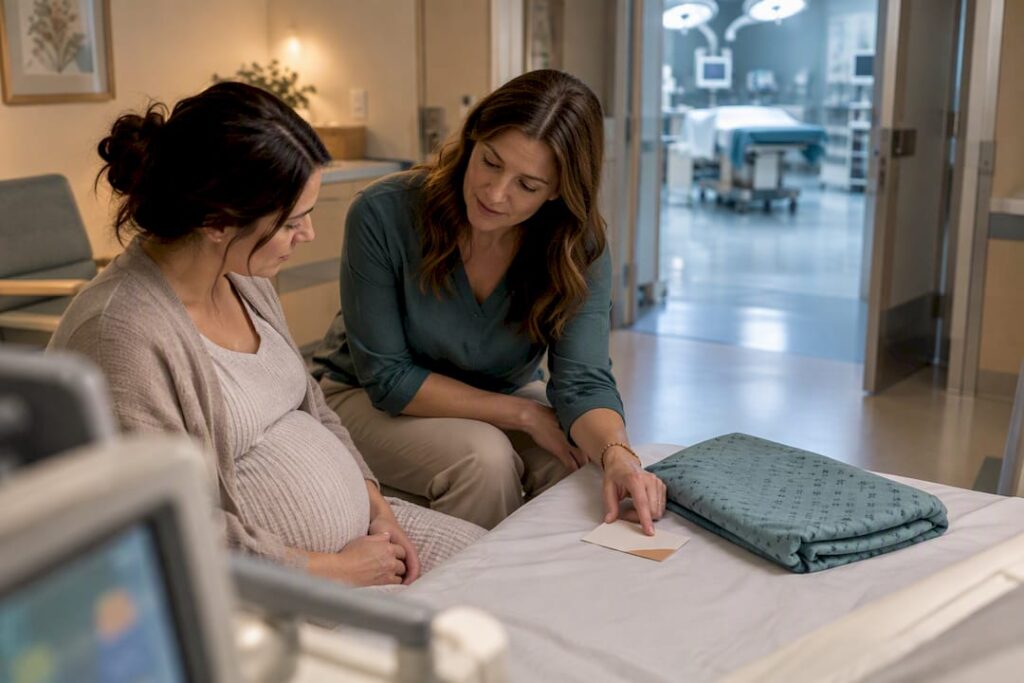
Yes, a trained cesarean birth doula can support you before your surgery, during it when hospital policy allows, and through every day of recovery afterward. Cochrane’s review of continuous labor support and ACOG’s committee guidance both back this up, and Serenity Doula has built its cesarean support around exactly this evidence. Keep reading for the practical checklists and hospital questions that make the difference on surgery day.
TL;DR:
- A cesarean birth doula should be involved weeks or months before surgery to help craft personalized birth preferences and rehearse potential scenarios.
- Hospital policies on support presence, skin-to-skin contact, and delayed cord clamping vary and must be confirmed in advance through prenatal communication.
- In the OR, a doula offers emotional support, helps communicate preferences, and coaches partners, but cannot make clinical decisions or touch sterile fields.
- Family-centered cesarean techniques like immediate skin-to-skin and early breastfeeding benefit from thorough coordination with medical staff and support from the doula.
- Preparation and planning with a cesarean-experienced doula reduce stress, improve adherence to preferences, and foster a more positive birth experience overall.
Table of Contents
- Prenatal Planning for a Cesarean Birth Doula
- What a Doula Can and Cannot Do in the Operating Room
- Family-Centered Cesarean Options for Skin-to-Skin and Early Feeding
- Recovering From a Cesarean: How a Doula Helps After Surgery
- Choosing a Cesarean-Experienced Doula: What to Ask
- From the Doula’s Chair: A Few Things I Tell Every Client
- Why the “Doulas Are Only for Unmedicated Births” Myth Persists
- How Serenity Doula Supports Cesarean Families in Bucks County
- Sources
- FAQ
Prenatal Planning for a Cesarean Birth Doula
A good cesarean birth doula starts working weeks, sometimes months, before your due date, not the morning of surgery. At Serenity Doula, that means sitting down with you to draft cesarean-specific preferences even if you’re planning a vaginal birth, because roughly one in three births ends up surgical and nobody wants to write a birth plan in a pre-op hallway. You’ll rehearse “what if” scenarios together so an unplanned cesarean feels less like a crisis and more like a plan B you already discussed.
Part of that prep is confirming hospital policy before you’re in labor, not after. Ask your provider or hospital:
- Can a doula (in addition to a partner) be present in the OR?
- Is immediate skin-to-skin possible in the operating room or recovery?
- Will the team delay cord clamping if you and baby are stable?
- How soon after surgery does the newborn exam happen, and can it happen at your bedside?
Your written plan should include specifics, not vague hopes. For example: “Request lowered drape for the birth moment if safe,” “Partner holds baby skin-to-skin if I cannot,” and “Doula relays feeding preferences to nursing staff.” Partners get coached too, since they’re often the one physically able to move around the OR when you can’t.
What a Doula Can and Cannot Do in the Operating Room
Inside the OR, a doula’s job shifts from active labor coaching to steady presence and quiet advocacy. Cochrane’s qualitative evidence on labor companionship describes this exact function: informational, practical, and emotional support that helps families communicate with their care team under pressure.
In practice, that looks like:
- Staying at your head or shoulder to talk you through each step as it happens
- Reminding the surgical team of your stated preferences (lowered drape, skin-to-skin, delayed clamping) at the right moment
- Coaching your partner on where to stand and what to expect so they aren’t frozen or in the way
- Offering calm narration, a hand to hold, or slow breathing cues since sterile fields rule out massage or touch below the shoulders
What a doula cannot do is make clinical decisions, touch the sterile field, or override hospital policy. OR visitor policies vary widely by hospital: some allow both a doula and a partner, others cap it at one support person. If your doula isn’t permitted inside, she’ll typically wait just outside and step in the moment you’re back in recovery.
Pro Tip: Write your top three preferences on a small card and hand it to your doula before surgery. In the OR, there’s rarely time for a paragraph; a short list she can read aloud to the team in seconds works far better than a memory under stress.
Family-Centered Cesarean Options for Skin-to-Skin and Early Feeding
“Gentle” or family-centered cesarean techniques include a lowered or clear drape so you can watch the birth, immediate skin-to-skin in the OR or recovery room, and early breastfeeding initiation instead of a routine separation for newborn checks. ACOG’s own guidance encourages these interventions when they’re clinically safe, and a doula’s job is to help you ask for them clearly and early.
Coordinating this well means your doula:
- Confirms with your OB or midwife during prenatal visits which family-centered options that specific hospital supports
- Loops in the lactation consultant or nursing staff ahead of delivery so skin-to-skin isn’t a surprise request in the moment
- Positions herself to help with that critical first latch, adjusting pillows and your position around the incision
A quasi-experimental trial found that midwife-led continuity of care paired with individualized breast support after cesarean nearly doubled exclusive breastfeeding at 48 hours, significantly higher exclusive breastfeeding rates in the supported group compared to the standard-care group, with faster ambulation and bowel recovery too. That gap is exactly what dedicated, hands-on support is designed to close.
Recovering From a Cesarean: How a Doula Helps After Surgery
Most cesarean recovery follows a fairly predictable arc. ACOG notes a typical hospital stay of two to four days, with full recovery stretching over several weeks at home. A doula’s postoperative role is entirely nonmedical, but it fills the hours your nursing team can’t.
While you’re still in the hospital, your doula focuses on a rough sequence of milestones:
- First ambulation. Gentle coaching to get you into a chair within 12 to 24 hours, as tolerated, since early movement is central to ERAS protocols for cesarean recovery and helps ease gas pain.
- First bowel movement. Encouraging fluids, movement, and patience, since this often causes more anxiety than the incision itself.
- Catheter removal. A cue that mobility and independence are returning.
- First full feed. Whether breast or bottle, getting positioning and support right so it isn’t painful.
At home, that support continues as light household help, newborn care coaching, and steady breastfeeding reinforcement so you’re not troubleshooting alone at 2 a.m. Your doula also watches for red flags that call for a call to your provider: heavy bleeding, fever, redness or discharge at the incision, or pain that’s escalating rather than easing. ACOG recommends early postpartum contact within about three weeks of a cesarean, and your doula will remind you not to skip that check even when you’re feeling fine.
Pro Tip: Ask your OB or midwife directly which symptoms warrant a same-day call versus one that can wait for your scheduled visit. Getting that answer before you go home removes a lot of 2 a.m. guesswork.

Choosing a Cesarean-Experienced Doula: What to Ask
Not every doula has deep OR experience, so ask specific questions rather than relying on a general certification. Look for someone who can speak fluently about hospital orientation, lactation basics, and trauma-informed care, since a cesarean, planned or not, is still a major abdominal surgery layered onto a birth experience.
In a consultation, ask:
- “How many cesarean births have you supported, and were you ever in the OR?”
- “What’s your backup plan if you’re unavailable when I go into labor?”
- “How many postpartum visits are included, and how soon after discharge is the first one?”
- “How do you handle an unplanned cesarean if we started planning for a vaginal birth?”
Red flags include vague answers about backup coverage, no mention of postpartum follow-up, or hesitation when you ask about hospital-specific OR policy. A solid contract should spell out availability windows, an on-call backup doula, and a defined number of postpartum visits. If you’re comparing two candidates, put their answers to those four questions side by side. The gaps usually show up fast.
From the Doula’s Chair: A Few Things I Tell Every Client
Ask about OR policy at your hospital tour, not in triage. I’ve watched families lose precious minutes negotiating access to the OR because nobody asked ahead of time. Decide your skin-to-skin preferences before labor starts, and say them out loud to your provider more than once. And book your postpartum check-ins now, because the third day home is when most families realize how much they need them.

The thing I hear most on surgery day isn’t fear of the incision. It’s relief that someone in the room already knows the plan, so nobody has to explain it from scratch while flat on an OR table.
— Alexis Wallace
Why the “Doulas Are Only for Unmedicated Births” Myth Persists
The most persistent misconception I run into is that doulas exist to help someone avoid a cesarean, and that once surgery is on the table, the doula’s job is basically over. That gets it backward. One OB-GYN’s own account of hiring a doula for her delivery makes the point well: a doula’s real value in a surgical birth is as a translator and an anchor, someone who can turn a fast-moving clinical conversation into plain language and hold your hand through it.
What gets underrated is how much of that value is prenatal. Families who wait until labor to think about OR policy or skin-to-skin preferences are improvising during the most stressful hour of their pregnancy. Families who’ve mapped it out in advance, ideally with a doula who already knows their hospital, walk into that OR with a plan instead of a scramble.
If you take one thing from this article, make it this: don’t treat cesarean planning as a backup to your “real” birth plan. Treat it as its own plan, built early, with someone who has done this before.
— Alexis Wallace
How Serenity Doula Supports Cesarean Families in Bucks County
Families seeking comprehensive cesarean recovery support can benefit from working with a doula who helps build a cesarean-specific plan months before the due date, confirms OR policies with hospitals, and provides presence during skin-to-skin contact, first latch, and early recovery at home.

Our Pregnancy & Birth Doula service covers prenatal planning, OR accompaniment where hospital policy allows, and birth-day advocacy tailored to your specific preferences. Pair it with our Postpartum Care support for in-home recovery help, or our Childbirth Education classes if you want to walk into your surgery already fluent in the process. A free consultation is the easiest way to start: we’ll talk through your hospital, your due date, and exactly what family-centered cesarean support could look like for you. Book yours through Serenity Doula’s birth doula page whenever you’re ready to talk it through.
This article is general information, not a substitute for advice from a qualified doctor. Consult a qualified healthcare professional about your own circumstances before acting on anything here.
Sources
- Continuous support for women during childbirth (systematic review / Cochrane)
- Partnering With Doulas in Clinical Settings | ACOG
FAQ
Are Doulas Allowed in C-Sections?
Whether a doula can join you in the OR depends entirely on your hospital’s visitor policy, which varies from one facility to another. Some hospitals allow both a doula and a partner, while others limit OR entry to a single support person, so confirming this during a prenatal tour matters more than any general rule.
Are Doulas Against Epidurals or Pain Medication?
No. A cesarean birth doula supports whatever pain management and birth choices you make, including epidurals, spinals, and general anesthesia when medically necessary. Her role is comfort, information, and advocacy, never steering you away from medical care your provider recommends.
How Much Do Postpartum Doulas Make Per Hour?
Postpartum doula rates vary widely by region, experience, and service package, and Serenity Doula’s current postpartum care pricing is available directly on the Postpartum Care page rather than a single published hourly rate. Ask about package options during your free consultation to get exact figures for your situation.
Will Insurance Cover a Postpartum Doula?
Coverage is inconsistent. Medicaid doula coverage has expanded in a growing number of states, but private insurance reimbursement for doula care still varies significantly by plan and state. Ask your insurer directly whether doula services qualify, and consider asking your employer about HSA or FSA eligibility as well.