
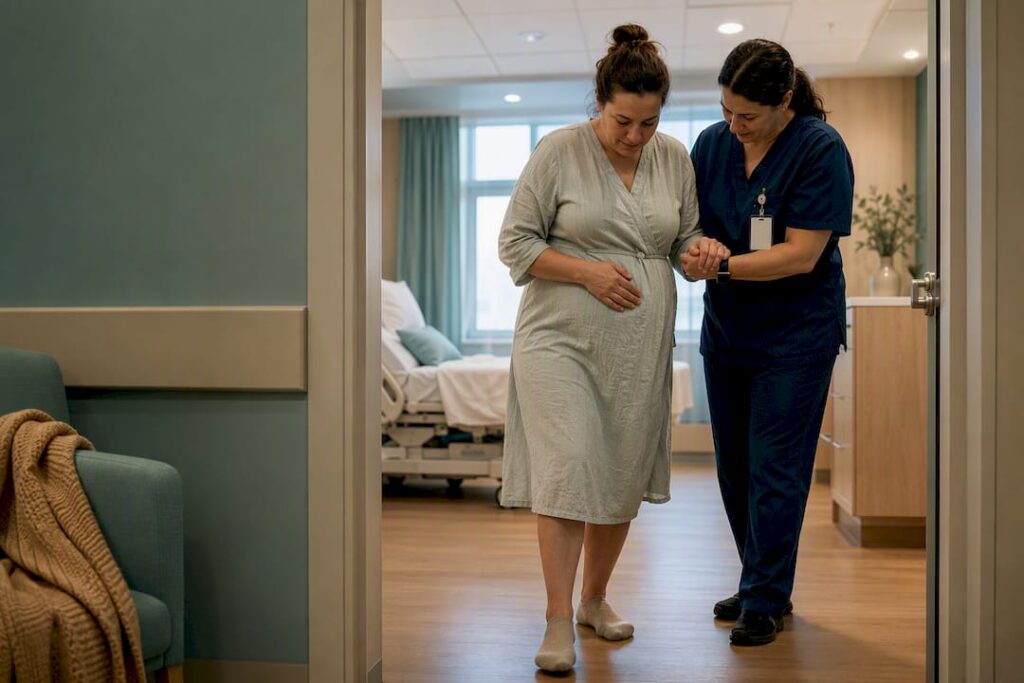
Most people go home 2 to 4 days after a cesarean and reach full physical recovery around 6 to 8 weeks, though how you feel week to week varies quite a bit. Early milestones include catheter removal, your first walk down the hallway, and a pain plan built around scheduled medication rather than waiting until you hurt. Bleeding shifts from bright red to lighter shades over several weeks. Call your provider right away for heavy bleeding, fever, or a wound that looks worse instead of better.
TL;DR:
- Heavy bleeding exceeding one pad per hour or large clots requires immediate medical attention, especially during the first week.
- The first two weeks are the most challenging, with peak soreness, intense bleeding, and limited activity, but pain generally starts to ease after week two.
- Incision care emphasizes keeping the wound dry and monitoring for signs of infection such as redness spreading or foul odor, with medication management supporting pain relief.
- Heavy lifting and strenuous activity remain off-limits for four to six weeks, and driving should wait until pain-free braking and turning are possible.
- Emotional symptoms like persistent sadness or anxiety beyond two weeks may indicate postpartum depression and warrant professional evaluation.
Table of Contents
- The Cesarean Recovery Timeline, Day by Day and Week by Week
- How Do You Care for the Incision and Manage Pain?
- When Should You Call Your Provider?
- When Can You Move, Drive, and Lift Again?
- What Does Bleeding and Cramping Look Like After Delivery?
- What Does Emotional Recovery Look Like After a Cesarean?
- What Should Your First Six Weeks at Home Actually Look Like?
- A Doula’s Honest Take on Cesarean Healing
- Get Support Through Every Stage of Cesarean Recovery
- Sources
- FAQ
The Cesarean Recovery Timeline, Day by Day and Week by Week
Recovery from a cesarean isn’t one long stretch. It moves through distinct phases, each with its own physical demands and its own version of “normal.”
Day of surgery. You’re in the recovery room with your vitals checked frequently, an IV running fluids, and a Foley catheter in place so you don’t have to worry about walking to the bathroom yet. Pain medication starts here, often on a schedule rather than as needed, which matters more than most people realize. Getting ahead of pain works better than chasing it.
Day 1 to 2. This is where things start moving, literally. Most hospitals remove the catheter within 6 to 24 hours and encourage you to sit up, then stand, then take a few steps with support. It sounds like a lot to ask of a body that just had surgery, but early walking is one of the most protective things you can do. It lowers your risk of blood clots and helps your bowels wake back up. Diet usually progresses from clear liquids to regular food as you tolerate it, and your care team will ask about your first bowel movement, since that’s a real marker of recovery.
Days 2 through 7 (week one). This tends to be the hardest stretch. Moving from a lying to a sitting position, laughing, coughing, all of it can pull at the incision in ways that catch you off guard. Scheduled acetaminophen and NSAIDs are the backbone of pain control here, with short courses of oral opioids available for breakthrough pain if you need them. Bleeding is heaviest and brightest red in these early days, gradually lightening as the week goes on.
Week 2. Many people notice a real shift here. Pain eases, energy starts trickling back, and the incision feels less like the center of your universe. That said, heavy lifting, long car rides, and anything strenuous are still off the table until your provider gives the go-ahead.
Weeks 3 and 4. The incision typically looks less angry and more like a healing scar. Follow your hospital’s specific instructions on dressings or steri-strips, and hold off on scar massage or scar creams until the wound has fully closed.
Weeks 6 to 8. This is when the standard postpartum check happens for many people, and it’s often the visit where you get clearance to increase activity. Scar tissue keeps remodeling well past this point, so don’t be surprised if the area still feels tight or numb in patches.
Two months and beyond. Most daily activities are back on the table by now, but fatigue, pelvic heaviness, or occasional twinges near the scar can linger. These are worth mentioning at a follow-up rather than quietly pushing through.
- Day of surgery: monitoring, IV fluids, catheter, first pain medication
- Day 1 to 2: catheter removal, first walk, diet progression
- Week 1: peak soreness, scheduled pain medication, bright red bleeding
- Week 2: noticeable easing, still no heavy lifting
- Weeks 3 to 4: incision healing visibly, dressing care per instructions
- Weeks 6 to 8: clinical check, activity clearance for many
- 2+ months: routine activity resumed, occasional lingering symptoms
How Do You Care for the Incision and Manage Pain?
Keeping the incision clean and dry, following whatever dressing instructions your hospital sent you home with, matters more than any special ointment or product. Watch for increasing redness that spreads rather than fades, warmth around the wound, drainage that smells off, or any separation of the skin along the incision line. Those are signs to get it checked, not signs to wait and see.
On pain, the current evidence-based approach favors scheduled acetaminophen and NSAIDs as the first line of defense, with oral opioids kept in reserve for pain that breaks through despite the schedule. If you’re breastfeeding, ask your provider directly which pain medications are considered compatible. That’s a conversation worth having before you leave the hospital, not after.
A few small adjustments make a real physical difference:
- Hug a pillow against your incision when you cough, sneeze, or laugh.
- Use the same pillow-brace trick when you sit up from lying down.
- Support your midsection while breastfeeding to ease strain on healing tissue.
Pro Tip: Keep a small pillow within arm’s reach of wherever you’re resting or nursing. That thirty seconds of setup saves you real pain later.
When Should You Call Your Provider?
Some symptoms are normal and expected. Others need a phone call now, not a wait-and-see approach. Here’s how to tell the difference.
- Heavy bleeding. Soaking through more than one pad an hour, or passing clots larger than a golf ball, warrants an immediate call.
- Fever over 100.4°F, combined with worsening redness at the incision, pus-like drainage, or new or spreading pain at the wound site.
- Signs of a blood clot, such as calf swelling or pain, or sudden shortness of breath and chest pain. These need emergency care right away, not a next-day appointment.
If you’re ever unsure whether something falls into “normal but uncomfortable” or “call now,” err toward calling. No one on your care team will fault you for checking.
When Can You Move, Drive, and Lift Again?
Getting up and moving early, often within hours of surgery, is one of the most protective things you can do after a cesarean. Enhanced Recovery After Cesarean protocols build this in deliberately: sitting on the edge of the bed, then a few supported steps, because early movement lowers clot risk and speeds up how quickly your body bounces back.
That said, early movement isn’t the same as unrestricted movement. Heavy lifting and strenuous exercise typically stay off-limits for 4 to 6 weeks, and driving should wait until you can comfortably brake and turn without pain. Ask your provider specifically about your baby’s carrier weight and car seat handling.
- Adjust your car seat forward so you’re not twisting to reach the wheel.
- Let your partner or a family member run errands that involve lifting.
- Hold off on baby-wearing carriers until you’re cleared for that kind of core engagement.
What Does Bleeding and Cramping Look Like After Delivery?
Lochia, the postpartum bleeding that follows any delivery method, can last up to six weeks, moving from bright red in the early days to pink or brown, then eventually to yellow or white as your body finishes shedding the uterine lining.
Breastfeeding often intensifies cramping during this window, sometimes called afterpains, because nursing triggers oxytocin, which prompts your uterus to contract. It’s uncomfortable, but it’s your body doing exactly what it’s supposed to do, and it should feel manageable rather than debilitating.
- Bright red bleeding in week one is expected; it should lighten steadily, not suddenly get heavier again.
- Afterpains during or right after nursing sessions are normal for the first couple of weeks.
- A sudden return to heavy bleeding, a strong odor, or unusually large clots deserves a call to your provider.
What Does Emotional Recovery Look Like After a Cesarean?
I’ve sat with a lot of families in that hazy first week home, and here’s what I want you to know: feeling weepy, overwhelmed, or unexpectedly emotional in the first couple of weeks is common, and it usually eases on its own. What’s often called the baby blues tends to peak around day four or five and fade by week two. If sadness, anxiety, or a sense of numbness is still sitting heavy at that two-week mark, that’s worth a real conversation with your provider about postpartum depression screening, not something to quietly wait out.
Recovery isn’t just physical. The families I support often need someone to notice the emotional weight before they’ve found the words for it themselves.
Doulas can’t diagnose or treat, but we can coordinate meals, help with newborn care in those blurry early days, and sit with you between medical appointments so you’re not carrying it all alone.
Pro Tip: Ask your provider directly: “What would postpartum depression look like for me specifically, and when should I call?” A concrete answer beats a vague worry every time.
What Should Your First Six Weeks at Home Actually Look Like?
Healing well after a cesarean often comes down to unglamorous daily habits repeated consistently.
- Rest in clusters around feedings rather than waiting for one long stretch of sleep that won’t come.
- Take pain medication on schedule, not just when discomfort becomes hard to ignore.
- Drink water consistently and prioritize protein at meals to support tissue repair.
- Take short, gentle walks daily, building duration slowly rather than pushing distance.
- Check the incision daily for changes, and use stool softeners if your provider recommends them.
- Limit visitors to short windows and lean on family or postpartum nutrition support for meals.
Pro Tip: Assign a specific person, not a group text, to organize the meal train. “Someone will figure it out” rarely works when everyone assumes someone else has it handled.
Partners and family can handle groceries, laundry, and older-sibling logistics, while professional postpartum support can step in for the hands-on infant care and household coordination that let you actually rest instead of just resting on paper.
A Doula’s Honest Take on Cesarean Healing
Here’s what I tell every client who comes to me nervous about a cesarean: your recovery will not look exactly like your sister’s, your best friend’s, or the timeline in this article, and that’s not a failure on your part. Bodies heal at different speeds, and a “textbook” six weeks is a median, not a promise.
What I can promise is that the first two weeks go easier with a second set of hands. A doula supporting your cesarean recovery means someone helping you into a comfortable position for that first feed, tracking your pain schedule when your brain is running on no sleep, and gently flagging when something looks worth a call to your provider. Families across Bucks County who’ve worked with us tell me the biggest relief wasn’t any single task. It was not having to manage the whole thing alone.
If you’re expecting a cesarean, or recovering from one now, book a free consultation and let’s talk through what your first six weeks could actually look like.
— Alexis Wallace
Get Support Through Every Stage of Cesarean Recovery
A week-by-week timeline tells you what’s typical. It can’t tell you who’s going to help you shower without pulling your incision, or notice you’ve gone quiet and check in before it becomes a bigger problem. Serenity Doula fills that gap for families across Newtown, Doylestown, and the rest of Bucks County who want more than a printed discharge sheet standing between them and a hard first month.

Our postpartum support includes in-home and virtual visits built specifically around cesarean healing: help positioning for breastfeeding without straining the incision, coordinating meals and light household tasks, and connecting you back to your OB or midwife at Trinity Health St. Mary or wherever you deliver when something needs a closer look. Our childbirth education sessions also cover what a family-centered or gentle cesarean can look like if you’re still planning ahead, including options like delayed cord clamping and skin-to-skin in the OR that many hospitals now support on request.
A free consultation is where we map out what your first six weeks might actually need, based on your birth plan, your support system, and your specific recovery. Schedule your free consultation and start building that plan now, before the fourth trimester catches you off guard.

This article is general information, not a substitute for advice from a qualified doctor. Consult a qualified healthcare professional about your own circumstances before acting on anything here.
Sources
- AJOG — Enhanced Recovery After Cesarean Delivery (ERAC) 2025 update
- MedlinePlus — After a C-section: in the hospital
- Cleveland Clinic — Postpartum guidance
- Mayo Clinic — Birthing services (patient guidance)
FAQ
What Is the Hardest Day of C-Section Recovery?
Most people find days two through five the toughest, when initial numbness fades and the anesthesia wears off completely, before scheduled pain medication has fully caught up with the discomfort.
What Is the 5-5-5 Rule for C-Section Recovery?
It’s an informal guideline some parents use: 5 days resting mostly in bed, 5 days resting mostly on the couch, and 5 days staying close to home before slowly resuming normal routines. It’s not an official clinical protocol, so treat it as a gentle framework and ask your provider what pace fits your specific recovery.
How Long Should a Woman Rest After a C-Section?
Full physical recovery is commonly measured at 6 to 8 weeks, though most people need the most concentrated rest in the first two weeks, with gradually increasing activity after that under their provider’s guidance.
What Should You Avoid Two Weeks After a C-Section?
Avoid heavy lifting, strenuous exercise, and long car rides at the two-week mark, since the incision is still healing internally even if it looks better on the surface. Ask your provider exactly when driving and lifting your baby’s car seat becomes safe for you.
When Does Bleeding After a C-Section Stop?
Lochia typically tapers off within six weeks, shifting from bright red to pink or brown and finally to yellow or white. Contact your provider if bleeding suddenly increases, smells unusual, or includes clots larger than a golf ball.