

TL;DR:
- Artificial rupture of membranes involves intentionally breaking the amniotic sac to support labor and fetal monitoring. It can shorten labor and provides immediate assessment of amniotic fluid but carries risks of cord prolapse and infection. Expect stronger contractions and closer monitoring after the procedure, which requires informed consent and careful clinical decision-making.
Artificial rupture of membranes (AROM) is the intentional breaking of the amniotic sac by a healthcare provider to support labor progress and fetal monitoring during childbirth. Also called amniotomy, this procedure is one of the most common obstetric interventions you may encounter during labor. Only about 10% of pregnant women experience spontaneous membrane rupture at the start of labor, which means most parents will face a conversation about whether and when to have it done. Understanding what to expect, why it is offered, and what the risks are helps you walk into that conversation feeling grounded and confident.
What is the amniotomy procedure and how is it done?
The amniotomy procedure uses a small, sterile plastic instrument called an amnihook to gently nick the amniotic sac through the cervix. Think of it like a long, thin crochet hook with a tiny tip. Your provider inserts it carefully during a vaginal exam and creates a small opening in the membrane.
Here is what typically happens during the procedure:
- Your provider performs a pelvic exam to confirm your cervix is ready and your baby’s head is in position.
- The amnihook is guided through the cervix to the amniotic sac.
- A small puncture releases the amniotic fluid in a warm gush or slow trickle.
- Your provider immediately checks the fluid’s color, smell, and amount for signs of concern.
- Your baby’s heart rate is monitored right after to confirm everything looks good.
The procedure itself is usually quick, taking less than a minute. Most parents describe it as feeling similar to a vaginal exam, with a surprising warm sensation as the fluid releases. It is not inherently painful, though sensations vary from person to person.
Pro Tip: Tell your provider exactly what you are feeling during the procedure. If something feels sharp or uncomfortable, say so. Good communication in that moment helps your care team adjust and keeps you feeling safe.

What are the benefits and clinical reasons for artificial membrane rupture?
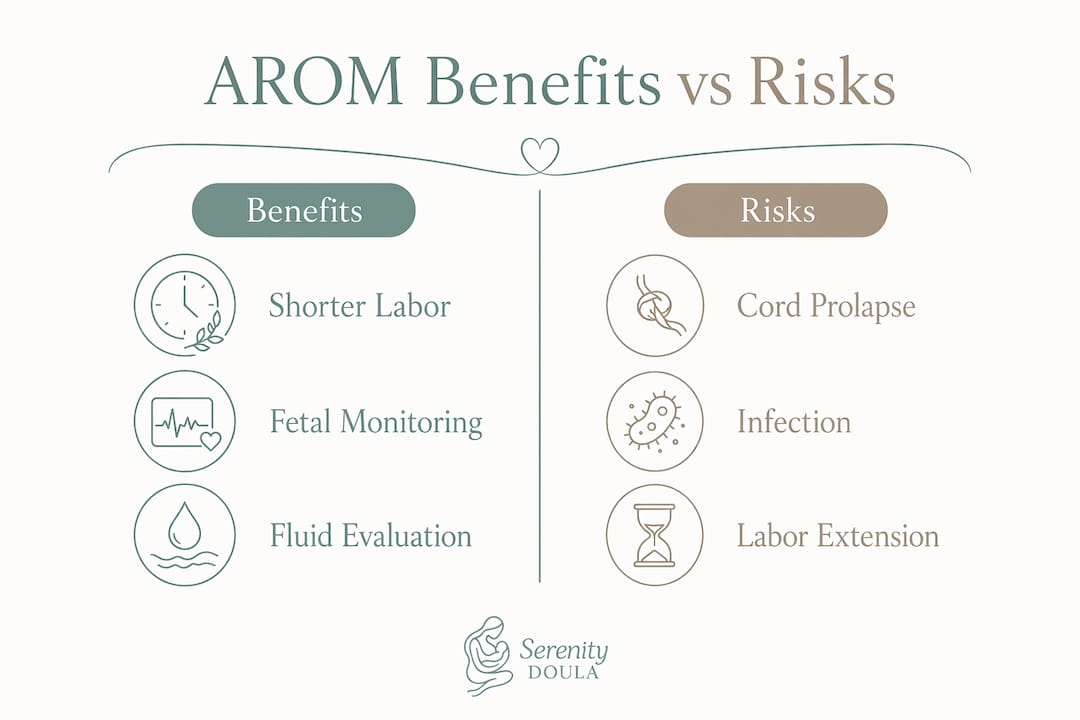
Providers recommend amniotomy for several clear clinical reasons. AROM may shorten labor by about one hour on average. That may not sound like much, but for a parent who has been laboring for hours, one hour matters enormously.
The table below shows how artificial rupture compares to spontaneous membrane rupture in key areas:
| Feature | Spontaneous rupture | Artificial rupture (AROM) |
|---|---|---|
| Timing | Unpredictable, often late in labor | Controlled, provider-directed |
| Fluid assessment | Delayed until rupture occurs | Immediate evaluation possible |
| Fetal monitoring | External only until rupture | Internal scalp electrode available |
| Labor speed | Variable | May shorten labor by about one hour |
| Meconium detection | Detected after spontaneous rupture | Detected immediately at rupture |
AROM allows internal fetal monitoring and direct evaluation of amniotic fluid for meconium, which is a sign of fetal distress. This is a significant advantage when your provider needs more accurate information about how your baby is handling labor. The procedure also supports induction of labor and augmentation when contractions need encouragement to become more regular and effective.
What are the risks and potential complications associated with AROM?
Every medical procedure carries risk, and amniotomy is no exception. The two most serious risks are umbilical cord prolapse and infection. Cord prolapse happens when the umbilical cord slips through the cervix ahead of the baby after the fluid releases. This is why providers confirm the baby’s head is well-engaged before proceeding.
Infection risk rises significantly if labor extends beyond 18–24 hours after rupture. The condition called chorioamnionitis can develop, requiring antibiotics and close monitoring. The clock starts the moment membranes are ruptured, whether naturally or artificially.
Other risks and safety considerations include:
- Stronger contractions. Without the cushion of amniotic fluid, contractions often feel more intense. You may need additional pain management, including an epidural.
- Increased monitoring. Your care team will watch your baby’s heart rate more closely after AROM.
- Higher chance of further interventions. Oxytocin use and epidural requests are more common after amniotomy.
- Rare complications. Fetal distress and vaginal bleeding can occur, though they are uncommon.
- Contraindications. AROM is not appropriate if your cervix is unfavorable, your baby’s head is not engaged, or certain fetal heart rate patterns are present.
Pro Tip: Ask your provider what your cervical exam shows before agreeing to AROM. A cervical assessment helps you understand whether your body is truly ready for this step.
How do healthcare providers decide whether to perform AROM?
The decision to perform amniotomy follows a clear clinical process. Providers do not offer it casually. Informed consent must be obtained and documented before the procedure begins. Your preferences and values are part of that conversation.
Here is how providers typically evaluate whether AROM is appropriate:
- Pelvic exam. Your provider checks cervical dilation, effacement, and position to confirm readiness.
- Fetal position confirmation. The baby must be head-down and well-engaged in the pelvis to reduce cord prolapse risk.
- Fetal heart rate review. Certain concerning heart rate patterns, called Category III tracings, are a contraindication.
- Ruling out contraindications. Conditions like vasa previa make AROM unsafe and must be excluded first.
- Shared decision-making. AROM should be selective, not routine. Professional guidelines recommend using it only when there is a clear clinical reason and the parent agrees.
You have every right to ask questions, request time to think, and say no. A good care team will welcome that conversation.
What can expectant parents expect during and after the procedure?
Once the procedure is done, your labor experience will likely shift. The most common sensation right after is a warm gush or steady trickle of fluid. Some parents describe it as a relief. Others feel surprised by how much fluid there is.
What to watch for and prepare for after AROM:
- Stronger, closer contractions. This is the most common change. Contractions often intensify because the fluid cushion is gone. Breathing techniques and position changes can help.
- Continuous fetal monitoring. Your nurse will keep a closer eye on your baby’s heart rate after rupture.
- Fluid leaking throughout labor. This is normal. Your body continues producing some fluid even after rupture.
- Signs of infection to report. Tell your care team immediately if you notice fever, foul-smelling fluid, or unusual pain between contractions.
- Possible need for oxytocin. If contractions do not pick up after AROM, your provider may suggest Pitocin to keep labor moving.
Knowing these changes are coming makes them much easier to handle. You can also explore ways to support labor progress alongside any medical interventions your team recommends.
Key Takeaways
Artificial rupture of membranes is a selective, evidence-based procedure that works best when used with clear clinical reasons, confirmed fetal position, and full informed consent from the expectant parent.
| Point | Details |
|---|---|
| AROM definition | A provider uses a sterile amnihook to intentionally rupture the amniotic sac during labor. |
| Labor impact | Amniotomy may shorten labor by about one hour and allows internal fetal monitoring. |
| Key risks | Cord prolapse and infection are the primary risks; infection risk rises after 18–24 hours post-rupture. |
| Decision-making | Providers must confirm fetal engagement and obtain informed consent before performing AROM. |
| Parent preparation | Expect stronger contractions and increased monitoring after the procedure. |
What I have learned from being in the room for AROM conversations
The moment a provider mentions “breaking your water,” I watch the room shift. Partners lean in. Parents get quiet. And I completely understand why. This is one of those interventions that sounds simple on paper but feels significant in the moment.
What I have seen over and over is that the parents who feel most at peace with the decision are the ones who asked their questions out loud. Not the ones who nodded along. The ones who said, “Wait, can you explain why now?” or “What happens if we wait another hour?” Those conversations change outcomes, and more importantly, they change how parents feel about their birth experience afterward.
AROM is genuinely useful when the timing is right. I have seen it move a stalled labor forward beautifully. I have also seen it offered too early, before the baby was well-engaged, and that is where things get complicated. The procedure is a tool, not a default. When your care team uses it thoughtfully and you feel heard in the process, it can be a calm, supported moment rather than a frightening one.
Having labor support in the room, whether a doula, a trusted partner, or both, gives you someone to help you process information in real time. You deserve that. Every parent does.
— Justin
Serenity Doula is here for the decisions that matter most
Facing decisions about labor interventions like AROM is a lot easier when you feel prepared. At Myserenitydoula, we help expectant parents understand exactly what to expect before, during, and after procedures like amniotomy so that nothing catches you off guard.

Our pregnancy and birth support services include personalized childbirth education that covers labor interventions, informed consent, and comfort strategies. We also offer childbirth education classes that walk you through the real conversations you will have with your care team. When you feel informed and supported, you can make decisions that feel right for you and your baby.
FAQ
What is artificial rupture of membranes?
Artificial rupture of membranes (AROM), also called amniotomy, is a procedure where a provider uses a sterile amnihook to intentionally break the amniotic sac during labor. It is done to support labor progress, enable fetal monitoring, or assess amniotic fluid.
Does AROM hurt?
The procedure is not inherently painful, though it may feel similar to a vaginal exam with an unexpected warm sensation as fluid releases. Contractions often intensify afterward, which is the most common discomfort parents report.
What are the main risks of amniotomy?
The primary risks are umbilical cord prolapse and infection. Infection risk increases significantly if labor extends beyond 18–24 hours after rupture, requiring close monitoring and possible antibiotics.
Can I say no to AROM?
Yes. Informed consent is required before any provider performs amniotomy. You have the right to ask questions, request more time, or decline the procedure.
How much does AROM shorten labor?
AROM may shorten labor by about one hour on average, though results vary and the procedure does not guarantee faster delivery for every parent.