

Becoming a dad is one of the most incredible things that will ever happen to you. And yet, the moment that tiny baby is placed in your arms, it’s completely normal to feel a wave of uncertainty wash over you. What do I do first? Am I holding them right? How do I even change a diaper? You are not alone in feeling this way. This guide walks you through every essential newborn care task, step by step, with evidence-backed advice and the kind of warm, practical support that helps you show up as the confident, grounded dad you already are.
Table of Contents
- What you need to get started
- Feeding your newborn: Step-by-step
- Diapering: Clean and dry, every time
- Bathing and skin-to-skin bonding
- Safe sleep and routines
- Troubleshooting common challenges and mental health
- Personalized support and resources for dads
- Frequently asked questions
Key Takeaways
| Point | Details |
|---|---|
| Confidence grows hands-on | Practicing daily care routines lets dads build skills and bond naturally with their baby. |
| Safety first | Follow evidence-based guidelines for sleep, feeding, and diapering to keep your newborn safe. |
| Share duties, seek support | Co-parent and access resources for mental well-being and smoother daily routines. |
| Bonding is gradual | Skin-to-skin and involved care strengthen the father-infant connection over time. |
What you need to get started
Before you can care for your newborn with confidence, you need the right tools and the right mindset. Think of it like prepping your workspace before a big project. When everything is within reach, you can focus on your baby instead of scrambling for supplies.
Here are the must-have supplies every new dad should have ready:
- Diapers and wipes (newborn size to start)
- Bottles and formula or a breast pump if your partner is breastfeeding
- A safe sleep space such as a firm, flat crib or bassinet
- Onesies, sleepers, and swaddle blankets
- Baby nail clippers, a soft brush, and gentle baby wash
- A thermometer for checking temperature
Research shows that dads build confidence through hands-on care, not by watching from the sidelines. The more you do, the more natural it feels. You can also explore postpartum care essentials to make sure your home setup supports both baby and your partner.
| Supply category | Examples | Why it matters |
|---|---|---|
| Diapering | Diapers, wipes, rash cream | Keeps skin clean and dry |
| Feeding | Bottles, formula, burp cloths | Supports nutrition and bonding |
| Sleep | Crib, firm mattress, sleep sack | Ensures safe rest |
| Hygiene | Baby wash, soft towels, nail clippers | Prevents irritation and infection |
Pro Tip: Set up two or three diapering and feeding stations around your home. One in the nursery, one in the living room, and one near your bed at night. This saves time and keeps you calm during those 3 a.m. moments.
With your mindset and tools ready, you can approach each care task calmly.
Feeding your newborn: Step-by-step
Feeding is one of the most frequent tasks you will do as a new dad. Newborns feed every 2-3 hours, totaling 8 to 12 times in a 24-hour period. That is a lot of feeds, and knowing what to do makes each one smoother.
Recognizing hunger cues is your first skill to master. Watch for:
- Rooting (turning head side to side, mouth open)
- Sucking on hands or fingers
- Fussiness before full crying starts
- Smacking lips
Crying is actually a late hunger cue. Try to catch the earlier signs so feeding stays calm for both of you.
Step-by-step bottle feeding:
- Warm the bottle by placing it in a bowl of warm water for a few minutes. Never microwave.
- Test the temperature on your inner wrist. It should feel neutral, not hot.
- Hold your baby at a slight incline, never flat on their back.
- Tilt the bottle so the nipple stays full of milk, reducing air intake.
- Pause every few minutes to burp your baby by holding them upright against your chest and gently patting their back.
- Watch for fullness cues: turning away, slowing down, or falling asleep.
For feeding routines that work for your family, consistency matters more than perfection. You can also find practical feeding advice on our blog.
Pro Tip: Use a simple app or a notebook to track feed times and amounts. One of my favorite apps is the Nara Baby App. This helps you spot patterns, reassures you that baby is eating enough, and makes pediatrician visits much easier.
Once feeding basics are clear, attention turns to keeping your baby clean and comfortable.
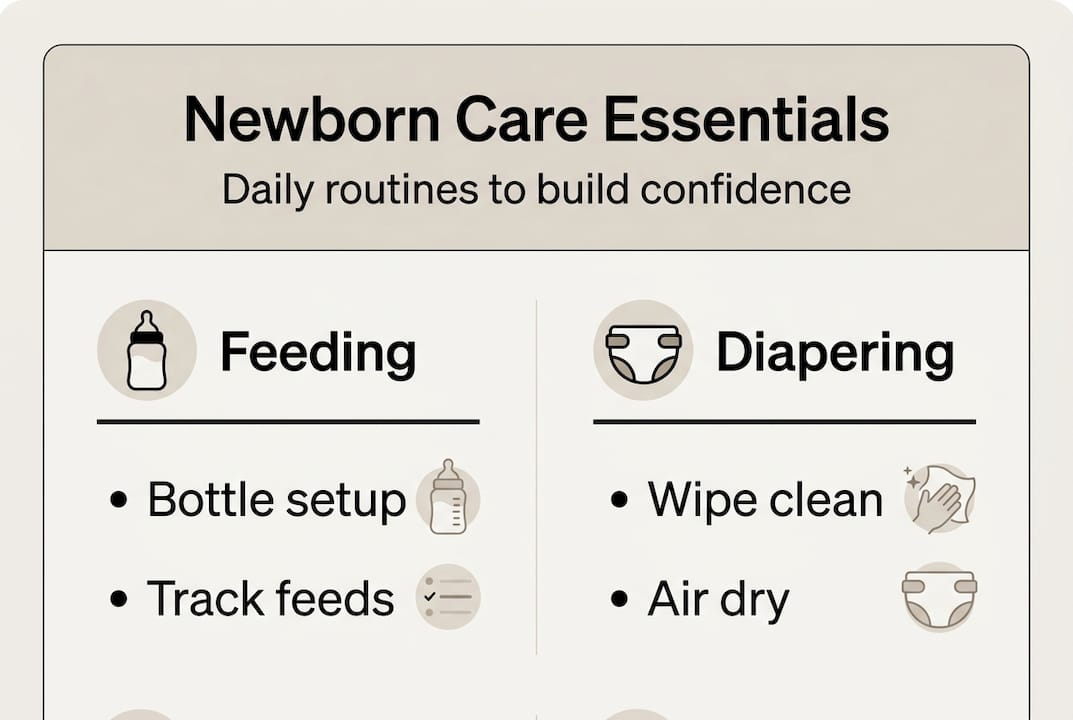
Diapering: Clean and dry, every time
Newborns go through a lot of diapers. Expect 8 to 12 changes per day, which means you will become a diaper-changing pro very quickly. The key is a clean technique and a well-stocked station.
Step-by-step diaper change:
- Lay baby on a flat, safe surface with a changing pad.
- Open the dirty diaper but do not remove it yet.
- Use the clean front of the diaper to gently wipe away the bulk of the mess.
- Lift baby’s bottom by holding both ankles gently.
- Wipe front to back, always. This is especially important for girls to prevent infection.
- Slide out the dirty diaper and slide in the clean one.
- Apply diaper rash cream if skin looks red or irritated.
- Fasten snugly but not too tight. You should be able to fit two fingers under the waistband.
Safety note: Always wipe front to back to prevent bacteria from spreading. Allow skin to air dry for 30 seconds before fastening the new diaper. This simple step significantly reduces diaper rash.
| Feature | Disposable diapers | Cloth diapers |
|---|---|---|
| Convenience | Very high | Moderate |
| Cost over time | Higher | Lower |
| Environmental impact | Higher | Lower |
| Ease for new dads | Easiest to start | Learning curve |
For more diapering tips and care routines, we have resources to support you every step of the way.
Pro Tip #1: If changing a diaper for your baby boy, cover them up so that you don’t get peed on! When fastening the diaper, make sure their penis is pointing downwards to reduce the chance of them peeing out of the diaper.
Pro Tip #2: Diapers have two layers of ruffles on them. Once the diaper is fastened, take two fingers on either side and run them along the outside of their legs from front to back to flare out these ruffles. This helps prevent some blowouts – unfortunately you’ll likely still experience a blowout though!
After diapering, caring for your newborn includes keeping them clean with gentle baths.
Bathing and skin-to-skin bonding
Newborn skin is delicate, and bath time does not need to be complicated. Until your baby’s umbilical cord stump falls off, stick to sponge baths with warm water kept between 98 and 100 degrees Fahrenheit. After the cord falls off, you can move to a small baby tub two to three times per week.
Step-by-step sponge bath:
- Gather everything before you start: warm water, soft washcloth, gentle baby wash, a dry towel.
- Keep baby wrapped in a towel and uncover only the area you are washing.
- Start with face and head, then move to the body.
- Support the head at all times.
- Rinse thoroughly and pat dry gently. Never rub.
- Dress baby quickly to prevent chilling.
After bath time is one of the best moments for skin-to-skin bonding. Hold your unclothed baby against your bare chest. Frequent skin-to-skin contact measurably increases father-infant bonding scores and supports your baby’s heart rate, temperature regulation, and stress levels. It is powerful for both of you.

| Skin-to-skin benefit | Impact on baby | Impact on dad |
|---|---|---|
| Temperature regulation | Stabilizes body temp | Builds nurturing instinct |
| Stress reduction | Lowers cortisol | Reduces anxiety |
| Bonding | Strengthens attachment | Increases confidence |
Explore more about skin-to-skin benefits and how to create a calm bath space for your baby.
Pro Tip: Schedule skin-to-skin time right after the bath. Baby is already calm and warm, making it the perfect window for deep bonding.
Daily routines are key, but sleep is where safety and structure matter most.
Safe sleep and routines
Sleep is one of the biggest concerns for new parents, and for good reason. Newborns sleep 14 to 17 hours per day but in short stretches of two to four hours at a time. That means your nights will be interrupted, and that is completely normal.
The most important thing you can do is follow the AAP ABCs of safe sleep guidelines:
- Alone: Baby sleeps by themselves, not with adults or siblings (note that some families choose to co-sleep instead. There are safety guidelines on co-sleeping as well.)
- Back: Always place baby on their back, never stomach or side
- Crib: Use a firm, flat surface with no loose bedding, pillows, or bumpers
SIDS prevention reminder: Room-share with your baby for at least the first six months. Keep the room at a comfortable temperature – 68-72. Offering a pacifier at sleep time also reduces SIDS risk. These small steps make a meaningful difference.
Building a simple bedtime routine, even in the early weeks, helps signal to your baby that sleep is coming. A warm bath, a feeding, a few minutes of skin-to-skin, and a quiet, darkened room can work wonders over time. Reach out our sleep support resources and sleep routine guidance for more structured help.
No routine is perfect. Here is how to handle challenges and prevent burnout as a new dad.
Troubleshooting common challenges and mental health
Even when you do everything right, babies are unpredictable. Fussiness, feeding struggles, and sleep regressions are part of the journey. The key is knowing you are not failing. You are learning.
Common challenges and quick responses:
- Colic or excessive crying: Try the five S’s: swaddle, side or stomach position while awake, shush, swing, and suck
- Feeding refusal: Check bottle temperature, nipple flow, and baby’s position
- Sleep struggles: Stick to your routine and give it time. Consistency is everything
Here is something important that does not get talked about enough. Paternal postnatal depression affects 1 in 10 new dads, and the risk is five times higher if your baby spends time in the NICU. This is real, and it is nothing to be ashamed of.
Watch for these signs in yourself:
- Persistent sadness or feeling empty
- Irritability or anger that feels out of proportion
- Withdrawing from your partner or baby
- Difficulty sleeping even when baby sleeps
- Feeling disconnected or like you are just going through the motions
If any of these feel familiar, please reach out to your doctor or a mental health professional. You can also find mental health resources and sharing duties guidance on our site.
One of the best things you can do is support your partner by taking on night feeds and household tasks. Sharing the load protects both of you from burnout and strengthens your relationship during a demanding season.
Pro Tip: Have a daily five-minute check-in with your partner. Ask what they need most today. This one habit prevents resentment and keeps you working as a team.
Personalized support and resources for dads
You have already taken a huge step by seeking out this kind of guidance. That matters. As you build your skills and settle into your new role, connecting with the right support can make everything feel more manageable.

At Serenity Doula, we believe every dad deserves to feel grounded and supported, not just the birthing parent. Our birth support doula services are designed to include partners fully in the experience, and our childbirth education classes give you practical tools before baby even arrives. Whether you need postpartum guidance, feeding support, or just someone to answer your questions without judgment, we are here. Visit Serenity Doula to explore everything we offer and find your village.
Frequently asked questions
How often should I feed my newborn?
Newborns feed every 2-3 hours, totaling 8 to 12 times daily. Watch for early hunger cues like rooting and hand-sucking rather than waiting for crying.
What’s the safest way for my newborn to sleep?
Place your baby alone, on their back, in a crib without loose blankets for at least the first six months. Room-sharing without bed-sharing is the AAP-recommended approach to reduce SIDS risk.
What is skin-to-skin bonding and how do I do it?
Hold your unclothed baby against your bare chest for 15 or more minutes. Frequent skin-to-skin contact boosts bonding scores and supports your baby’s temperature, heart rate, and stress regulation.
How many diaper changes does a newborn need?
A newborn needs 8 to 12 diaper changes per day. Always wipe front to back and allow skin to air dry briefly before fastening the clean diaper.
What signs of postnatal depression should dads watch for?
Watch for persistent sadness, irritability, withdrawal, or trouble bonding with your baby. Paternal postnatal depression affects 1 in 10 new dads, so please reach out to a doctor if these feelings persist.